Risky Strategy Lures Investors Seeking Yield
Popular 'Reverse Convertibles' Offer Lucrative Payouts But Could Cause Steep Losses
By ELEANOR LAISE
Wall Street Journal
March 26, 2008; Page D1
Wall Street is luring income-hungry investors with complex securities that come with big risks as well as extravagant yields.
The products -- called "reverse convertibles" -- are typically linked to the performance of a single stock like Apple Inc. or AT&T Inc. and often offer yields ranging from 7% to as high as 25% or more. Sales on these notes have been soaring as yields on many fixed-income investments have been sinking. Small U.S. investors snapped up $8.5 billion worth of reverse convertibles in 2007, up 81% from 2006, according to Arete Consulting LLC, which tracks the products.
At Incapital LLC, a distributor of reverse convertibles, sales doubled in 2007 from a year earlier, says Chief Executive Tom Ricketts. The notes are issued by firms such as Morgan Stanley, Barclays PLC and ABN Amro Holding NV. The companies whose share prices are linked to reverse convertibles have no involvement in the products.
For small investors, reverse convertibles offer a high level of income for a low minimum investment. But investors typically don't participate in any gains in the underlying stock, and if the stock falls sharply, they can lose much of their investment. Regulators have grown increasingly concerned about how complex "structured products" such as reverse convertibles are marketed to small investors, and they're pushing issuers to closely monitor their sales practices.
For full article, click here.
SPA-2008


Wednesday, March 26, 2008


Sunday, March 23, 2008
Fund industry's ETN challenge may backfire (Investment News)
Leading House Republican questions attacks on deferred tax status of exchange traded notes
By Sara Hansard
Investment News
WASHINGTON (March 17, 2008) - The mutual fund industry's push for raising taxes on exchange-traded notes may come back to hurt the industry when it asks Congress to defer taxes on mutual funds, the ranking minority member of a House Ways and Means subcommittee said.
The Investment Company Institute should "articulate a tax policy beyond simply arguing for a level playing field," Pennsylvania Rep. Phil English told InvestmentNews.
Mr. English is the ranking Republican member of the Ways and Means select revenue measures subcommittee, which held a hearing March 5 on legislation introduced by subcommittee chairman Richard Neal, D-Mass., which would end tax deferrals for ETNs and other prepaid forward contracts and tax them at ordinary income tax rates. Currently, many ETNs are taxed at lower capital gains rates.
At the same time, however, Mr. English said he sympathizes with the Washington-based ICI. "I think ICI is genuinely conflicted on this, and has been forced into a position of having to weigh some truly unsatisfactory alternatives."
"The obvious answer is to basically create a deferral for people who are involved with mutual funds," Mr. English said. Legislation known as the Generate Retirement Ownership Through Long-Term Holding (Growth) Act of 2007, which was introduced by Rep. Paul Ryan, R-Wis., would allow investors in taxable mutual funds to defer capital gains taxes until their shares are sold.
However, Mr. English said, "I don't believe the current majority in Congress has the ideological flexibility to consider doing that." The legislation introduced by Mr. Neal is being driven by "the majority's hunger for revenue," he said. "What they're doing is [looking for ways to raise money] rather than coming up with the best strategy for dealing with these sorts of investments."
Indeed, a Democratic tax counsel on the Ways and Means Committee, who declined to speak for direct attribution, agreed that the Growth Act is not a bill "that the Democratic members have been very interested in the past."
For the full article, click here.
By Sara Hansard
Investment News
WASHINGTON (March 17, 2008) - The mutual fund industry's push for raising taxes on exchange-traded notes may come back to hurt the industry when it asks Congress to defer taxes on mutual funds, the ranking minority member of a House Ways and Means subcommittee said.
The Investment Company Institute should "articulate a tax policy beyond simply arguing for a level playing field," Pennsylvania Rep. Phil English told InvestmentNews.
Mr. English is the ranking Republican member of the Ways and Means select revenue measures subcommittee, which held a hearing March 5 on legislation introduced by subcommittee chairman Richard Neal, D-Mass., which would end tax deferrals for ETNs and other prepaid forward contracts and tax them at ordinary income tax rates. Currently, many ETNs are taxed at lower capital gains rates.
At the same time, however, Mr. English said he sympathizes with the Washington-based ICI. "I think ICI is genuinely conflicted on this, and has been forced into a position of having to weigh some truly unsatisfactory alternatives."
"The obvious answer is to basically create a deferral for people who are involved with mutual funds," Mr. English said. Legislation known as the Generate Retirement Ownership Through Long-Term Holding (Growth) Act of 2007, which was introduced by Rep. Paul Ryan, R-Wis., would allow investors in taxable mutual funds to defer capital gains taxes until their shares are sold.
However, Mr. English said, "I don't believe the current majority in Congress has the ideological flexibility to consider doing that." The legislation introduced by Mr. Neal is being driven by "the majority's hunger for revenue," he said. "What they're doing is [looking for ways to raise money] rather than coming up with the best strategy for dealing with these sorts of investments."
Indeed, a Democratic tax counsel on the Ways and Means Committee, who declined to speak for direct attribution, agreed that the Growth Act is not a bill "that the Democratic members have been very interested in the past."
For the full article, click here.
Friday, March 14, 2008
Nominate an Advisor Now for the SPA-2008 LeadingEdge Advisors Awards
Click here for the form to nominate an advisor for the SPA-2008 LeadingEdge Awards.
Submit your nominations of the most innovative investment advisors for the First Annual Structured Products Association (SPA) LeadingEdge Five Awards co-sponsored by Societe Generale.
Submit your nominations of the most innovative investment advisors for the First Annual Structured Products Association (SPA) LeadingEdge Five Awards co-sponsored by Societe Generale.
 The Structured Products Association's first-ever LeadingEdge awards are given to five investment professionals who have at least $100 million under management and are committed to using Structured Products in optimizing portfolio diversification and management of clients' assets.
The awards will be given on the basis of the nominees' leading edge use of structured investments to achieve clients' investment objectives.Co-sponsored by SG Americas (www.equityderivatives.com), the awards will be presented at a lunch ceremony at SPA-2008 -- the Structured Products Association's 4th Annual Conference -- held at New York's Grand Hyatt Hotel on April 9-10, 2008.
This is the nomination form for the LeadingEdge awards. The committee will consider self-nominations as well as thrid-party nominations. All eligible advisors, asset managers and financial consultants who enter may be eligible to attend SPA-2008 as a guest of the Association.
The first deadline for early nominations is March 30, 2008. The LeadingEdge Awards committee will consider additional nominations through April 5, 2008, but preference will be given to early nominees. The process of nomination should take less than 10 minutes.
Click here for the form to nominate an advisor for the SPA-2008 LeadingEdge Awards.
Thursday, March 13, 2008
SPA-2008: 1st Structured Products Distribution Summit NYC - Apr 9-10, 2008
 UPDATE (13-March-2008) -- Registrations are now being accepted for the SPA-2008 Conference for the discounted "first-mover advantage" rate, which expires on Friday, March 21. To access the discounted registration page -- click here. For those without a PayPal account, click on the link at the bottom left that says continue, and enter your information on the next screen.
The SPA-2008 brochure is available here.
========
Nearly 300 structured products professionals attended last year’s highly successful Structured Products Association annual conference in New York, and the SPA is taking North America’s longest-running and most highly attended structured investments event to the next level.
Focus on Distribution: In addition, the theme of this year’s conference is The Last Mile: the Future of Structured Products Distribution. The SPA Conference Committee has invited over fifty speakers from the distribution side to speak on the challenges they face in marketing, distribution, regulation, compliance and resources. Accordingly, SPA-2008 is focused primarily on bridging the needs of the distribution side – and providing a unique opportunity for the buy-side and sell-side to come together.
Awards Recognition for the Sell-Side: For the first time, SPA-2008 will present awards to some of the most innovative brokers and advisors using structured products in their clients’ portfolios. The recognition will be amplified in trade publications to encourage scores of other advisors to consider utilizing structured investments in portfolios.
New Location: The conference will move to the Grand Hyatt Hotel in New York’s Grand Central in the center of the city, offering a highly accessible location to accommodate the growth in attendees.
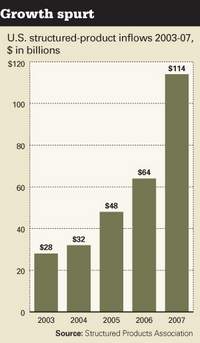
Your participation in SPA events permits the Association to continue its successful efforts to position structured investments as a compelling new alternative in optimal asset allocation, and to remain out in front of legal, regulatory, tax and legislative issues. With a record $114 billion year in structured products sales in 2007, the SPA’s role in building the industry has been essential -- and it will become more ever more prominent.
SPA-2008 Participants from the Buy-Side (Confirmed or Invitees)
AG Edwards ALPS Ameriprise Blue Bell Claymore Countrywide Credit Suisse DWS Scudder E*Trade Eksportfinans Fidelity First Trust FIS-AAM Foreside Wholesaling Greenwich Research Hartford Life Incapital Invesco JPMorgan Private Bank JVB Kellogg LPL MyCFO Harris Bank Northeast Pension Consultants Northern Trust Nuveen Pershing Raymond James Raymond Jones Schwab Susquehanna UBS Wachovia Wealth 2k . . . and 20 more independent advisory firms and regional broker-dealers.
Topics for SPA-2008 (Some Speaking Roles Still Available)
MARKET GROWTH: What Distributors Need from Issuers to Double the Business in Two Years
EDUCATION: The Buzzword for the Future of Structured Products, But the Industry Needs to Do More
NEW MARKETS: Pensions Retirement Foundations Insurance Mutual Funds
REGULATORY: How the Industry Is in Front of Efforts from the SEC, Treasury, CFTC and Congress
NEW PRODUCTS: The Best of the New Generation of Structured Investments
INNOVATIVE INDEXING: 130-30 Strategies, Dynamic Indexes, Synthetic Hedge Funds
RETAIL’S FUTURE: Hear Directly from the Collective Crystal Ball of 50 Speakers on the Distribution Side
INDUSTRY CHALLENGES: How the Industry Responds to Anti-Competitive Efforts
Discounted "first mover advantage" registration for SPA-2008: $1,775
After Friday, March 21 the SPA-2008 single badge rate will be $1,975.
Contact structured.products.events@gmail.com for team discounts on 3-badge and 5-badge packages.
Tuesday, March 11, 2008
SEC, CFTC to Review Gold Financial Products
Washington, D.C., March 11, 2008 — Securities and Exchange Commission Chairman Christopher Cox and Commodity Futures Trading Commission Acting Chairman Walter L. Lukken today signed a ground-breaking mutual cooperation agreement to establish a closer working relationship between their agencies. The agencies also announced their immediate plans to consider two new derivative products under the agreement.
The agreement establishes a permanent regulatory liaison between the agencies, provides for enhanced information sharing, and sets forth several key principles guiding their consideration of novel financial products that may reflect elements of both securities and commodity futures or options.
"This agreement represents a valuable coordination of the roles of the SEC and the CFTC in our capital markets," said SEC Chairman Cox. "Years ago, when the dividing lines between our agencies' regulated products were bright, the high level of coordination we are establishing today was not a priority for the U.S. government. But today, the blurring of these distinctions requires the U.S. government to adopt a more coherent and coordinated approach. To this end, we look forward to enhancing our collaborative relationship with the CFTC within the formal framework covered by the agreement."
"As innovation blurs financial sector lines, this agreement will create regulatory synergies between the agencies for the benefit of the public," said CFTC Acting Chairman Lukken. "While recognizing our distinct missions, the MOU establishes a solid framework for increased cooperation and communication between the CFTC and SEC. The agreement also contains specific principles to guide future consideration of novel products, with the goal of reviewing product filings expeditiously, providing legal certainty for participants, encouraging market neutrality and choice, and enhancing innovation and competitive growth. This is smart government, and we look forward to this new era of enhanced cooperation with the SEC."
Today, as tangible evidence of their closer relationship, the agencies also announced they are issuing notices requesting public comment on two new products. Both products would be based on the streetTracks ® Gold Trust Shares (Gold Shares). One product is an option that would be traded on options exchanges, and the other is a future that would trade on a single stock futures exchange. The requests for comment will be published in the Federal Register shortly.
In addition, the Options Clearing Corporation, which is subject to the joint jurisdiction of the agencies in certain areas, recently filed with both the SEC and the CFTC for approval to clear and settle both of the new products. Both agencies expect to act on these filings expeditiously and issue notices for public comment in the near future.
The two new products have raised questions about how they best should be regulated under federal law. Other recent products, such as credit default options, have raised similar questions. The Memorandum of Understanding addresses how the agencies will approach products that raise these issues in this burgeoning area of financial innovation. It also establishes a framework that will facilitate discussions and coordination regarding issues in other areas of common regulatory interest between the two agencies, such as portfolio margining, foreign security index products, and the oversight of firms registered with both agencies.
Under the principles governing the review of novel derivative products, the agencies agree to recognize their mutual regulatory interests and encourage innovation, competition, and legal certainty. Additionally, the agencies commit to share information relating to novel derivative products and act on any related requests in a timely manner. Finally, the agencies agree to endeavor, for products that implicate overlapping areas of regulatory concern, to permit such novel derivative products to trade in either or both a CFTC- or SEC-regulated environment, in a manner consistent with their respective laws and regulations.
Enhanced coordination and cooperation between the SEC and CFTC are critical to providing effective oversight and legal certainty, while avoiding unnecessary duplication and undue regulatory burdens. The Commissions historically have taken action to further these objectives. For example, the Commissions previously entered into an MOU in March 2004 regarding their joint oversight of security futures products (SFPs), pursuant to the Commodity Futures Modernization Act of 2000, and the sharing of information on SFPs. The Commissions also have regularly cooperated in matters of shared enforcement concern. Implementation of today's agreements will further the effectiveness and efficiency of the SEC and CFTC in other areas of common regulatory interest by improving interagency coordination and communication.
Source: Securities and Exchange Commission website -- http://www.sec.gov/news/press/2008/2008-40.htm
The agreement establishes a permanent regulatory liaison between the agencies, provides for enhanced information sharing, and sets forth several key principles guiding their consideration of novel financial products that may reflect elements of both securities and commodity futures or options.
"This agreement represents a valuable coordination of the roles of the SEC and the CFTC in our capital markets," said SEC Chairman Cox. "Years ago, when the dividing lines between our agencies' regulated products were bright, the high level of coordination we are establishing today was not a priority for the U.S. government. But today, the blurring of these distinctions requires the U.S. government to adopt a more coherent and coordinated approach. To this end, we look forward to enhancing our collaborative relationship with the CFTC within the formal framework covered by the agreement."
"As innovation blurs financial sector lines, this agreement will create regulatory synergies between the agencies for the benefit of the public," said CFTC Acting Chairman Lukken. "While recognizing our distinct missions, the MOU establishes a solid framework for increased cooperation and communication between the CFTC and SEC. The agreement also contains specific principles to guide future consideration of novel products, with the goal of reviewing product filings expeditiously, providing legal certainty for participants, encouraging market neutrality and choice, and enhancing innovation and competitive growth. This is smart government, and we look forward to this new era of enhanced cooperation with the SEC."
Today, as tangible evidence of their closer relationship, the agencies also announced they are issuing notices requesting public comment on two new products. Both products would be based on the streetTracks ® Gold Trust Shares (Gold Shares). One product is an option that would be traded on options exchanges, and the other is a future that would trade on a single stock futures exchange. The requests for comment will be published in the Federal Register shortly.
In addition, the Options Clearing Corporation, which is subject to the joint jurisdiction of the agencies in certain areas, recently filed with both the SEC and the CFTC for approval to clear and settle both of the new products. Both agencies expect to act on these filings expeditiously and issue notices for public comment in the near future.
The two new products have raised questions about how they best should be regulated under federal law. Other recent products, such as credit default options, have raised similar questions. The Memorandum of Understanding addresses how the agencies will approach products that raise these issues in this burgeoning area of financial innovation. It also establishes a framework that will facilitate discussions and coordination regarding issues in other areas of common regulatory interest between the two agencies, such as portfolio margining, foreign security index products, and the oversight of firms registered with both agencies.
Under the principles governing the review of novel derivative products, the agencies agree to recognize their mutual regulatory interests and encourage innovation, competition, and legal certainty. Additionally, the agencies commit to share information relating to novel derivative products and act on any related requests in a timely manner. Finally, the agencies agree to endeavor, for products that implicate overlapping areas of regulatory concern, to permit such novel derivative products to trade in either or both a CFTC- or SEC-regulated environment, in a manner consistent with their respective laws and regulations.
Enhanced coordination and cooperation between the SEC and CFTC are critical to providing effective oversight and legal certainty, while avoiding unnecessary duplication and undue regulatory burdens. The Commissions historically have taken action to further these objectives. For example, the Commissions previously entered into an MOU in March 2004 regarding their joint oversight of security futures products (SFPs), pursuant to the Commodity Futures Modernization Act of 2000, and the sharing of information on SFPs. The Commissions also have regularly cooperated in matters of shared enforcement concern. Implementation of today's agreements will further the effectiveness and efficiency of the SEC and CFTC in other areas of common regulatory interest by improving interagency coordination and communication.
Source: Securities and Exchange Commission website -- http://www.sec.gov/news/press/2008/2008-40.htm
Monday, March 10, 2008
ETNs: Tax-Favored Investment? [Morrison & Foerster]
[Excerpted from: Morrison & Foerster Tax Talk, March 7, 2008]
Overview
Exchange traded funds (“ETFs”) are investment funds whose shares trade on a stock exchange. From a U.S. federal income tax standpoint, ETFs are flow-through vehicles that generally must distribute their income currently.
Taxable U.S. investors include these amounts in their income annually. Viewed as economic cousins of ETFs, exchange traded notes (“ETNs”) are structured notes representing securities issued by corporations, typically financial institutions. ETNs generally do not distribute income currently. Contrary to the current inclusion and ordinary income regime applicable to ETFs, ETNs are treated as prepaid forward contracts for U.S. federal income tax purposes.
 As such, under current law, investors in ETNs generally do not report current accruals of income and gain or loss is determined only upon a sale of the note. The following chart summarizes the treatment of ETFs and ETNs under current law.
Structure and Tax Treatment to Holders
ETFs =
Pass-Thrus Current Ordinary Income Treatment on Distributions
ETNs =
Structured Notes Income Deferral and Capital Gain
Recent Developments
On December 7, 2007 the Internal Revenue Service (“IRS”) and the Treasury Department (“Treasury”) published Revenue Ruling 2008-1 (“Ruling”) and Notice 2008-2 (“Notice”) addressing the U.S. federal income tax treatment of prepaid forward contracts, which include certain ETNs.
Viewed together, the Ruling and the Notice serve as a warning that the IRS is inclined to require current accrual of income on instruments, such as ETNs, that the market has previously treated under a “wait and see” accounting system.
The Ruling is expected to have an immediate impact only on a narrow class of single currency-linked ETNs. In the Notice, the IRS and Treasury have asked for public comments on a comprehensive list of tax issues regarding the U.S. federal income tax treatment of prepaid forward contracts including ETNs. This request for public comments comes as the tax treatment of ETNs has come under close scrutiny on Capitol Hill in recent weeks.
Legislation was introduced in the United States Congress by Representative Richard E. Neal (D - MA) in December 2007 which, if enacted, would impact the taxation of notes such as ETNs. Under the proposed legislation, a holder that acquires such a note after legislative enactment would be required to include income in respect of the note on a current basis. As of this writing, it is not possible to predict whether the legislation will be enacted in its proposed form, whether any other legislative action may be taken in the future, or whether any such legislation may apply on a retroactive basis.
That said, Treasury official David Shapiro is reported as having announced at a January 18, 2008 session of the American Bar Association Section of Taxation midyear meeting that any IRS guidance affecting the treatment of prepaid forward contracts is not expected to be retroactive.
Friday, March 7, 2008
Draft: Retail Structured Products Principles from RSP Taskforce - March 6, 2008
Structured Products: Principles for Managing the Distributor-Individual Investor Relationship
DRAFT - as of March 6, 2008
The distributor-individual investor relationship should deliver fair treatment of the individual investor. Individual investors need to take responsibility for their investment goals and to stay informed about the risks and rewards of their investments. Distributors can play a key role in helping them achieve these objectives.
In light of the increased interest in structured products as part of individual investors’ investment and asset allocation strategies, it is important for firms to keep these principles in mind in their dealings with individual investors in structured products. These principles complement our recently released, “Retail Structured Products: Principles for Managing the Provider-Distributor Relationship,” available at the websites of the five sponsoring associations, which focus on the relationship between manufacturers and distributors. These principles apply to the relationship between the distributor and the individual investor.
Although these principles are aspirational in nature and do not create enforceable obligations or duties, firms involved in the distribution of structured products to individual investors are encouraged to reflect these principles in their policies and procedures. Further, each firm is encouraged, given differing regulatory environments and both cultural and client base differences, to consider the extent to which the firm should adapt these principles to its particular circumstances.
While some or most of these principles may be applicable to all individual investors, their primary focus is on those individual investors, often referred to as “retail” investors, rather than high net worth clients or accredited investors.
Overview
The term "structured products" refers to a variety of financial instruments that combine various cash assets and/or derivatives to provide a particular risk/reward profile that may not otherwise be available in a traditional investment. The return of a structured product is usually derived from the performance of one or more underlying assets. Examples of underlying assets include, but are not limited to; interest rates, a particular equity or debt instrument, a basket of securities, a securities index or indices, an individual commodity or commodities, a commodities index, an individual currency or currency basket or any combination thereof.
Some structured products offer full or partial principal protection, while others have no principal protection. Some offer a yield; others do not. It is possible that the value of an individual structured product may not increase as much as the underlying asset, or may decrease more than the underlying asset. Some structured products offer individual investors access to new asset classes that can help with portfolio diversification.
Structured products can be more or less risky than traditional products such as equities, fixed income products, or mutual funds. Where products are highly structured, it may be difficult for an individual investor to understand the mechanics of the product, although there is no necessary link between product complexity and investment risk - complex products may be low risk, and vice versa. It is important that an investor understands the role in an investment strategy that can be played by any particular structured product in light of the investor’s specific investment objectives, risk tolerance, and investment horizons.
Principles
1. Product Transparency
All public materials containing product descriptions of structured products should be clear and not misleading, and should contain adequate disclosure of the nature of the product and of its benefits, risks, and limitations. The disclosure should, to the extent permitted by applicable law and regulation, be drafted in a way that takes into account the knowledge and sophistication of the clients in the target market.
Where a distributor is primarily responsible for the creation of marketing materials,[1] or is responsible for a prospectus, the distributor should use reasonable efforts to ensure that the material features of structured products are clearly articulated and delineated to individual investors in a way that enables them to evaluate the investment from a risk/reward perspective. This will be helpful to both individual investors’ and financial advisors’[2] understanding of the product. Further, to the extent that a distributor is primarily responsible for the creation of marketing materials, such materials should be adapted to, and reflective of, the proposed target audience. For example, it should be clearly disclosed when returns on a structured product are linked to an underlying asset.
Marketing materials that are geared to individual investors should be subject to review by the distributor’s appropriate supervisory staff, as well as other internal processes, such as compliance or legal, as appropriate.
2. Risk Disclosure
Risk disclosure is important to an investor’s understanding of structured products and should be made available to investors before a decision to invest is made. Investors should understand the risks inherent in the product before investing in it. Investors should be informed of the types of risks generally associated with products of the type concerned, and, subject to individual regulatory standards as to specific language required, particular prominence should be given to any risk not usually associated with a product of that particular type, including risks arising from the underlying asset, liquidity and market risks in relation to the product itself, creditworthiness of the issuer, tax considerations, risk of loss due to sale of the product before maturity, and any other material risks associated with the structure of the product. Where information on past performance is given, the presentation should be fair and not misleading, and, in particular, should acknowledge any limitations in available data.
3. Fees and Costs
Investors in a structured product should be informed of the existence of fees, costs, commissions, discounts, and any other sums paid to the distributor for acting as such over the life of that product. Distributors should have internal processes and controls in place to consider the appropriateness of fees and other incentives given local market conditions and regulatory requirements. A distributor's internal processes and controls should also consider the level of disclosure regarding such fees and costs in light of their possible impact on the secondary market value of the structured product concerned.
Potential Conflicts Management
Distributors should have internal processes and controls in place to consider potential conflicts issues and identify measures designed to mitigate, manage, or disclose material conflicts of interest arising from the sale of structured products. Such processes should, where necessary or appropriate, provide timely, adequate, and clear disclosure related to conflicts of interest or potential conflicts of interest that may exist or arise in connection with the sale of the structured product, or as a result of the business they conduct.
5. Credit Ratings
Distributors should use credit ratings responsibly. Credit ratings of issuers, while important, may not represent a rating of the potential performance of the individual structured product itself. If credit ratings are provided, the related disclosure should make clear the significance of the rating.
6. New Product Review
Distributors should understand the products they distribute. New structured products, whether developed by the distributor or developed by a third-party provider or manufacturer, should be subject to the distributor’s product review and assessment process. This process should take into account the nature of the new structured product, the target market, and an assessment as to whether the product is appropriate for that target market. Distributors should also have a process for determining what generally constitutes a “new product.” It is not sufficient for a distributor to accept a third-party manufacturer’s assessment regarding appropriateness of structured products for individual investors. Distributing firms should conduct an independent assessment.
7. Liquidity/Secondary Market
Investors should be informed before investing of the likelihood of their being able to sell or otherwise realize the value of a particular structured product prior to maturity, and of the ways in which this might be done. Any secondary market facilities to be provided by the distributor itself or through an exchange should be disclosed. If there is little likelihood of such sale or other liquidation being possible, that fact should be clearly disclosed. Investors should be made aware that sales in the secondary markets, even where possible, may be at prices that are below either the redemption value at maturity or the new issue price. In addition, distributors should make a clear distinction between the likely value of the structured product and the value of the underlying asset, noting in particular that these two values may not necessarily move in tandem.
Structured products should be valued on a regular basis and disclosed to the investor through the distributor’s normal client statement process or otherwise.
8. Client Appropriateness
Where a firm actively markets a particular product, as opposed to merely executing transactions on clients’ instructions, it should determine which particular types of clients the product could properly be sold to (appropriateness) and may also be required to determine whether the particular product is right for a particular client (suitability). Methodologies and standards for making these determinations should be developed by the distributor and adequately communicated to the distributor’s financial advisors. Liquid net worth, degree of sophistication, age, and investment experience are several variables that may be relevant to such an assessment. Also, distributors should consider how a specific structured product would fit into an individual’s portfolio. These standards should be reviewed periodically and amended, as needed.
9. Financial Advisor Training
Structured products vary a great deal as to their terms, risk/reward profile, liquidity/availability of a secondary market, underlying asset, underlying value, and a variety of other factors. As such, it is important that financial advisors interacting with individual investors have an adequate understanding of structured products in general as well as an understanding of the characteristics of the individual structured products being offered. The financial advisor should be able to clearly explain the product’s features to an individual investor. Distributors should provide their financial advisors with the necessary training, or access to training, in structured products, including both the benefits and risks of the products, and should consider providing educational materials on structured products generally.
10. Oversight and Compliance
Structured product sales to individual investors should be subject to the distributor’s internal compliance and review processes. Distributors should have supervisory procedures in place covering transactions in structured products, which should involve supervisory staff of appropriate seniority in light of the nature of the particular product and investor target market. Supervisory responsibilities may encompass sales practices, reasonableness of profit/loss potential, fees, and adequacy of training. Managers performing such supervision should have access to appropriate legal and compliance department support.
Tax Implications
Investments in structured products may have tax consequences for individual investors depending on their personal circumstances and jurisdiction of residence. Investors should be encouraged to discuss the specific tax implications of structured products with their accountant, tax attorney, or other tax professional.
Post-Trade Follow-up/Product Life Cycle Issues
Distributors should provide financial advisors with the necessary information to help clients monitor performance of any structured product in which they have invested, and access to information regarding the terms of that structured product, including its maturity, pay-out details, and other pertinent information.
Endnotes:
[1] Manufacturers have a similar responsibility, which is addressed in “Retail Structured Products: Principles for Managing the Provider-Distributor Relationship,” Point #5, Joint Trade Associations, July 2007.
[2] “Financial advisor” refers to the firm’s employees, or independent contractors, who interact directly with individual investors and who are registered to solicit trades and effect transactions. The formal term may vary significantly by firm and/or jurisdiction.
DRAFT - as of March 6, 2008
The distributor-individual investor relationship should deliver fair treatment of the individual investor. Individual investors need to take responsibility for their investment goals and to stay informed about the risks and rewards of their investments. Distributors can play a key role in helping them achieve these objectives.
In light of the increased interest in structured products as part of individual investors’ investment and asset allocation strategies, it is important for firms to keep these principles in mind in their dealings with individual investors in structured products. These principles complement our recently released, “Retail Structured Products: Principles for Managing the Provider-Distributor Relationship,” available at the websites of the five sponsoring associations, which focus on the relationship between manufacturers and distributors. These principles apply to the relationship between the distributor and the individual investor.
Although these principles are aspirational in nature and do not create enforceable obligations or duties, firms involved in the distribution of structured products to individual investors are encouraged to reflect these principles in their policies and procedures. Further, each firm is encouraged, given differing regulatory environments and both cultural and client base differences, to consider the extent to which the firm should adapt these principles to its particular circumstances.
While some or most of these principles may be applicable to all individual investors, their primary focus is on those individual investors, often referred to as “retail” investors, rather than high net worth clients or accredited investors.
Overview
The term "structured products" refers to a variety of financial instruments that combine various cash assets and/or derivatives to provide a particular risk/reward profile that may not otherwise be available in a traditional investment. The return of a structured product is usually derived from the performance of one or more underlying assets. Examples of underlying assets include, but are not limited to; interest rates, a particular equity or debt instrument, a basket of securities, a securities index or indices, an individual commodity or commodities, a commodities index, an individual currency or currency basket or any combination thereof.
Some structured products offer full or partial principal protection, while others have no principal protection. Some offer a yield; others do not. It is possible that the value of an individual structured product may not increase as much as the underlying asset, or may decrease more than the underlying asset. Some structured products offer individual investors access to new asset classes that can help with portfolio diversification.
Structured products can be more or less risky than traditional products such as equities, fixed income products, or mutual funds. Where products are highly structured, it may be difficult for an individual investor to understand the mechanics of the product, although there is no necessary link between product complexity and investment risk - complex products may be low risk, and vice versa. It is important that an investor understands the role in an investment strategy that can be played by any particular structured product in light of the investor’s specific investment objectives, risk tolerance, and investment horizons.
Principles
1. Product Transparency
All public materials containing product descriptions of structured products should be clear and not misleading, and should contain adequate disclosure of the nature of the product and of its benefits, risks, and limitations. The disclosure should, to the extent permitted by applicable law and regulation, be drafted in a way that takes into account the knowledge and sophistication of the clients in the target market.
Where a distributor is primarily responsible for the creation of marketing materials,[1] or is responsible for a prospectus, the distributor should use reasonable efforts to ensure that the material features of structured products are clearly articulated and delineated to individual investors in a way that enables them to evaluate the investment from a risk/reward perspective. This will be helpful to both individual investors’ and financial advisors’[2] understanding of the product. Further, to the extent that a distributor is primarily responsible for the creation of marketing materials, such materials should be adapted to, and reflective of, the proposed target audience. For example, it should be clearly disclosed when returns on a structured product are linked to an underlying asset.
Marketing materials that are geared to individual investors should be subject to review by the distributor’s appropriate supervisory staff, as well as other internal processes, such as compliance or legal, as appropriate.
2. Risk Disclosure
Risk disclosure is important to an investor’s understanding of structured products and should be made available to investors before a decision to invest is made. Investors should understand the risks inherent in the product before investing in it. Investors should be informed of the types of risks generally associated with products of the type concerned, and, subject to individual regulatory standards as to specific language required, particular prominence should be given to any risk not usually associated with a product of that particular type, including risks arising from the underlying asset, liquidity and market risks in relation to the product itself, creditworthiness of the issuer, tax considerations, risk of loss due to sale of the product before maturity, and any other material risks associated with the structure of the product. Where information on past performance is given, the presentation should be fair and not misleading, and, in particular, should acknowledge any limitations in available data.
3. Fees and Costs
Investors in a structured product should be informed of the existence of fees, costs, commissions, discounts, and any other sums paid to the distributor for acting as such over the life of that product. Distributors should have internal processes and controls in place to consider the appropriateness of fees and other incentives given local market conditions and regulatory requirements. A distributor's internal processes and controls should also consider the level of disclosure regarding such fees and costs in light of their possible impact on the secondary market value of the structured product concerned.
Potential Conflicts Management
Distributors should have internal processes and controls in place to consider potential conflicts issues and identify measures designed to mitigate, manage, or disclose material conflicts of interest arising from the sale of structured products. Such processes should, where necessary or appropriate, provide timely, adequate, and clear disclosure related to conflicts of interest or potential conflicts of interest that may exist or arise in connection with the sale of the structured product, or as a result of the business they conduct.
5. Credit Ratings
Distributors should use credit ratings responsibly. Credit ratings of issuers, while important, may not represent a rating of the potential performance of the individual structured product itself. If credit ratings are provided, the related disclosure should make clear the significance of the rating.
6. New Product Review
Distributors should understand the products they distribute. New structured products, whether developed by the distributor or developed by a third-party provider or manufacturer, should be subject to the distributor’s product review and assessment process. This process should take into account the nature of the new structured product, the target market, and an assessment as to whether the product is appropriate for that target market. Distributors should also have a process for determining what generally constitutes a “new product.” It is not sufficient for a distributor to accept a third-party manufacturer’s assessment regarding appropriateness of structured products for individual investors. Distributing firms should conduct an independent assessment.
7. Liquidity/Secondary Market
Investors should be informed before investing of the likelihood of their being able to sell or otherwise realize the value of a particular structured product prior to maturity, and of the ways in which this might be done. Any secondary market facilities to be provided by the distributor itself or through an exchange should be disclosed. If there is little likelihood of such sale or other liquidation being possible, that fact should be clearly disclosed. Investors should be made aware that sales in the secondary markets, even where possible, may be at prices that are below either the redemption value at maturity or the new issue price. In addition, distributors should make a clear distinction between the likely value of the structured product and the value of the underlying asset, noting in particular that these two values may not necessarily move in tandem.
Structured products should be valued on a regular basis and disclosed to the investor through the distributor’s normal client statement process or otherwise.
8. Client Appropriateness
Where a firm actively markets a particular product, as opposed to merely executing transactions on clients’ instructions, it should determine which particular types of clients the product could properly be sold to (appropriateness) and may also be required to determine whether the particular product is right for a particular client (suitability). Methodologies and standards for making these determinations should be developed by the distributor and adequately communicated to the distributor’s financial advisors. Liquid net worth, degree of sophistication, age, and investment experience are several variables that may be relevant to such an assessment. Also, distributors should consider how a specific structured product would fit into an individual’s portfolio. These standards should be reviewed periodically and amended, as needed.
9. Financial Advisor Training
Structured products vary a great deal as to their terms, risk/reward profile, liquidity/availability of a secondary market, underlying asset, underlying value, and a variety of other factors. As such, it is important that financial advisors interacting with individual investors have an adequate understanding of structured products in general as well as an understanding of the characteristics of the individual structured products being offered. The financial advisor should be able to clearly explain the product’s features to an individual investor. Distributors should provide their financial advisors with the necessary training, or access to training, in structured products, including both the benefits and risks of the products, and should consider providing educational materials on structured products generally.
10. Oversight and Compliance
Structured product sales to individual investors should be subject to the distributor’s internal compliance and review processes. Distributors should have supervisory procedures in place covering transactions in structured products, which should involve supervisory staff of appropriate seniority in light of the nature of the particular product and investor target market. Supervisory responsibilities may encompass sales practices, reasonableness of profit/loss potential, fees, and adequacy of training. Managers performing such supervision should have access to appropriate legal and compliance department support.
Tax Implications
Investments in structured products may have tax consequences for individual investors depending on their personal circumstances and jurisdiction of residence. Investors should be encouraged to discuss the specific tax implications of structured products with their accountant, tax attorney, or other tax professional.
Post-Trade Follow-up/Product Life Cycle Issues
Distributors should provide financial advisors with the necessary information to help clients monitor performance of any structured product in which they have invested, and access to information regarding the terms of that structured product, including its maturity, pay-out details, and other pertinent information.
Endnotes:
[1] Manufacturers have a similar responsibility, which is addressed in “Retail Structured Products: Principles for Managing the Provider-Distributor Relationship,” Point #5, Joint Trade Associations, July 2007.
[2] “Financial advisor” refers to the firm’s employees, or independent contractors, who interact directly with individual investors and who are registered to solicit trades and effect transactions. The formal term may vary significantly by firm and/or jurisdiction.
Thursday, March 6, 2008
Timeline of MA's Galvin Complaint vs. Cantella on Marketing of Structured Products
Abstract:
On July 11, 2007, Bloomberg News reported that Massachusetts Secretary of State William Galvin was probing the sales practices of structured products firms to investors in the state. "Structured products are becoming more complex, increasing the possibility that investors will buy `unsuitable investments,' said Galvin in a statement. The probe focused on Bank of America, Citigroup, Morgan Stanley, Wachovia Corp., Linsco/Private Ledger Corp. and Cantella & Co.
On December 11, 2007, Secretary Galvin announced that the state would be taking action against Cantella & Company, not only for failing to have adquate procedures in place; it accused the firm of creating procedures after the date of the inquiry to make it appear as if Cantella did have policies and procedures in place. (Presumably, the other firms had adequate policies and procedures in place.) Click here for a copy of the Complaint.
This is a highly significant (though isolated) development. It is the first time that a regulatory authority has taken action against a financial services firm for the marketing of structured products. To Secretary Galvin's credit, the state issued a 4-page set of policies and procedures of its own for marketing structured products to Massachusetts investors.
Structured products professionals, legal and compliance departments and interested parties should pay close attention to this case, as (1) a cautionary tale of the importance of having up-to-date policies and procedures, and (2) as a reminder that regulators will be scrutinizing structured products much more closely since the industry surpassed $114 billion in sales in 2007.
====
From boston.com's December 12, 2007 posting, reported by Chris Riedy: Galvin charges Cantella with failure to supervise
Massachusetts Secretary of State William F. Galvin charged Cantella & Co. with failure to supervise its representatives in the sale of highly complex and risky investment vehicles called structured products. In a statement, Cantella, a Boston broker-dealer, said it has "acted properly." Galvin's office defines structured products as "securities derived from or based on a single security, a basket of securities, an index, a commodity, a debt issuance, and/or a foreign currency." (Chris Reidy)
====
From Bloomberg News' July 11, 2007 article, written by Sree Vidya Bhaktavatsalam and Stacie Servetah: Massachusetts Is Probing `Structured Products' Sales
July 11 (Bloomberg) -- Bank of America Corp., Citigroup Inc. and other firms that sell derivatives known as structured products to investors including retirees have been sent initial letters of inquiry by Massachusetts securities regulators.
Structured products are becoming more complex, increasing the possibility that investors will buy ``unsuitable investments,'' Secretary of the Commonwealth William Galvin, Massachusetts' top securities regulator, said today in a statement.
The products are bonds or notes based on an underlying index such as the Standard & Poor's 500.
Sales of structured products are expected to climb 56 percent to $100 billion in 2007, with about half of that going to retail or individual investors, according to Keith Styrcula, chairman of trade group Structured Products Association in New York. Some of the securities pay interest, making them popular with retirees.
``It encompasses a range of esoteric offerings being sold to investors who aren't as sophisticated,'' Galvin said today in an interview. Structured-product sales ``remind us of problems with variable-annuity sales practices targeting older investors.''Galvin fined Citizens Financial Group Inc. $3 million in 2005 for pressuring elderly customers to buy variable annuities without properly disclosing risks. Galvin also pressed Bank of America to cash in annuities held by some senior citizens without penalties. Variable annuities combine the investment features of mutual funds with insurance coverage.
`Healthy Inquiry'
In the latest inquiry, letters have also been sent to units of Morgan Stanley, Wachovia Corp., Linsco/Private Ledger Corp. and Cantella & Co., according to the statement.
``As a matter of policy, we cooperate fully with all requests by regulators for information,'' Christy Pollak, a spokeswoman for Morgan Stanley, said in an interview. Christy Phillips-Brown, a spokeswoman for Wachovia, said the company cooperates with inquiries from regulators. Officials at the other firms didn't return calls seeking comment.
``I'm confident that firms have stringent internal policies,'' said Styrcula, who founded the Structured Products Association in 2003. The trade group has about 2,000 members, including executives from Bank of America and Citigroup.
"This is a healthy inquiry that will be good for the structured-products industry.''
Galvin has started at least two other probes this year that are looking into business practices of banks and brokers. He cracked down on UBS AG last month, accusing it of unethical practices in dealing with hedge-fund advisers. He also subpoenaed UBS and Bear Stearns Cos. for writing upbeat reports on subprime lenders.
SPA weblink: http://structuredproducts.org/initiatives//5/
Reuters link: http://www.reuters.com/article/governmentFilingsNews/idUSN118858720070711
Boston Globe link: http://www.boston.com/business/ticker/2007/07/galvin_begins_i.html
Website: Secretary Galvin Files Complaint Against Cantella and Co., Inc. Regarding Structured Products:
http://www.sec.state.ma.us/sct/sctcan2/can2idx.htm
Complaint (PDF, 1.1mb)
Massachusetts Structured Products Guidance see:
Structured Products Guidance (PDF, 88kb)
On July 11, 2007, Bloomberg News reported that Massachusetts Secretary of State William Galvin was probing the sales practices of structured products firms to investors in the state. "Structured products are becoming more complex, increasing the possibility that investors will buy `unsuitable investments,' said Galvin in a statement. The probe focused on Bank of America, Citigroup, Morgan Stanley, Wachovia Corp., Linsco/Private Ledger Corp. and Cantella & Co.
On December 11, 2007, Secretary Galvin announced that the state would be taking action against Cantella & Company, not only for failing to have adquate procedures in place; it accused the firm of creating procedures after the date of the inquiry to make it appear as if Cantella did have policies and procedures in place. (Presumably, the other firms had adequate policies and procedures in place.) Click here for a copy of the Complaint.
This is a highly significant (though isolated) development. It is the first time that a regulatory authority has taken action against a financial services firm for the marketing of structured products. To Secretary Galvin's credit, the state issued a 4-page set of policies and procedures of its own for marketing structured products to Massachusetts investors.
Structured products professionals, legal and compliance departments and interested parties should pay close attention to this case, as (1) a cautionary tale of the importance of having up-to-date policies and procedures, and (2) as a reminder that regulators will be scrutinizing structured products much more closely since the industry surpassed $114 billion in sales in 2007.
====
From boston.com's December 12, 2007 posting, reported by Chris Riedy: Galvin charges Cantella with failure to supervise
Massachusetts Secretary of State William F. Galvin charged Cantella & Co. with failure to supervise its representatives in the sale of highly complex and risky investment vehicles called structured products. In a statement, Cantella, a Boston broker-dealer, said it has "acted properly." Galvin's office defines structured products as "securities derived from or based on a single security, a basket of securities, an index, a commodity, a debt issuance, and/or a foreign currency." (Chris Reidy)
====
From Bloomberg News' July 11, 2007 article, written by Sree Vidya Bhaktavatsalam and Stacie Servetah: Massachusetts Is Probing `Structured Products' Sales
July 11 (Bloomberg) -- Bank of America Corp., Citigroup Inc. and other firms that sell derivatives known as structured products to investors including retirees have been sent initial letters of inquiry by Massachusetts securities regulators.
Structured products are becoming more complex, increasing the possibility that investors will buy ``unsuitable investments,'' Secretary of the Commonwealth William Galvin, Massachusetts' top securities regulator, said today in a statement.
The products are bonds or notes based on an underlying index such as the Standard & Poor's 500.
Sales of structured products are expected to climb 56 percent to $100 billion in 2007, with about half of that going to retail or individual investors, according to Keith Styrcula, chairman of trade group Structured Products Association in New York. Some of the securities pay interest, making them popular with retirees.
``It encompasses a range of esoteric offerings being sold to investors who aren't as sophisticated,'' Galvin said today in an interview. Structured-product sales ``remind us of problems with variable-annuity sales practices targeting older investors.''Galvin fined Citizens Financial Group Inc. $3 million in 2005 for pressuring elderly customers to buy variable annuities without properly disclosing risks. Galvin also pressed Bank of America to cash in annuities held by some senior citizens without penalties. Variable annuities combine the investment features of mutual funds with insurance coverage.
`Healthy Inquiry'
In the latest inquiry, letters have also been sent to units of Morgan Stanley, Wachovia Corp., Linsco/Private Ledger Corp. and Cantella & Co., according to the statement.
``As a matter of policy, we cooperate fully with all requests by regulators for information,'' Christy Pollak, a spokeswoman for Morgan Stanley, said in an interview. Christy Phillips-Brown, a spokeswoman for Wachovia, said the company cooperates with inquiries from regulators. Officials at the other firms didn't return calls seeking comment.
``I'm confident that firms have stringent internal policies,'' said Styrcula, who founded the Structured Products Association in 2003. The trade group has about 2,000 members, including executives from Bank of America and Citigroup.
"This is a healthy inquiry that will be good for the structured-products industry.''
Galvin has started at least two other probes this year that are looking into business practices of banks and brokers. He cracked down on UBS AG last month, accusing it of unethical practices in dealing with hedge-fund advisers. He also subpoenaed UBS and Bear Stearns Cos. for writing upbeat reports on subprime lenders.
SPA weblink: http://structuredproducts.org/initiatives//5/
Reuters link: http://www.reuters.com/article/governmentFilingsNews/idUSN118858720070711
Boston Globe link: http://www.boston.com/business/ticker/2007/07/galvin_begins_i.html
Website: Secretary Galvin Files Complaint Against Cantella and Co., Inc. Regarding Structured Products:
http://www.sec.state.ma.us/sct/sctcan2/can2idx.htm
Complaint (PDF, 1.1mb)
Massachusetts Structured Products Guidance see:
Structured Products Guidance (PDF, 88kb)
SPA to Congress: Handle Tax Changes with Care (structuredretailproducts.com)
by Lori Pizzani, US news reporter
StructuredRetailProducts.com
WASHINGTON D.C. (March 5, 2008) -- The US Structured Products Association (SPA) today asked US lawmakers to take a slow and even-handed approach when considering tax changes to all financial instruments and investments as they consider a bill seeking to impose higher taxes on derivative products.
Giving testimony earlier today to the House of Representatives Ways and Means Subcommittee on Financial Derivatives Taxation, the industry body asked whether adding potentially burdensome taxes on those investing in structured products would deepen the competitive financial market chasm that has developed between the US and other nations globally.
The testimony, given by Keith Styrcula, chairman and founder of the SPA, implored Congress to be thoughtful when considering tax changes to an array of financial products. "We agree wholeheartedly with the Subcommittee that new legislation on the taxation of retail financial instruments is in order. Such legislation, however, should analyse all investment vehicles at the ground-level -- inclusive of ETFs, closed-end funds, mutual funds, convertible bonds, managed accounts, insurance products, unit investment trusts and single-stock positions -- to arrive at a fair and consistent approach to taxation of financial instruments," said Styrcula.
"Any attempt to single out financial derivatives, prepaid forwards, and structured products in the absence of a full consideration of all other financial instruments is a potentially dangerous precedent that could have vast and unforeseen consequences in the global arena."
Styrcula highlighted the growing local structured products industry, which grew from $64bn in 2006 to $114bn by the end of 2007, and asked the committee to consider any unintended consequences of a sudden change in tax laws, including widening the current competitive gap between the US capital markets and its global rivals.
He also said that capital-guaranteed investments had the potential to follow the European model and become, "the dominant investment vehicle for prudent American investors, if it weren't for a significant drawback -- an exceptionally disadvantageous tax treatment."
If, however, the tax treatment of capital-guaranteed products were simple and reasonable to the investor, the US financial services industry would be able to promote them on a larger scale while generating substantial revenue for the Treasury, he predicted, citing analysis from SRP.
Following pressure from the Investment Company Institute, the US trade organisation representing the $11tr mutual fund and exchange-traded fund industry, Representative Richard Neal introduced a bill (H.R. 4912) to the House of Representatives on 19 December 2007 seeking to impose more stringent taxes on derivative instruments, including prepaid forward contracts (such as exchange traded notes).
Click here <http://www.structuredretailproducts.com/uploads/news/SPA_tax_testimony.pdf> for the full written testimony of the US SPA.
StructuredRetailProducts.com
WASHINGTON D.C. (March 5, 2008) -- The US Structured Products Association (SPA) today asked US lawmakers to take a slow and even-handed approach when considering tax changes to all financial instruments and investments as they consider a bill seeking to impose higher taxes on derivative products.
Giving testimony earlier today to the House of Representatives Ways and Means Subcommittee on Financial Derivatives Taxation, the industry body asked whether adding potentially burdensome taxes on those investing in structured products would deepen the competitive financial market chasm that has developed between the US and other nations globally.
The testimony, given by Keith Styrcula, chairman and founder of the SPA, implored Congress to be thoughtful when considering tax changes to an array of financial products. "We agree wholeheartedly with the Subcommittee that new legislation on the taxation of retail financial instruments is in order. Such legislation, however, should analyse all investment vehicles at the ground-level -- inclusive of ETFs, closed-end funds, mutual funds, convertible bonds, managed accounts, insurance products, unit investment trusts and single-stock positions -- to arrive at a fair and consistent approach to taxation of financial instruments," said Styrcula.
"Any attempt to single out financial derivatives, prepaid forwards, and structured products in the absence of a full consideration of all other financial instruments is a potentially dangerous precedent that could have vast and unforeseen consequences in the global arena."
Styrcula highlighted the growing local structured products industry, which grew from $64bn in 2006 to $114bn by the end of 2007, and asked the committee to consider any unintended consequences of a sudden change in tax laws, including widening the current competitive gap between the US capital markets and its global rivals.
He also said that capital-guaranteed investments had the potential to follow the European model and become, "the dominant investment vehicle for prudent American investors, if it weren't for a significant drawback -- an exceptionally disadvantageous tax treatment."
If, however, the tax treatment of capital-guaranteed products were simple and reasonable to the investor, the US financial services industry would be able to promote them on a larger scale while generating substantial revenue for the Treasury, he predicted, citing analysis from SRP.
Following pressure from the Investment Company Institute, the US trade organisation representing the $11tr mutual fund and exchange-traded fund industry, Representative Richard Neal introduced a bill (H.R. 4912) to the House of Representatives on 19 December 2007 seeking to impose more stringent taxes on derivative instruments, including prepaid forward contracts (such as exchange traded notes).
Click here <http://www.structuredretailproducts.com/uploads/news/SPA_tax_testimony.pdf> for the full written testimony of the US SPA.
Subscribe to:
Posts (Atom)