by Lori Pizzani, US news reporter
StructuredRetailProducts.com
WASHINGTON D.C. (March 5, 2008) -- The US Structured Products Association (SPA) today asked US lawmakers to take a slow and even-handed approach when considering tax changes to all financial instruments and investments as they consider a bill seeking to impose higher taxes on derivative products.
Giving testimony earlier today to the House of Representatives Ways and Means Subcommittee on Financial Derivatives Taxation, the industry body asked whether adding potentially burdensome taxes on those investing in structured products would deepen the competitive financial market chasm that has developed between the US and other nations globally.
The testimony, given by Keith Styrcula, chairman and founder of the SPA, implored Congress to be thoughtful when considering tax changes to an array of financial products. "We agree wholeheartedly with the Subcommittee that new legislation on the taxation of retail financial instruments is in order. Such legislation, however, should analyse all investment vehicles at the ground-level -- inclusive of ETFs, closed-end funds, mutual funds, convertible bonds, managed accounts, insurance products, unit investment trusts and single-stock positions -- to arrive at a fair and consistent approach to taxation of financial instruments," said Styrcula.
"Any attempt to single out financial derivatives, prepaid forwards, and structured products in the absence of a full consideration of all other financial instruments is a potentially dangerous precedent that could have vast and unforeseen consequences in the global arena."
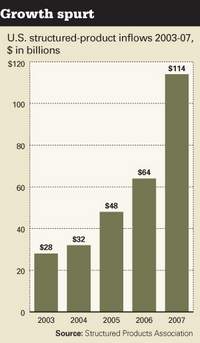
Styrcula highlighted the growing local structured products industry, which grew from $64bn in 2006 to $114bn by the end of 2007, and asked the committee to consider any unintended consequences of a sudden change in tax laws, including widening the current competitive gap between the US capital markets and its global rivals.
He also said that capital-guaranteed investments had the potential to follow the European model and become, "the dominant investment vehicle for prudent American investors, if it weren't for a significant drawback -- an exceptionally disadvantageous tax treatment."
If, however, the tax treatment of capital-guaranteed products were simple and reasonable to the investor, the US financial services industry would be able to promote them on a larger scale while generating substantial revenue for the Treasury, he predicted, citing analysis from SRP.
Following pressure from the Investment Company Institute, the US trade organisation representing the $11tr mutual fund and exchange-traded fund industry, Representative Richard Neal introduced a bill (H.R. 4912) to the House of Representatives on 19 December 2007 seeking to impose more stringent taxes on derivative instruments, including prepaid forward contracts (such as exchange traded notes).
Click here <http://www.structuredretailproducts.com/uploads/news/SPA_tax_testimony.pdf> for the full written testimony of the US SPA.
SPA-2008


Showing posts with label mutual fund industry. Show all posts
Showing posts with label mutual fund industry. Show all posts
Thursday, March 6, 2008


Ways & Means Hearing on Taxation of Prepaid Forwards -- Links
Subcommittee on Select Revenue Measures
Hearing on Tax Treatment of Derivatives
Wednesday, March 05, 2008
Hearing Advisory
Neal Announces Hearing on Tax Treatment of Derivatives
Witness List and Testimony (Printer Friendly)
Witnesses
Panel 1:
Michael J. Desmond, Tax Legislative Counsel, United States Department of Treasury
Alex Raskolnikov, Associate Professor of Law, Co-Chair, Charles E. Gerber Transactional Studies Program, Columbia Law School
Reuven S. Avi-Yonah, Irwin I. Cohn Professor of Law, University of Michigan Law School
Keith A Styrcula, Chairman, on behalf of Structured Products Association
Panel 2:
George U. “Gus” Sauter, Chief Investment Officer, The Vanguard Group; Managing Director, Quantitative Equity Group
William M. Paul, Covington & Burling, LLP, on behalf of Investment Company Institute (ICI)
Leslie B. Samuels, Partner, Cleary Gottlieb Steen & Hamilton LLP on behalf of Securities Industry and Financial Markets Association (SIFMA)
Michael B. Shulman, Partner, Shearman & Sterling LLP
Submissions for the Record
Click here to provide a submission for the record.
Hearing Transcript
Not Yet Available
Printed Hearing
Not Yet Available
====
Additional links:
www.structuredproducts.org -- SPA Official website
http://waysandmeans.house.gov/news.asp?formmode=release&id=628 -- Neal Opening Statement at March 5, 2008 Hearing on Tax Treatment of Derivatives -- "This topic is not for the faint of heart. Just explaining the different types of derivatives can fill volumes. Plus, the market is constantly evolving and growing. The Bank for International Settlements recently estimated the market for derivatives has exceeded $500 trillion in notional amounts just for the first half of last year. And for those taking notes, 500 trillion is half a quadrillion."
Hearing on Tax Treatment of Derivatives
Wednesday, March 05, 2008
Hearing Advisory
Neal Announces Hearing on Tax Treatment of Derivatives
Witness List and Testimony (Printer Friendly)
Witnesses
Panel 1:
Michael J. Desmond, Tax Legislative Counsel, United States Department of Treasury
Alex Raskolnikov, Associate Professor of Law, Co-Chair, Charles E. Gerber Transactional Studies Program, Columbia Law School
Reuven S. Avi-Yonah, Irwin I. Cohn Professor of Law, University of Michigan Law School
Keith A Styrcula, Chairman, on behalf of Structured Products Association
Panel 2:
George U. “Gus” Sauter, Chief Investment Officer, The Vanguard Group; Managing Director, Quantitative Equity Group
William M. Paul, Covington & Burling, LLP, on behalf of Investment Company Institute (ICI)
Leslie B. Samuels, Partner, Cleary Gottlieb Steen & Hamilton LLP on behalf of Securities Industry and Financial Markets Association (SIFMA)
Michael B. Shulman, Partner, Shearman & Sterling LLP
Submissions for the Record
Click here to provide a submission for the record.
Hearing Transcript
Not Yet Available
Printed Hearing
Not Yet Available
====
Additional links:
www.structuredproducts.org -- SPA Official website
http://waysandmeans.house.gov/news.asp?formmode=release&id=628 -- Neal Opening Statement at March 5, 2008 Hearing on Tax Treatment of Derivatives -- "This topic is not for the faint of heart. Just explaining the different types of derivatives can fill volumes. Plus, the market is constantly evolving and growing. The Bank for International Settlements recently estimated the market for derivatives has exceeded $500 trillion in notional amounts just for the first half of last year. And for those taking notes, 500 trillion is half a quadrillion."
Monday, March 3, 2008
SP Industry Hits $114 Billion in 2007 - Mutual Fund Industry Seeks Legislation to Slow Growth
 Despite challenging market conditions in the second half of 2007, the structured products business is coming off an exceptional year. As reported by Jeff Benjamin in Investment News , “The structured-products industry has been relatively obscure among most U.S. investors and financial advisers, but lately, it is basking in the glow of a record-setting 78% increase in 2007 sales. The $114 billion in sales has surprised even some industry insiders, who have watched annual structured-product sales climb steadily from $28 billion in 2003.”
This sentiment was echoed by speakers at three recent industry events.
At this weekend’s JVB Financial 2nd Annual Structured Products Educational Excursion in Breckenridge, CO, panelists from Bear Stearns (Bill Bamber), SocGen (Alexandre Ecot), Netixis (Derrick Smith), Credit Suisse (Scott Milner) and Fortis (Kelly Treseder) unanimously agreed with JVB’s structured products head Steve Peters that the industry continues to defy the volatility and turbulence roiling the rest of the US capital markets.
At the February 21 SPA/Morrison and Foerster Year-in-Review event in New York last week, Wachovia’s Rick Sandulli made the case that the volume of structured products will increasingly challenge the dominance of mutual funds as the mainstay investment vehicle of retail wealth over the next 2 to 5 years. (Other panelists included Citigroup’s Soma Rao, Cadwalader’s Ray Shirazi, and JPMorgan’s John Neubauer.
Additionally, at the 26th Annual LaSalle Bank Fixed Income Symposium at Boca Raton, FL on January 24, Barclay’s Philippe el-Asmar noted that structured investments are giving other investment vehicles a run for the money.
According to el-Asmar, while hedge funds attracted $194 billion in new assets, the total of $114 billion for structured products was highly competitive with exchange-traded funds ($151.2 billion) and superior to closed-end funds ($27.6 billion) and convertible bonds ($94.3 billion). (For copies of the presentations from the LaSalle conference, click on http://www.lasallesymposiumpresentations.com/.)
Impressive stuff, to be sure. So what does this mean – exactly?
It means that the structured products industry is under unprecedented attack by a natural competitor. The Mutual Fund industry.
The mutual fund industry is going to war to circumvent the structured products industry’s growth. Through its trade group – the Investment Company Institute (ICI) – the MF industry is working frantically behind the scenes to kill our business. An Investment News editorial, “ICI Seeks a Protected Market for Mutual Funds” was spot-on when it noted, “Call me cynical, but whenever I see a behemoth mutual fund industry trade association campaigning in the interest of the lowly retail investor, I find it prudent to consider the notion that there might be more to it.”
As the “powerful mouthpiece of the mutual fund industry” the ICI began crowing to the press that it would “prevail” in its attempts to “torpedo” the “tax advantages” of ETNs. Bloggers immediately reacted to the ICI’s nefarious efforts. In a piece entitled “Vanguard Tries to Ruin Your Investing Tax Break,” Jonas Ferris of Maxfunds.com stated that, “You can count on mutual fund companies to try to squash any product they think is a competitive threat to their multi-trillion-dollar-in-assets cash machine.” Brad Ziegler recently posted a blog (“ETNs Thrive Despite Mutual Fund Tantrums”) stating, “When Barclays Global Investors introduced exchange-traded notes [ETNs] last year, the $13 trillion industry called across the schoolyard for Congress and the Treasury Department to protect it from the big, bad bully.” SeekingAlpha.com published a piece entitled, ”ICI Pushes Congress to Punish ETN Investors for Not Choosing Mutual Funds” which stated succinctly that,” It's quite obvious that the monolithic mouthpiece of the $10 trillion mutual fund industry is working around the clock to destroy a competitive threat -- prepaid forwards generally and Exchange Traded Notes specifically -- before it takes root and swipes a few dollars from its fossilized business model. As you're reading this, the ICI is racing to erect anti-competitive barriers around its AUM before the investing public finds out about its secretive, back-room dealings.”
The ICI initially sought out a mere $10 billion snack as its prey – ETNs – but it has gotten a much bigger game in its sights: the entire derivatives industry. For the first time, a mainstream financial reporter – Bloomberg’s Ryan Donmoyer -- has cracked the real story. Believe it or not, it’s Vanguard that’s attempting to put competitive barriers upon the ETN business. “Barclays Plc introduced a new product that put a scare into Vanguard Group Inc. and the rest of the $13 trillion U.S. mutual-fund industry. Now Congress and the Treasury Department are coming to the funds' aid,” Donmoyer wrote in his groundbreaking February 14 article, “Vanguard Battles Barclays Over `Derivatives for the Masses.”'
So where does that put the industry? On Wednesday, March 5, the House Ways and Means Committee will conduct hearings on the recently introduced Neal bill on prepaid derivatives, which proposes a new tax on prepaid forwards generally, and exchange-traded notes specifically. SIFMA, Cleary Gottlieb, Shearman & Sterling and the Structured Products Association will testify at the hearings on behalf of the industry.
SPA will keep you apprised of developments at the Congressional hearings as they happen. Otherwise, we expect to have key players at the SPA-2008 Annual Conference in New York on April 9-10, 2008.
Subscribe to:
Posts (Atom)