TESTIMONY OF STRUCTURED PRODUCTS ASSOCIATION (USA)
BEFORE THE COMMITTEE ON WAYS AND MEANS, U.S. HOUSE OF REPRESENTATIVES
(MARCH 5, 2008)
Good morning. I am grateful to Chairman Neal, Ranking Member English, and Members of the Subcommittee for providing me with the opportunity to testify on this exceptionally important matter.
I am the Founder and Chairman of the Structured Products Association (the “SPA”),
[1] a six-year-old professional trade organization that includes approximately 3,000 financial services professionals among its membership. In addition to my responsibilities as Chairman of the SPA, I have 15 years of experience as a senior-level structured products and derivatives professional with firms such as JPMorgan, UBS and Credit Suisse. I am here before you this morning to discuss the rapidly-growing U.S. structured products market.
We also appreciate the opportunity to express our concerns over the potential impact a disadvantageous tax treatment on financial derivatives may have on the American financial services industry’s ability to remain competitive with foreign counterparts. We are also concerned about the possible adverse impact such treatment may have on prepaid derivative contracts on retail investors as well as the American economy.
On behalf of our members and of those in the industry whose view the SPA represents, I would like to thank Chairman Neal for recognizing the importance of initiating a comprehensive dialogue on the proper tax treatment of innovative financial instruments. Given the importance of financial derivatives, structured products and economic innovation to the American economy both here and abroad – as well as its growing contribution to the revenues of Treasury -- it is imperative that all parties have an opportunity to contribute to an open dialogue on the matter.
The SPA appreciates the privilege and opportunity to present a perspective today that reflects those of its professional members.
We fully recognize that the challenge of determining the appropriate tax treatment of new financial instruments is frequently daunting. Such is the clearly the case with financial derivatives and structured products. These often-misunderstood financial instruments have been mischaracterized as “risky” and “complex.” Nevertheless, the positive impact the industry has had on the American economy over the last two decades should not be underestimated.
In a 1999 speech, former Federal Reserve Chairman Alan Greenspan described “the extraordinary development and expansion” of financial derivatives as “[b]y far the most significant event in finance during the past decade.”
[2] Chairman Greenspan remarked that the U.S. commercial banks were the leading players in global derivatives markets, with outstanding derivatives contracts with a notional value of $33 trillion, a rate “that has been growing at a compound annual rate of around 20 percent since 1990.”
[3] The astounding growth of financial derivatives has not only continued its ascendancy in the new decade – it has accelerated to exceptionally compelling heights.
The Bank of International Settlements noted that as of June 2007, the notional amounts of positions in financial derivatives globally was $516 trillion at the end of June 2007 – representing an annualized compound rate of growth of 33%.
[4] By all measures, financial derivatives are integral to the health of the global economy – and in particular, the American economy.
It is imperative, however, to acknowledge that the US is in jeopardy of losing its standing as the dominant global force in financial derivatives due to burdensome regulation in the post-Enron/WorldCom environment. In foreign exchange derivatives, for example, the June 2007 BIS report indicates that “Among countries with major financial centres [sic], Singapore, Switzerland and the United Kingdom gained market share, while the shares of Japan and the United States dropped.”
[5] The SPA cannot overemphasize how critical it is for the US financial derivatives market to remain on a level-playing field with global competitors in Europe, Asia, Australia and Canada. Any newly-imposed regulatory disadvantages introduced to our industry could impede our ability to compete on a global scale – during a time in which most reputable economists agree is a critical paradigm shift in the world economy.
I am not here before you as an expert on the treatment of prepaid forwards and financial derivatives. Accordingly, I will now speak to the issues surrounding the potential tax treatment of an emerging investment class known as “structured products” and the SPA’s serious concern that H.R. 4912 -- in its current form -- is likely to impose a burdensome tax regime that would adversely impact a new American financial innovation that is only now competing effectively with the European marketplace.
1. What Is a Structured Product? Simply put, structured products are the fastest growing investment class in the United States, and the most exciting financial innovation since exchange-traded funds (“ETFs”). A structured product, generally speaking, has an embedded financial derivative that changes the “payoff profile” of a traditional asset class, such as equities, fixed income, currencies, commodities or alternative investments (hedge funds, private equity). Structured products are “synthetic
investment instruments specially created to meet specific needs that cannot be met from the standardized financial instruments available in the markets. Structured products can be used as an alternative to a direct investment; as part of the asset allocation process to reduce risk exposure of a
portfolio; or to utilize the current market trend.”
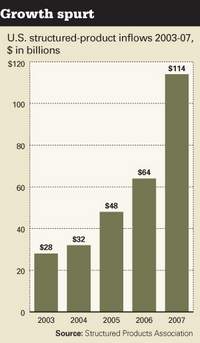
[6]As noted in the mainstream financial media, the structured products investment class represents the fastest growing investment class in all of U.S. financial services. According to SPA statistics, the structured products market in the U.S. grew from $64 billion in 2006 to $114 billion in 2007. As Investment News noted in its February 4, 2008 issue, “The structured-products industry has been relatively obscure among most U.S. investors and financial advisers, but lately, it is basking in the glow of a record-setting 78% increase in 2007 sales.”
[7] The dramatic increase in popularity is linked to the fact that structured products – in many, but not all cases -- offer a superior value proposition to direct or managed investments.
For example, a popular type of structured product might offer a "capital guarantee" function, which offers protection of principal if held to maturity. If an investor invests $100, the issuer simply invests in a five-year bond that today might cost $80 dollars – but will grow to $100 after five years. The remaining $20 is invested in a financial derivative that is linked to a desirable asset class such as equity or fixed income indexes. Regardless of how markets perform, the investor is guaranteed to receive at least $100 back upon maturity of the structured product.
Capital-guaranteed structured products are to European investors what mutual funds are to American investors. They often provide the best of both worlds – protecting investors from a significant market decline, while providing exposure to the upside potential of a reference index, basket or asset class. Indeed, it is the position of the Structured Products Association that capital-guaranteed structured products would have the potential to be the dominant investment vehicle for prudent American investors, if it weren’t for a significant drawback -- an exceptionally disadvantageous tax treatment.
2. The Disadvantageous Tax Treatment of Capital-Guaranteed Structured Products. The SPA believes that the current tax treatment of capital-guaranteed structured products is a highly-illustrative cautionary tale for all interested parties. A typical prospectus on a capital-guaranteed structured note might note that the investment will be “treated as ‘contingent payment debt instruments’ for U.S. federal income tax purposes. Accordingly, U.S. taxable investors, regardless of their method of accounting, will be required to accrue as ordinary income amounts based on the ‘comparable yield’ of the Securities, even though they will receive no payment on the Securities until maturity. [Emphasis ours]. In addition, any gain recognized upon a sale, exchange or retirement of the Securities will generally be treated as ordinary interest income for U.S. federal income tax purposes. [Emphasis ours.]”
[8]As a direct result of the unduly burdensome and disadvantageous tax treatment of capital-guaranteed structured products, the United States is a poor competitor with Europe. According to the structuredretailproducts.com database, the tax disadvantage of capital-guaranteed structured products not only adversely impacts American retail investors; it results in a devastating impact on potential tax revenues to Treasury – an artificial inhibition on a potentially strong generator of tax dollars to close the gap on AMT reform. If the tax treatment were simple and reasonable to the investor, the U.S financial services industry would be able to promote this significant, highly-advantaged vehicle to the average American retail investor while generating substantial revenue for the US Treasury.
Unfortunately, this tax-driven impediment has put the US far behind its European competitors. In 2006, for example, Europe captured $193.38 billion in capital-guaranteed structured products. The US only managed $7.152 billion in 2006. We attribute this directly to the unfavorable tax treatment accorded to the capital-guaranteed investment vehicle, which has been roundly criticized by all market participants who are understandably reluctant to offer the investment to taxable accounts.
In the final analysis, the Treasury is deprived of revenue it might otherwise realize if the taxation of these appealing investments were simplified and comparative to the European equivalents.
3. The U.S. Financial Derivatives and Structured Products Markets Need Simple and Appropriate Tax Treatment to Compete Globally. We appeal to the Ways and Means Committee to recognize the exceptional challenges the financial derivatives and structured products industries face against our global competitors. The United States is just now catching up with Europe in structured products sales – after a decade-long headstart --- and imposing a singular, disadvantageous tax scheme on our industry will have vast and devastating consequences on our ability to compete on a global basis. We are struggling mightily to maintain our market share against Europe, Asia, Australia and Canada in the next decade in the financial derivatives arena.
The structured products industry, in particular, has seen a significant increase in its ability to compete against Europe in the global structured products arena. After trailing for most of the last two decades, the ascendancy of the U.S. growth has – for the first time – put us within striking range (Europe = $316.17 billion vs. U.S. = $114 billion, narrowing the gap from 6:1 over 2006.)
The SPA is concerned that an inopportune tax treatment specifically targeting structured products could put the U.S. at a significant disadvantage against the rest of the world, a repeat scenario of what happened to capital-guaranteed structured products.
With regard to exchange-traded notes (“ETNs”), the equivalent in Europe and Asia are “certificates” and “warrants.” Almost without exception, the local jurisdictions treat these instruments as long-term capital gains, if held for one year or longer. Any attempt to put ETNs at a tax disadvantage would have devastating consequences on structured products -- the greatest financial innovation since convertible securities and exchange-traded notes .
Based on the industry’s experience with capital guaranteed structured products, the SPA strongly believes that any tax-driven complexities introduced to structured products will have a highly adverse impact on the impressive growth of the U.S. structured products and financial derivatives markets over the last decade, especially given the industry’s efforts to compete with the European structured products market.
4. Conclusion – We agree wholeheartedly with the Subcommittee that new legislation on the taxation of retail financial instruments is in order. Such legislation, however, should analyze all investment vehicles at the ground-level – inclusive of ETFs, closed-end funds, mutual funds, convertible bonds, managed accounts, insurance products, unit investment trusts (“UITs”) and single-stock positions – to arrive at a fair and consistent approach to the taxation of financial instruments.
The SPA respectfully submits that any attempt to single out financial derivatives, prepaid forwards, and structured products in the absence of a full consideration of all other financial instruments is a potentially dangerous precedent that could have vast and unforeseen consequences in the global arena.
We point not only to the previous example of capital-guaranteed structured products as a cautionary tale, but to the clear and present impact of the well-intended Sarbanes-Oxley bill. Much like the proposed Neal bill, it was an exceptionally admirable piece of responsible legislation. Unfortunately, however, it had unforeseen consequences that put the U.S. at a disadvantage in the global capital markets – consequences our nation’s capital markets have yet to recover from.
Sarbanes-Oxley permitted London to surpass New York as “the world's most competitive financial center,” according to a report released February 28 by the city of London, which analyzed the competitiveness of business centers around the world. The survey interviewed 1,236 senior business personnel from around the world, who ranked New York second and Hong Kong third. “While New York dominated all cities when measured by the capitalization of its listed companies and the trading volumes of its stock exchanges, the city . . .was criticized by some survey participants because of Sarbanes Oxley Act regulatory requirements.” The SPA is keen to avoid any similar impediment to the global competitiveness of the financial services industry, and respectfully asks the Subcomittee to seriously consider the consequences of an unprecedented taxation on financial derivatives, prepaid forwards and structured products.
H.R. 4912’s approach to single out financial derivatives and its progeny has the real and present danger of imposing an unfavorable tax treatment on U.S. financial instruments. The direct result is a devastating impact on our industry’s competitive efforts against highly formidable and well-capitalized European counterparts, many of which enjoy substantial tax advantages over us. We respectfully request that the Subcommittee fully consider our industry’s intensively competitive position, and not impose any singular tax treatment that would provide further undue burden upon the American financial services industry’s Herculean efforts to remain competitive against European and Asian in this rapidly-changing global economy.
[1] The Structured Products Association (SPA) is a New York-based trade group whose mission includes positioning structured products as a distinct asset class; promoting financial innovation among member firms; developing model “best practices” for members and their firms; identifying legal, tax, compliance and regulatory challenges to the business. With more than 3000 members, the Association has members from the exchanges, self-regulatory bodies, legal compliance community financial media, investor networks, family offices, and both buy-side and sell-side structured product firms. The primary mission of the Structured Products Association is to position structured products as a distinct investment class, promote financial innovation among member firms, develop model "best practices" for member organizations, identify issues related to legal, tax, and compliance. The URL for the SPA website is
www.structuredproducts.org.
[2] Chairman Greenspan’s remarks on Financial Derivatives were made before the Futures Industry Association conference in Boca Raton, Florida on March 19, 1999. The full transcript appears on the Federal Reserve website at http://www.federalreserve.gov/boarddocs/speeches/1999/19990319.htm
[3] Chairman Greenspan further commented on the leading role played by U.S. commercial and investment banks in the global OTC derivatives markets. “[T]he size of the global OTC market at an aggregate notional value of $70 trillion, a figure that doubtless is closer to $80 trillion today. . . U.S. commercial banks' share of this global market was about 25 percent, and U.S. investment banks accounted for another 15 percent. While U.S. firms' 40 percent share exceeded that of dealers from any other country.”
[4] See
http://www.bis.org/press/p071219.htm[5] BIS Triennial Central Bank Survey 2007 (June 2007),
http://www.bis.org/publ/rpfxf07t.pdf?noframes=1[6] Source:
http://en.wikipedia.org/wiki/Structured_products[7] Jeff Benjamin, Investment News, “Structured products flourish in today's 'choppy market'”, February 4, 2008. Source:
http://www.investmentnews.com/apps/pbcs.dll/article?AID=/20080204/REG/544709651[8] A typical capital-guaranteed structured product issued by ABN Amro in the US. For more information, the EDGAR link is http://www.secinfo.com/dRCqp.v4e.htm



 As such, under current law, investors in ETNs generally do not report current accruals of income and gain or loss is determined only upon a sale of the note. The following chart summarizes the treatment of ETFs and ETNs under current law.