The only thing anyone knows for certain is that today will be tumultuous for financial markets, after a historic Sunday that has remade Wall Street. With Lehman Brothers probably on the road to liquidation, and Merrill Lynch to be acquired by Bank of America, we are getting a Category 5 test of our financial levees.
In the event of a Lehman bankruptcy, we will also get a test of whether a major broker-dealer can fail without triggering a systemic crisis. As of last evening, the Federal Reserve and Treasury had refused to offer the same taxpayer guarantees to Lehman paper that it had for Bear Stearns last March. That was enough to cause Barclays and other potential Lehman acquirers to walk away.
The result will be a very rough Monday, but the government had to draw a line somewhere or it would have become the financier of first resort for every company hoping to buy a troubled firm. Especially with the Fed discount window now wide open to many more financial institutions, and to many kinds of collateral, Treasury Secretary Hank Paulson's refusal to blink won't get any second guessing from us. If Lehman is able to liquidate without a panic, and especially if its derivative contracts can be safely undone, the benefits would include the reassertion of "moral hazard" on Wall Street. The Merrill acquisition before it faces a Lehman-like run should also reduce the risk of contagion.
In the days ahead, Treasury will have to take more aggressive steps to protect the banking system -- including, perhaps, another Resolution Trust Corp. that can acquire real-estate and mortgage assets when there are no other buyers, provide some floor under prices, and liquidate or sell them in more orderly fashion. Whatever happens today, we'd rather not repeat the exercise.
Click here for the WSJ online version of this editorial.
SPA-2008


Monday, September 15, 2008
Tuesday, September 9, 2008
FTAdviser.com (UK): SPs an Easy Adviser Sale?
by Sharon Flaherty
FTAdviser.com
There’s never a dull day (well not too many anyway) working in the financial services industry and here's a fine example.
Structured products, seemingly simple and boring on the outside, suddenly became rather interesting after the Investment Management Association (IMA) threw its two pennies worth into the ring.
In a statement to journalists across the industry, Richard Saunders, chief executive of IMA, warned against structured products because of their lack of transparency.
Source: FTAdviser.com
He said promotional literature on the products should not be taken at face value because promoters are under no obligation to report performance, making it hard to assess the accuracy of claims about product returns.
His comments, however, promoted a storm of both opposition and support.
FTAdviser.com
There’s never a dull day (well not too many anyway) working in the financial services industry and here's a fine example.
Structured products, seemingly simple and boring on the outside, suddenly became rather interesting after the Investment Management Association (IMA) threw its two pennies worth into the ring.
In a statement to journalists across the industry, Richard Saunders, chief executive of IMA, warned against structured products because of their lack of transparency.
Source: FTAdviser.com
He said promotional literature on the products should not be taken at face value because promoters are under no obligation to report performance, making it hard to assess the accuracy of claims about product returns.
His comments, however, promoted a storm of both opposition and support.
Structured Products 101: Frequently-Asked Questions
by the Structured Products Association
How do structured products work?
A structured product can come in any one of several forms -- notes, units, shares, CD or trusts. Structured products typically provide exposure to an asset class with some additional feature that is desirable to an investor (and for which the investor is willing to pay a modest premium). These features include principal protection, moderate leverage, above-market yields, alternative investment exposure or tax advantaged returns.
If there's a "derivative" embedded in the investment, what are my risks?
All structured products have a derivative element , which provides the additional feature desired by the investor. Although many advisors generally have a negative reaction to an investment with an embedded "derivative," it should be noted that the derivative exposure often takes away risk from an investment (for example, principal protection). Indeed, many vanilla securities have "embedded derivatives" such as callable bonds and convertible securities. The most prominent risk of a derivative-added investment is a misunderstanding of how the ultimate payout formula on the structured product works.
What are the fees?
Predictably, the fees vary considerably, based on the term of the investment, the reference asset and the complexity of the structured product. A recent survey by the SPA demonstrated that most structured products charge between 25 to 50 basis points per annum, considerably lower than the 1.26% fees charged by mutual funds. This figure does not take into account the cost of distribution -- or the fee charged by the broker-dealer or investment advisor.
What are the investment minimums?
Many structured products are listed on exchanges, and on the initial offering can be as low as $10 per unit. A round lot of a structured investment (100 shares) would cost an investor $1,000 plus commissions. The trend over the last five years has been to reduce the minimums for the more vanilla structured investments for retail investors to smaller sizes, in part to reduce "concentration risk" and permit diversification of issuers.
Are the investments liquid or are investors locked in for long periods?
With over 60 issuers of structured investments, competition has compelled all firms to provide at least daily liquidity for their offerings. The top structured products distribution firms such as Advisors Asset Management and Incapital will not permit access to their platforms unless the issuers meet their high standards of liquidity-on-demand. Exchange-listed securities have 15 second pricing and instant liquidity. Investors are generally not locked in, however, because of the potential complexity of some structured investments, it is important to emphasize that these are buy-and-hold securities. The benefit of a particular structured product typically comes at maturity. Such is the case with a principal protected note where the protection is guaranteed only upon maturity.
Isn't this kind of like Las Vegas? When I lose, the house wins?
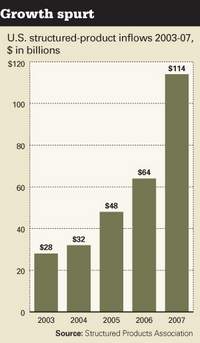
Contrary to the belief of even some of the more sophisticated brokers and advisors, structured investments are not a "zero-sum game" where the issuer wins only if the investor loses. The structured products industry is very keen to create products that will have superior risk-adjusted returns that outperform other investments; the growth of the market is highly attributable to the positive returns experienced by structured products investors. The majority of growth in the $120 billion-a-year structured products business comes from repeat investors.
If structured products are so great, why doesn't everyone have them in their portfolio?
Structured products have traditionally been available only to wealthy investors of private banks. After the dot-com market decline, many investors came to learn that structured products could repair portfolios, protect capital and enhance yield. Many of these investment strategies were then made available to retail investors beginning around 2003. Much like the ETF market, it takes awhile for a revolutionary idea to go mainstream. That said, MIT Professor Zvi Bodie sees the structured products market as a $1 trillion industry in the next several years, primarily because of its applicability to boomer wealth.
Don't I have credit risk with the firm issuing the product?
Generally speaking, yes. Much like any corporate bond, the return of the security is dependent upon the creditworthiness of the issuer. This time last year it was unthinkable that a structured products issuer with the global footprint of a Bear Stearns would experience a flash-bankruptcy over the course of a single week. (Of course, structured products had nothing to do with Bear Stearns' deteriorating balance sheet, which was actually occasioned by a toxic mix of leverage and subprime mortgage-linked investments.)
What happened to the holders of Bear Stearns structured products?
Happily, holders of Bear Stearns ETNs, structured products and corporate debt are better off now than they may have been previously. Ironically, the federal government now stands behind Bear Stearns credit, meaning its outstanding debt has the explicit backing of the US Treasury. But investors would be wise to not rely on Uncle Sam in case other financial firms falter. Many investors are purchasing structured product-linked CDs in amounts under $100,000 to take advantage of FDIC insurance.
How do structured products work?
A structured product can come in any one of several forms -- notes, units, shares, CD or trusts. Structured products typically provide exposure to an asset class with some additional feature that is desirable to an investor (and for which the investor is willing to pay a modest premium). These features include principal protection, moderate leverage, above-market yields, alternative investment exposure or tax advantaged returns.
If there's a "derivative" embedded in the investment, what are my risks?
All structured products have a derivative element , which provides the additional feature desired by the investor. Although many advisors generally have a negative reaction to an investment with an embedded "derivative," it should be noted that the derivative exposure often takes away risk from an investment (for example, principal protection). Indeed, many vanilla securities have "embedded derivatives" such as callable bonds and convertible securities. The most prominent risk of a derivative-added investment is a misunderstanding of how the ultimate payout formula on the structured product works.
What are the fees?
Predictably, the fees vary considerably, based on the term of the investment, the reference asset and the complexity of the structured product. A recent survey by the SPA demonstrated that most structured products charge between 25 to 50 basis points per annum, considerably lower than the 1.26% fees charged by mutual funds. This figure does not take into account the cost of distribution -- or the fee charged by the broker-dealer or investment advisor.
What are the investment minimums?
Many structured products are listed on exchanges, and on the initial offering can be as low as $10 per unit. A round lot of a structured investment (100 shares) would cost an investor $1,000 plus commissions. The trend over the last five years has been to reduce the minimums for the more vanilla structured investments for retail investors to smaller sizes, in part to reduce "concentration risk" and permit diversification of issuers.
Are the investments liquid or are investors locked in for long periods?
With over 60 issuers of structured investments, competition has compelled all firms to provide at least daily liquidity for their offerings. The top structured products distribution firms such as Advisors Asset Management and Incapital will not permit access to their platforms unless the issuers meet their high standards of liquidity-on-demand. Exchange-listed securities have 15 second pricing and instant liquidity. Investors are generally not locked in, however, because of the potential complexity of some structured investments, it is important to emphasize that these are buy-and-hold securities. The benefit of a particular structured product typically comes at maturity. Such is the case with a principal protected note where the protection is guaranteed only upon maturity.
Isn't this kind of like Las Vegas? When I lose, the house wins?
Contrary to the belief of even some of the more sophisticated brokers and advisors, structured investments are not a "zero-sum game" where the issuer wins only if the investor loses. The structured products industry is very keen to create products that will have superior risk-adjusted returns that outperform other investments; the growth of the market is highly attributable to the positive returns experienced by structured products investors. The majority of growth in the $120 billion-a-year structured products business comes from repeat investors.
If structured products are so great, why doesn't everyone have them in their portfolio?
Structured products have traditionally been available only to wealthy investors of private banks. After the dot-com market decline, many investors came to learn that structured products could repair portfolios, protect capital and enhance yield. Many of these investment strategies were then made available to retail investors beginning around 2003. Much like the ETF market, it takes awhile for a revolutionary idea to go mainstream. That said, MIT Professor Zvi Bodie sees the structured products market as a $1 trillion industry in the next several years, primarily because of its applicability to boomer wealth.
Don't I have credit risk with the firm issuing the product?
Generally speaking, yes. Much like any corporate bond, the return of the security is dependent upon the creditworthiness of the issuer. This time last year it was unthinkable that a structured products issuer with the global footprint of a Bear Stearns would experience a flash-bankruptcy over the course of a single week. (Of course, structured products had nothing to do with Bear Stearns' deteriorating balance sheet, which was actually occasioned by a toxic mix of leverage and subprime mortgage-linked investments.)
What happened to the holders of Bear Stearns structured products?
Happily, holders of Bear Stearns ETNs, structured products and corporate debt are better off now than they may have been previously. Ironically, the federal government now stands behind Bear Stearns credit, meaning its outstanding debt has the explicit backing of the US Treasury. But investors would be wise to not rely on Uncle Sam in case other financial firms falter. Many investors are purchasing structured product-linked CDs in amounts under $100,000 to take advantage of FDIC insurance.
Saturday, August 30, 2008
4th Annual SPA AutumnExpo: October 2 at NYC's Grand Hyatt Hotel

On October 2, 2008 the Structured Products Association will hold a single day event focused entirely on "Structured Products Distribution – New Channels, New Opportunities."
If you’ve attended any of the SPA’s semi-annual conferences, you’re familiar with the caliber of speakers, topics, networking and knowledge attained at the New York events.
The SPA is committed to providing valuable insight and market intelligence, while growing the size and the profile of structured products in the Americas. Over 100 buy-side firms have been invited to this special one-day event – a budget-conscious discount rate is available for first-movers through Sept. 15.
Don’t miss this watershed event that will explore all areas of potential distribution: pension plans, family offices, new wholesalers, insurance companies, 401(k), structured settlements, and college savings plans.
Full agenda and confirmed speakers available shortly. Details on discounted rates available by clicking here.
RIA Wright Opts for Short-Dated Protection (structuredretailproducts.com)
by Lori Pizzani
structuredretailproducts.com
A US wealth manager has said it is buying shorter dated equity-linked notes with capital protection for its clients as volatile conditions persist.
Frederick S Wright IV, chief investment officer of Smith & Howard Wealth Management told SRP he favors structured notes with performance linked to the S&P 500 (as a way of hedging against large cap stocks) and the Russell 2000 (to hedge against small cap stocks).
“We use them as equity replacements,” he said. He also likes those linked to the MSCI EAFE as stand-ins for international equities. Wright said his firm has used structured notes since late 2006/early 2007.
What he finds most appealing are notes with short maturities of two years or less.
The firm’s primary use for structured products is to reduce downside risk. “Most important to us is principal protection or partial protection, more so than a leveraged upside,” he said. “We look at it as a risk reduction tool versus enhanced return notes.”
While Wright says he has reviewed some structured notes linked to oil and global infrastructure indices, “there is nothing well priced [at present].” What he would like to see is a principal protected oil note that can provide positive returns whether oil prices rise or fall within a 30% to 35% range.
Smith & Howard usually works on a discretionary basis with clients, investing without specific security approval, but due to the relative novelty of structured products on the US market, Wright believes in discussing them with clients prior to purchasing.
Structured notes that provide returns even in down markets do not always get a strong reception, he said: “You’d think they would be attractive now. But clients’ credit concerns have eclipsed the potential benefits.
“I actually find it more difficult now because they are being issued by the banks with credit crisis [involvement],” he said. One question he repeatedly hears is: where do structured products fall in terms of the order of debt obligations of the issuer? “It’s a concern I’m hearing from clients and I don’t see this addressed in the product literature,” he said.
For a trial subscription to StructuredRetailProducts.com, click here.
structuredretailproducts.com
A US wealth manager has said it is buying shorter dated equity-linked notes with capital protection for its clients as volatile conditions persist.
Frederick S Wright IV, chief investment officer of Smith & Howard Wealth Management told SRP he favors structured notes with performance linked to the S&P 500 (as a way of hedging against large cap stocks) and the Russell 2000 (to hedge against small cap stocks).
“We use them as equity replacements,” he said. He also likes those linked to the MSCI EAFE as stand-ins for international equities. Wright said his firm has used structured notes since late 2006/early 2007.
What he finds most appealing are notes with short maturities of two years or less.
The firm’s primary use for structured products is to reduce downside risk. “Most important to us is principal protection or partial protection, more so than a leveraged upside,” he said. “We look at it as a risk reduction tool versus enhanced return notes.”
While Wright says he has reviewed some structured notes linked to oil and global infrastructure indices, “there is nothing well priced [at present].” What he would like to see is a principal protected oil note that can provide positive returns whether oil prices rise or fall within a 30% to 35% range.
Smith & Howard usually works on a discretionary basis with clients, investing without specific security approval, but due to the relative novelty of structured products on the US market, Wright believes in discussing them with clients prior to purchasing.
Structured notes that provide returns even in down markets do not always get a strong reception, he said: “You’d think they would be attractive now. But clients’ credit concerns have eclipsed the potential benefits.
“I actually find it more difficult now because they are being issued by the banks with credit crisis [involvement],” he said. One question he repeatedly hears is: where do structured products fall in terms of the order of debt obligations of the issuer? “It’s a concern I’m hearing from clients and I don’t see this addressed in the product literature,” he said.
For a trial subscription to StructuredRetailProducts.com, click here.
Friday, August 29, 2008
Research Magazine: Q & A with the SPA
By DAVID MACCHIA, WEALTH2K
ResearchMag.com
Last year structured products sales in the U.S. increased to $117 billion. And while most sales of structured products have occurred in the institutional and high-net-worth markets, the movement of structured products into the retail marketplace is clearly underway. What are the implications for competing products? According to Boston University Professor, Zvi Bodie, “The total amount of wealth that will be converted to structured products is in the trillions of dollars.”
The potential impact on other industries from the rise of structured products is one that the Structured Products Association, tackles in this interview. It’s not hard to imagine that the impact of structured products could be significant given the potent appeal of principal protection combined with investment growth potential.
----
DAVID MACCHIA (davidmacchia.com): I'm most interested in exploring the whole issue of structured products, the industry and the SPA's role in it. And I'd like to start with sort of a foundational question, if I could. Which is, given the fact that in the financial services world, apart from the sector that deals with structured products regularly, I think there’s a lot of wonder and mystery about what structured products really are? Could you start at the beginning and define what structured products are?
SPA: David, it’s a privilege to be speaking with you today. Structured products are fundamentally a variation on a direct investment in a particular asset class. Equities, fixed income, commodities -- any type of traditional asset class can be the basis of a structured product. For example, a structured note linked to the S&P 500 might provide two times the upside up to a cap, or protection of your principal 100%, or the first 15% of the downside risk in the investment. Structured products may be described as enhanced ETFs – similar index exposure, but with a desirable benefit to the payoff profile that the investor values enough to pay for.
MACCHIA: The notion of delivering equity-linked returns combined with a principal protection is a concept that's I’ve written about a lot. Among others the Retirement Income Industry Association has certainly identified what we refer to as the transition management phase. Let's describe that as the period beginning roughly 10 years before retirement and continuing until 10 years after retirement. It’s becoming well understood that investment losses during this period will, at the very least, diminish for life the amount of retirement income that can be generated. Or, depending on when the investment loss occurs, potentially lead to portfolio ruin. So when I think about the benefits that structured products can provide, I become pretty excited because you can see a role for them in the lives of potentially millions of boomer clients. So what I'm describing here is the context for the migration of structured products to the retail market. Is this something that the industry is focused on? Is it a high priority? How would you describe the urgency, if there is one, to enter that marketplace?
SPA: Our belief is that we’re at the ascendancy of structured products as the pre-eminent vehicle for the massive pool of boomer retirement wealth. Interestingly enough, the U.S. lags behind the rest of the world – Europe, Asia, Australia, South America and the rest of North America for that matter -- is far behind the rest of the world in terms of principal protected exposure with guaranteed income. For Europeans, principal protected structured products are the equivalent of mutual funds to American investors. Europeans, by and large, value capital preservation over picking stocks and going for outsized returns. Americans have a different investment mentality. We believe that you can “asset allocate” risk out of your portfolio through diversification. Unfortunately, we have found that the fixed income and equities markets have a tendency to move in lockstep. The dot-com market break in 2000 proved how fallible that theory could be.
When indexes take 30, 40 and 50% hits and interest rates are so low that you get only 1 or 2% of return on your investment for a year without taking exceptional credit risk, structured products are simply the superior investment vehicle. You can repair your portfolio by selling call options in an automated structure, by purchasing high-yielding reverse convertibles.
The top 5 or 10 percent of cutting-edge investment advisors have embraced the structured products investment class and consider it to be the secret weapon that sets them apart from their competitors.
On the subject of principal protected notes, they would be a core holding in investor portfolios. But in the U.S. , there’s something of a tax disadvantage if they are held outside of retirement accounts. The Structured Products Association has engaged Congress and the Treasury on revisiting this adverse tax treatment, but in the meantime, they are optimal investments for tax-free retirement accounts.
Certain structured products that with a ten year horizon, if managed the right way, can give you more than 100% exposure to the S&P 500. It can give you more than 100% principal protection. In fact, it'll pay you a coupon of up to 1 or 2% per year at a minimum and give you full leveraged exposure to the S&P 500. As a core holding in your retirement account, it’s a very powerful value proposition for those who have that time horizon in their retirement accounts.
MACCHIA: What you're describing in terms of economic benefit seems obvious and important. And of course, John Bogle would think that investing in the S&P 500 is exciting. But what occurs to me is that because, for instance, you may think in terms of a ten-year timeframe for these products, with limited liquidity-- I'd like to come back to the liquidity issue later-- then having them in a strategic asset allocation within a retirement account framework seems to make a lot of sense. Do you agree?
SPA: David, that’s absolutely right. Advisors who haven’t made the effort to understand the new technology have inaccurately stated that structured products are “gimmicks” with “high fees.” Such thinking is a disservice to their clients and their fiduciary responsibilities to provide the client with the best possible investment allocation. To disregard structured products is potentially a disservice to the client. To be clear, not all portfolios call for structured investments, but the advisor should arrive at that decision only after a careful assessment of her client’s needs.
MACCHIA: If you accept the notion that accumulation planning is inherently different than income- generation planning, then you have to say that the majority of financial advisors in the U.S. remain in the accumulation mode mindset.
SPA: Agreed. You could say that Modern Portfolio Theory is no longer so modern, and that structured products represent the next wave of MPT.
MACCHIA: This implies, to me at least, that maybe the largest challenge the structured products industry faces is a communications challenge, in terms of recasting people's thinking about these products. Educating advisors and investors about their use in proper income distribution planning, and getting people to focus on critical benefits that they currently they don't see. Do you agree that communications is a huge issue for the structured products industry?
SPA: It's our number one priority as an industry. And I think you touched upon a very important point – it’s not simply education of the brokers and advisors on the utility of structured investments, it's more about winning over hearts and minds. I’m going to be a bit controversial here: a good number of brokers and advisors have been intellectually lazy about learning about the investment class and have resorted to denigrating the investment class to the clients by saying, "Oh, it's too high fee, too high risk, too complicated for you. So I’m going to do you a favor and steer you away from that.”
Some advisors sell their own portfolio management skills by selling against structured investments. As an industry, we have our work cut out for us. And I spend a lot of time with the chief investment officers of the major wealth management firms advocating for this investment class, telling CIOs they should have structured products available to their top producers. So it's a top-to-bottom/bottom-to-top education challenge before us.
For the full interview in Research Magazine, click here.
ResearchMag.com
Last year structured products sales in the U.S. increased to $117 billion. And while most sales of structured products have occurred in the institutional and high-net-worth markets, the movement of structured products into the retail marketplace is clearly underway. What are the implications for competing products? According to Boston University Professor, Zvi Bodie, “The total amount of wealth that will be converted to structured products is in the trillions of dollars.”
The potential impact on other industries from the rise of structured products is one that the Structured Products Association, tackles in this interview. It’s not hard to imagine that the impact of structured products could be significant given the potent appeal of principal protection combined with investment growth potential.
----
DAVID MACCHIA (davidmacchia.com): I'm most interested in exploring the whole issue of structured products, the industry and the SPA's role in it. And I'd like to start with sort of a foundational question, if I could. Which is, given the fact that in the financial services world, apart from the sector that deals with structured products regularly, I think there’s a lot of wonder and mystery about what structured products really are? Could you start at the beginning and define what structured products are?
SPA: David, it’s a privilege to be speaking with you today. Structured products are fundamentally a variation on a direct investment in a particular asset class. Equities, fixed income, commodities -- any type of traditional asset class can be the basis of a structured product. For example, a structured note linked to the S&P 500 might provide two times the upside up to a cap, or protection of your principal 100%, or the first 15% of the downside risk in the investment. Structured products may be described as enhanced ETFs – similar index exposure, but with a desirable benefit to the payoff profile that the investor values enough to pay for.
MACCHIA: The notion of delivering equity-linked returns combined with a principal protection is a concept that's I’ve written about a lot. Among others the Retirement Income Industry Association has certainly identified what we refer to as the transition management phase. Let's describe that as the period beginning roughly 10 years before retirement and continuing until 10 years after retirement. It’s becoming well understood that investment losses during this period will, at the very least, diminish for life the amount of retirement income that can be generated. Or, depending on when the investment loss occurs, potentially lead to portfolio ruin. So when I think about the benefits that structured products can provide, I become pretty excited because you can see a role for them in the lives of potentially millions of boomer clients. So what I'm describing here is the context for the migration of structured products to the retail market. Is this something that the industry is focused on? Is it a high priority? How would you describe the urgency, if there is one, to enter that marketplace?
SPA: Our belief is that we’re at the ascendancy of structured products as the pre-eminent vehicle for the massive pool of boomer retirement wealth. Interestingly enough, the U.S. lags behind the rest of the world – Europe, Asia, Australia, South America and the rest of North America for that matter -- is far behind the rest of the world in terms of principal protected exposure with guaranteed income. For Europeans, principal protected structured products are the equivalent of mutual funds to American investors. Europeans, by and large, value capital preservation over picking stocks and going for outsized returns. Americans have a different investment mentality. We believe that you can “asset allocate” risk out of your portfolio through diversification. Unfortunately, we have found that the fixed income and equities markets have a tendency to move in lockstep. The dot-com market break in 2000 proved how fallible that theory could be.
When indexes take 30, 40 and 50% hits and interest rates are so low that you get only 1 or 2% of return on your investment for a year without taking exceptional credit risk, structured products are simply the superior investment vehicle. You can repair your portfolio by selling call options in an automated structure, by purchasing high-yielding reverse convertibles.
The top 5 or 10 percent of cutting-edge investment advisors have embraced the structured products investment class and consider it to be the secret weapon that sets them apart from their competitors.
On the subject of principal protected notes, they would be a core holding in investor portfolios. But in the U.S. , there’s something of a tax disadvantage if they are held outside of retirement accounts. The Structured Products Association has engaged Congress and the Treasury on revisiting this adverse tax treatment, but in the meantime, they are optimal investments for tax-free retirement accounts.
Certain structured products that with a ten year horizon, if managed the right way, can give you more than 100% exposure to the S&P 500. It can give you more than 100% principal protection. In fact, it'll pay you a coupon of up to 1 or 2% per year at a minimum and give you full leveraged exposure to the S&P 500. As a core holding in your retirement account, it’s a very powerful value proposition for those who have that time horizon in their retirement accounts.
MACCHIA: What you're describing in terms of economic benefit seems obvious and important. And of course, John Bogle would think that investing in the S&P 500 is exciting. But what occurs to me is that because, for instance, you may think in terms of a ten-year timeframe for these products, with limited liquidity-- I'd like to come back to the liquidity issue later-- then having them in a strategic asset allocation within a retirement account framework seems to make a lot of sense. Do you agree?
SPA: David, that’s absolutely right. Advisors who haven’t made the effort to understand the new technology have inaccurately stated that structured products are “gimmicks” with “high fees.” Such thinking is a disservice to their clients and their fiduciary responsibilities to provide the client with the best possible investment allocation. To disregard structured products is potentially a disservice to the client. To be clear, not all portfolios call for structured investments, but the advisor should arrive at that decision only after a careful assessment of her client’s needs.
MACCHIA: If you accept the notion that accumulation planning is inherently different than income- generation planning, then you have to say that the majority of financial advisors in the U.S. remain in the accumulation mode mindset.
SPA: Agreed. You could say that Modern Portfolio Theory is no longer so modern, and that structured products represent the next wave of MPT.
MACCHIA: This implies, to me at least, that maybe the largest challenge the structured products industry faces is a communications challenge, in terms of recasting people's thinking about these products. Educating advisors and investors about their use in proper income distribution planning, and getting people to focus on critical benefits that they currently they don't see. Do you agree that communications is a huge issue for the structured products industry?
SPA: It's our number one priority as an industry. And I think you touched upon a very important point – it’s not simply education of the brokers and advisors on the utility of structured investments, it's more about winning over hearts and minds. I’m going to be a bit controversial here: a good number of brokers and advisors have been intellectually lazy about learning about the investment class and have resorted to denigrating the investment class to the clients by saying, "Oh, it's too high fee, too high risk, too complicated for you. So I’m going to do you a favor and steer you away from that.”
Some advisors sell their own portfolio management skills by selling against structured investments. As an industry, we have our work cut out for us. And I spend a lot of time with the chief investment officers of the major wealth management firms advocating for this investment class, telling CIOs they should have structured products available to their top producers. So it's a top-to-bottom/bottom-to-top education challenge before us.
For the full interview in Research Magazine, click here.


Thursday, August 28, 2008
SPA MarketColor: Recent Headlines - September 2008
STRATEGIES AND INVESTMENTS:
· Business Week: Absolute Return Notes Rule As Bear Mkt Scares Off Optimists
· Credit Suisse on Using Hedge Fund Structured Products to Raise Capital
· IndexUniverse.com: Deutsche Bank's New ETNs Replicate Graham Strategies
· Wall Street Journal's FAQs on ETNs - What You Need to Know
· Happy Birthday, iPath ETNs (seekingalpha.com)
· Reg. Rep: Structured Products - Bright Future for Securitization?
· Financial Times: Downside protection gains popularity
MARKETS AND DISTRIBUTION:
· Bonds.com to Distribute Structured Products
· Derivatives Week: Ex-Countrywide Structured Pros Seek New Home
· DWS Scudder Doubles S-Notes Sales to $600 Million (Investment News)
· Financial Times: In the US, Structured Products Flying Into Harsher Climate
· Financial Times: High Structured Products Inflows Show US Playing Catch-Up
· Bloomberg: Bridgewater predicts $1.6 trillion in subprime losses
INTERNATIONAL:
· India: Structured Products 'Pick Up' In Tough Market
· India: Equity SPs - Best of both worlds (Business Times)
· China: Overseas Banks Grab Bigger Share of China's SP Market
· UK: 88% of Advisors Recommend SPs Over the Next 12 Months
· UK: Wealth advisers and private banks turn to structured products
· Australia: Choosing products that are structurally sound
REGULATORY:
· SPA Asks SEC to Distinguish Structured Products from Asset-Backed Securities
· NYSE Releases Informed Investor Guide to ETNs
· Lawyer: The Hapless Members of Citi’s ELKS Club (Seeking Alpha)
· Final Version of Structured Products Principles For Individual Investors Released
::: Get instant SPA News in a Feedburner reader.
::: The SPA is sponsoring two new groups on LinkedIn.::: To join the Structured Products Association group, click here. ::: To join the SPA's Structured Products and Investments group, click here.
· Business Week: Absolute Return Notes Rule As Bear Mkt Scares Off Optimists
· Credit Suisse on Using Hedge Fund Structured Products to Raise Capital
· IndexUniverse.com: Deutsche Bank's New ETNs Replicate Graham Strategies
· Wall Street Journal's FAQs on ETNs - What You Need to Know
· Happy Birthday, iPath ETNs (seekingalpha.com)
· Reg. Rep: Structured Products - Bright Future for Securitization?
· Financial Times: Downside protection gains popularity
MARKETS AND DISTRIBUTION:
· Bonds.com to Distribute Structured Products
· Derivatives Week: Ex-Countrywide Structured Pros Seek New Home
· DWS Scudder Doubles S-Notes Sales to $600 Million (Investment News)
· Financial Times: In the US, Structured Products Flying Into Harsher Climate
· Financial Times: High Structured Products Inflows Show US Playing Catch-Up
· Bloomberg: Bridgewater predicts $1.6 trillion in subprime losses
INTERNATIONAL:
· India: Structured Products 'Pick Up' In Tough Market
· India: Equity SPs - Best of both worlds (Business Times)
· China: Overseas Banks Grab Bigger Share of China's SP Market
· UK: 88% of Advisors Recommend SPs Over the Next 12 Months
· UK: Wealth advisers and private banks turn to structured products
· Australia: Choosing products that are structurally sound
REGULATORY:
· SPA Asks SEC to Distinguish Structured Products from Asset-Backed Securities
· NYSE Releases Informed Investor Guide to ETNs
· Lawyer: The Hapless Members of Citi’s ELKS Club (Seeking Alpha)
· Final Version of Structured Products Principles For Individual Investors Released
::: Get instant SPA News in a Feedburner reader.
::: The SPA is sponsoring two new groups on LinkedIn.::: To join the Structured Products Association group, click here. ::: To join the SPA's Structured Products and Investments group, click here.
Tuesday, August 26, 2008
UK: 88% of Advisors Recommend SPs Over the Next 12 Months
by Nick Rice
FT Advisor
IFAs have said they will increase their allocation to structured products more than to any other mainstream asset class over the next year, according to Keydata Investment Services.
A Keydata telephone poll of 50 advisers this month revealed 88.1 per cent would recommend that clients put more money in structured products over the next 12 months. Just 2.4 per cent of advisers would recommend clients maintain their current weighting and 7.1 per cent would tell clients to decrease it.
Other defensive asset classes will receive lower boosts. Cash was the most heavily favoured after structured products, with 83.3 per cent of advisers recommending clients increase their exposure, 9.5 per cent saying they should maintain it and 2.4 per cent suggesting they decrease it.
Fixed income received a higher recommendation than pure corporate bonds. Sixty-nine per cent said they would advise clients to increase their weighting to fixed income against 38.1 per cent for corporate bonds.
Cautious Managed funds, which have seen high inflows over the last year, would see allocation increases from 66.7 per cent of IFAs, less than fixed income as a whole. UK equities, international equities and property were at the bottom of the recommendation list at 16.7 per cent, 14.3 per cent and 4.8 per cent, respectively.
Mark Owen, director of sales and strategy at Keydata, said he had anticipated a large move into fixed income and cash, but was surprised at the allocation to structured products, although Keydata itself is a structured-product provider.
He said the move indicated a greater awareness of structured products among advisers, particularly in terms of their return profiles and objectives.
For the full article from FTAdvisor.com, click here.
FT Advisor
IFAs have said they will increase their allocation to structured products more than to any other mainstream asset class over the next year, according to Keydata Investment Services.
A Keydata telephone poll of 50 advisers this month revealed 88.1 per cent would recommend that clients put more money in structured products over the next 12 months. Just 2.4 per cent of advisers would recommend clients maintain their current weighting and 7.1 per cent would tell clients to decrease it.
Other defensive asset classes will receive lower boosts. Cash was the most heavily favoured after structured products, with 83.3 per cent of advisers recommending clients increase their exposure, 9.5 per cent saying they should maintain it and 2.4 per cent suggesting they decrease it.
Fixed income received a higher recommendation than pure corporate bonds. Sixty-nine per cent said they would advise clients to increase their weighting to fixed income against 38.1 per cent for corporate bonds.
Cautious Managed funds, which have seen high inflows over the last year, would see allocation increases from 66.7 per cent of IFAs, less than fixed income as a whole. UK equities, international equities and property were at the bottom of the recommendation list at 16.7 per cent, 14.3 per cent and 4.8 per cent, respectively.
Mark Owen, director of sales and strategy at Keydata, said he had anticipated a large move into fixed income and cash, but was surprised at the allocation to structured products, although Keydata itself is a structured-product provider.
He said the move indicated a greater awareness of structured products among advisers, particularly in terms of their return profiles and objectives.
For the full article from FTAdvisor.com, click here.
Tuesday, August 19, 2008
NYSE Regulation: ETNs and the Informed Investor
An Exchange Traded Note (ETN) is a relatively new type of investment vehicle that is unfamiliar to many investors. Before you decide to invest, there are some basic questions which you should consider in order to make an informed investment decision.
What Is An Exchange-Traded Note? An Exchange Traded Note (ETN) is a common name for a senior unsecured debt obligation designed to track the total return of an underlying market index or other benchmark, minus investor fees. The creditworthiness of an ETN is itself not rated, but instead is based on the creditworthiness of the issuer.
Thus, the issuer’s credit rating is an important consideration for ETN investors. Typically, ETNs have a repurchase feature, providing qualified investors the election to redeem notes of at least a specified minimum denomination or value with the issuer on a daily or weekly basis at a predetermined price. The details of this feature are in the ETN prospectus. Individual investors, not qualified for redemption election, can purchase or sell their ETNs in the secondary market, sell at a specified issuer call event, or allow them to mature.
ETNs can offer investment exposure to market sectors and asset classes that may be difficult to achieve in a cost-effective way with other types of investments. ETNs can also act as an effective hedging tool.
An ETN allows individual investors to buy an obligation, similar to a forward contract, which is traded on an Exchange. ETNs may be linked to a wide variety of assets. Today there are many types of ETNs linked to indexes and/or single reference assets based on a variety of products such as commodity futures (e.g., energy, grains, industrial metals, livestock, and petroleum), foreign currencies (e.g., Euro, yen), and equities (grouped by such categories as industry sector, strategy or geographic location).
For the entire NYSE Informed Investor educational piece, click here.
What Is An Exchange-Traded Note? An Exchange Traded Note (ETN) is a common name for a senior unsecured debt obligation designed to track the total return of an underlying market index or other benchmark, minus investor fees. The creditworthiness of an ETN is itself not rated, but instead is based on the creditworthiness of the issuer.
Thus, the issuer’s credit rating is an important consideration for ETN investors. Typically, ETNs have a repurchase feature, providing qualified investors the election to redeem notes of at least a specified minimum denomination or value with the issuer on a daily or weekly basis at a predetermined price. The details of this feature are in the ETN prospectus. Individual investors, not qualified for redemption election, can purchase or sell their ETNs in the secondary market, sell at a specified issuer call event, or allow them to mature.
ETNs can offer investment exposure to market sectors and asset classes that may be difficult to achieve in a cost-effective way with other types of investments. ETNs can also act as an effective hedging tool.
An ETN allows individual investors to buy an obligation, similar to a forward contract, which is traded on an Exchange. ETNs may be linked to a wide variety of assets. Today there are many types of ETNs linked to indexes and/or single reference assets based on a variety of products such as commodity futures (e.g., energy, grains, industrial metals, livestock, and petroleum), foreign currencies (e.g., Euro, yen), and equities (grouped by such categories as industry sector, strategy or geographic location).
For the entire NYSE Informed Investor educational piece, click here.
Credit Suisse: Cap-Raising with Fund Linked PPNs (FINalternatives.com)
By Steven Krawciw and Irene Aldridge
Prime brokerages and their partner private banks provide hedge fund managers with services ranging from execution to capital introductions to lending. One of the areas least utilized by hedge fund managers, however, is a banks’ structuring capability.
The main advantage of structured products is that it allows a fund manager to raise capital from a vast pool of untapped investors. In addition, the bank performs due diligence and finds an appropriate way to package the product, acts as a clearinghouse of the product, and potentially assumes credit liability at maturity of the product. With the number of wealthy retail investors rising worldwide, we are likely to see an increasing number of structuring deals that may benefit hedge fund managers.
“Structuring” refers to the process of creating, packaging and distributing structured products.
“Structured products” is a moniker for a vast array of hybrid, or financially-engineered, products that banks distribute through their networks of financial advisers to their clients. Private clients consider structured products as a credible and affordable way to access a fund, perhaps with principal protection. These retail distribution capabilities comprise an important value-added service by banks that hedge fund managers may not be fully utilizing.
Structured products are typically sold “over the counter” (OTC), which means that unlike their exchange-traded cousins—Exchange-Traded Funds (ETFs) and Exchange-Traded Notes (ETNs)—structured products are private placements. Still, the Securities and Exchange Commission oversees the distribution of structured products, and one needs to have all the proper SEC registrations in order to sell these securities. Another value add by the prime broker is that the broker’s licenses cover a fund’s product and spare the manager having to register with the SEC.
Unlike ETFs, structured products are typically underwritten by a bank. During the underwriting process, the bank performs due diligence analysis, structures the product, and often assumes the counterparty risk. It is also possible for a bank to securitize obligations outstanding on structured products. Whether securitized or not, underwriting of the structured product backed by a fund is the third benefit a bank delivers a fund manager through structuring.
The “structured” part in “structured products” refers to bundling the underlying exposure to a fund with various financial instruments. A typical goal of structuring is to create a product with a custom payout that is appealing to retail investors with a specific risk appetite. For example, a class of structured products known as Principal-Protected Notes (PPNs) provide the retail investor with either a portion of the payout, say, from a fund if it meet its targets. If the fund does not meet its performance targets, then the retail investor holding a PPN will receive his principal back along with the pre-agreed interest rate on that principal. With such a PPN, the retail investor gains exposure to a fund, but is protected from any downside.
So how does the actual structuring work?
For the complete article on FINalternatives.com, click here.
Prime brokerages and their partner private banks provide hedge fund managers with services ranging from execution to capital introductions to lending. One of the areas least utilized by hedge fund managers, however, is a banks’ structuring capability.
The main advantage of structured products is that it allows a fund manager to raise capital from a vast pool of untapped investors. In addition, the bank performs due diligence and finds an appropriate way to package the product, acts as a clearinghouse of the product, and potentially assumes credit liability at maturity of the product. With the number of wealthy retail investors rising worldwide, we are likely to see an increasing number of structuring deals that may benefit hedge fund managers.
“Structuring” refers to the process of creating, packaging and distributing structured products.
“Structured products” is a moniker for a vast array of hybrid, or financially-engineered, products that banks distribute through their networks of financial advisers to their clients. Private clients consider structured products as a credible and affordable way to access a fund, perhaps with principal protection. These retail distribution capabilities comprise an important value-added service by banks that hedge fund managers may not be fully utilizing.
Structured products are typically sold “over the counter” (OTC), which means that unlike their exchange-traded cousins—Exchange-Traded Funds (ETFs) and Exchange-Traded Notes (ETNs)—structured products are private placements. Still, the Securities and Exchange Commission oversees the distribution of structured products, and one needs to have all the proper SEC registrations in order to sell these securities. Another value add by the prime broker is that the broker’s licenses cover a fund’s product and spare the manager having to register with the SEC.
Unlike ETFs, structured products are typically underwritten by a bank. During the underwriting process, the bank performs due diligence analysis, structures the product, and often assumes the counterparty risk. It is also possible for a bank to securitize obligations outstanding on structured products. Whether securitized or not, underwriting of the structured product backed by a fund is the third benefit a bank delivers a fund manager through structuring.
The “structured” part in “structured products” refers to bundling the underlying exposure to a fund with various financial instruments. A typical goal of structuring is to create a product with a custom payout that is appealing to retail investors with a specific risk appetite. For example, a class of structured products known as Principal-Protected Notes (PPNs) provide the retail investor with either a portion of the payout, say, from a fund if it meet its targets. If the fund does not meet its performance targets, then the retail investor holding a PPN will receive his principal back along with the pre-agreed interest rate on that principal. With such a PPN, the retail investor gains exposure to a fund, but is protected from any downside.
So how does the actual structuring work?
For the complete article on FINalternatives.com, click here.
Subscribe to:
Posts (Atom)