by Sam Mamudi
The final version of a new set of principles for the structured product industry is due to be released early next week.
The Principles for Managing the Distributor-Individual Investor Relationship follows last year’s retail structured products provider-distributor principles. While those principles were focused on the relationships between firms, the latest principles address interactions with clients.
As with the previous principles, the new ones will be jointly released by five trade associations, the European Securitisation Forum, International Capital Market Association, International Swaps and Derivatives Association, London Investment Banking Association and Securities Industry and Financial Markets Association.
Timothy Hailes, managing director and associate general counsel at JPMorgan and Chairman of the Joint Associations Committee on Retail Structured Products who produced the principles, said in producing the latest set he had spoken with various regulators, including the U.S. Securities and Exchange Commission and Hong Kong’s Securities and Futures Commission.
He said the they should be read as a list of desirable outcomes, rather than a document that prescribes how things should be done.
The principles call for measures such as adequate risk disclosure to clients and training for financial advisors. “Although these principles are non-binding…and do not create enforceable obligations or duties, firms…are encouraged to reflect these principles in their policies and procedures,” states the document.
Anna Pinedo, partner at Morrison & Foerster in New York, said the document will not give firms in the U.S. reason to pause or reassess compliance procedures. “These are a nice reminder, nothing more than that,” she said.
However, the principles are “ahead of the curve in a number of [other] jurisdictions,” said Hailes.
SPA-2008


Thursday, July 3, 2008


Australia: Choosing products that are structurally sound
by David Jones-Prichard
LAST year Australians invested some $4 billion, with new products and providers continuing to emerge.
No longer confined to a simple choice between stocks, bonds and mutual funds, today's retail investors are using structured products to access a greater variety of asset classes previously the preserve of professionals.
Now, in one straightforward transaction, retail investors can use structured products to buy or leverage into international stocks, emerging markets, currencies, hedge funds, exchange traded funds and others.
The broad and growing appeal of structured products can be attributed to the careful balance between the exotic and the familiar. High gearing potential and capital protection offer the additional benefits of a tax-efficient strategy with built-in buffers.
Given this variety and "balance", it is not surprising that investors vary in their own individual circumstances and financial goals. However, to illustrate, two typical investor profiles are the High-Roller and the Saver.
For the full article in The Australian, click here.
Business Week: Absolute Return Notes Rule As Bear Mkt Scares Off Optimists
By Matthew Goldstein, Ben Steverman and Ben Levisohn
The first six months of 2008 ended with U.S. stock markets in the dumps. Now, with the major indexes in or near bear market territory after touching highs in October, hopes for a happier second half are fading fast.
 A toxic brew of sluggish economic growth, rising unemployment, and spiking inflation-otherwise known as stagflation-is prompting market watchers to backpedal furiously on earlier predictions of a rally later this year. Noticeably absent from the discussion are the traditional stock market drivers of strong earnings and interest-rate cuts, neither of which seem to be on the horizon.
Economists, meanwhile, are beginning to tamp down expectations for global growth not only for the rest of this year but for 2009 as well-especially with oil surging to new heights.
All of which is leaving traders tossing around adjectives like "tired," "nervous," and "depressed" to describe the mood heading into the slow July-August months. "The market is in for a rough summer," says Gary Wolfer, chief economist with Univest's Wealth Management & Trust Group, who has been dialing down his once-optimistic outlook for corporate profits. Some pros are even seeking refuge in newfangled instruments known as absolute return barrier notes, designed to protect principal first and allow for capital gains second. In this environment, one can't be too safe.
If history is any guide, investors might need to hunker down for a while. James Swanson, chief investment strategist for mutual fund firm MFS Investment Management, notes that the average bear market lasts 406 days, during which stocks fall 31%, on average. Using that benchmark, we're only halfway through the pain.
Unhappy Anniversary
Much of the malaise, of course, stems from the credit crunch, which will soon mark its one-year anniversary. Banks are expected to notch an additional $600 billion in losses in coming quarters from the mortgage mess and the resulting economic troubles, bringing the total to $1 trillion. They're still ducking for cover: In a recent Federal Reserve survey, 70% of banks had tightened their lending standards for home equity loans.
Whether it's technically a recession or not, it certainly feels like one for many individuals and businesses. Credit-card delinquencies are on the rise, meaning banks will have to set aside money to cover a new round of losses from troubled loans. American Express (AXP), for example, issued a sobering statement on June 25, noting that the business environment in the U.S. continues to weaken as "credit indicators deteriorate beyond our expectations."
That's bad news for the broader stock market. Usually, financials and consumer discretionary stocks lead the way in a recovery, but both sectors are heading south now.
The Philadelphia KBW Bank Index, which tracks banking stocks, was down 34% in the first half of 2008, compared with 12.8% for the Standard & Poor's 500-stock index. And consumer-related companies from Starbucks to Kohl's are reeling.
In fact, few sectors are showing signs of life. Technology-industry analysts are fretting about a slowdown in corporate spending, while health-care stocks are being pummeled on fears of policy changes in Washington after the 2008 election.
On July 2, for example, medical insurer UnitedHealth Group cut its profit outlook for the year. The lone bright spot: energy, especially coal stocks and oil drillers.
With so much uncertainty swirling, some money managers are pushing instruments designed to limit investors' exposure to volatility.
Absolute return barrier notes tie up a wealthy client's money for 18 months. If a specific benchmark, such as the Dow Jones industrial average, stays within a certain range over that period the notes pay a hefty interest rate.
Should the index deviate from the target range, the investor in these sophisticated products doesn't collect the yield, but the principal remains intact. "It's an opportunity to get an above-market return with protection," says Keith Styrcula, chairman of the Structured Products Assn. "You either get everything or nothing but your principal." Given the way the market has been performing, just treading water may be enough for many investors.
For the full Business Week article, click here.
Wednesday, June 25, 2008
HNWI's Alternative Investments "Ease" in 2008 (Merrill CapGemini World Weath Wealth Report)
The economic downturn, and the heightened levels of uncertainty it created for investors in the second half of the year, deterred HNWIs from increasing their allocations to alternative investment vehicles -- which included structured products.
HNWI allocations to alternative investments were shaped by the balance between the uncertainty spurred by the economic turmoil and the strong performances of select products within that asset class. Ultimately, HNWIs trimmed their allocations to alternative
investments by a single percentage point, from 10% of their financial assets in 2006 to 9% in 2007.
Counterbalancing HNWI concerns, growth opportunities developed as a result of shifting economic strengths. For instance, gold, among other commodities, gained popularity as a hedge against inflation and the sliding U.S. dollar, boosting gold futures by 31.4% in 2007.
Additionally, various hedge funds froze client withdrawals starting in late 2007, which helped minimize reductions in allocations to alternative investments.
Globally, hedge funds represented the largest portion—over 30%—of alternative investments.
During the course ofthe year, HNWIs seemed to grow more distrustful of hedge funds as subprime mortgage-related turmoil intensified.
The collapse of two Bear Stearns hedge funds, resulting from losses stemming from highly leveraged mortgage-backed security positions, deepened investors’ concerns over participation in hedge funds, limited pricing transparency and the investment vehicles they were likely to impact.
Ultimately, however, hedge funds’ average gains of 12.6% in 2007 were enough to outweigh HNWIs’ worries. Consequently, HNWIs made only slight adjustments to their overall allocations
to alternative investments.
The full report can be accessed on the CapGemini website by clicking here and registering.
Bloomberg: Winning Converts (November 2007)
Reverse convertibles and other structured investments promise to boost returns and limit risks.
By Michael Iver and Jon Asmundsson
(Bloomberg Magazine, November 2007) -- In the years after the dot-com bubble burst in 2000, U.S. investors were hungry for anything that could give their portfolios a boost—or at least stanch the bleeding. Stocks plunged. The Standard & Poor’s 500 Index lost half of its value from its 2000 peak to its low in 2002. Bonds or money markets didn’t look much better. Yields on Treasuries fell to the lowest in four decades.
There was nowhere to hide . . . and a new class of securities gained a foothold on Wall Street. Managers of assets for high-net worth investors led the trend, offering debt instruments designed to mimic derivatives- based strategies. These securities promised a way to limit losses and enhance returns, and they became known as “structured” investments.
“Around 2000–2003, structured products became very prominent in portfolios of private banks such as JPMorgan and Merrill Lynch and Morgan Stanley,” the Structured Products Association said in a report on the subject. The new approach “was so useful that they started mass marketing it for retail investors at minimums of $1,000,” it says.
Protecting against further drops in the stock market was key, says Rhian Horgan, global head of equity derivatives at JPMorgan Chase & Co.’s private banking arm, which oversees $430 billion for its clients, who include more than 180 billionaires. Investors hurt by the S&P 500 Index’s slide from 1,553 to 769 wanted protection before they would even consider buying stocks again. “So we started putting together strategies that gave clients some protection on the next 10 percent downside in the equity market, and they financed that by selling away the upside above 14–15 percent annualized returns,” Horgan says.
For the full feature in Bloomberg Magazine, click here.
Tuesday, June 24, 2008
Australia: Capital Protected Products on the Rise (Investor Daily)
Greater competition between issuers
By Victoria Papandrea
SYDNEY, Australia -- The take-up of capital protected structured products in Australia has increased over the past few years along with the competition between issuers.
There was around $4 billion dollars worth of 100 per cent capital guaranteed products sold to Australian investors in 2007.
This represented a 50 per cent growth in issuance of the products compared to 2006 figures, according to JPMorgan vice president equity derivatives and structured products David Jones-Prichard.
"One of the reasons for that was an increase in the quality of the products we've seen over the last two to three years in Australia," he said.
"We've really started to see more flexibility, versatility and just a much more expansive and innovative range of structured products throughout the market as well as a lot of competition between issuers."
There is currently around a dozen issuers in the Australian market that are providing a variety of different structured products to Australian investors, Jones-Prichard said.
"There's also greater technology that's gone into the products so not only is there greater competition between the issuers but there's also greater call on our resources from our global desks," he said.
For the original article from Australia's Investor Daily, click here.
Sunday, June 22, 2008
India: Wealthy Investors Exit Stocks, Seek Protected Exposure to Nifty-50
From The Economic Times (India).
As the tides have turned, many well-heeled investors are moving out of stocks to park some of their money in structured products which are linked to leading market benchmarks.
Structured products, offered by banks and brokerages, have taken off in the last two years. But now with the Sensex having lost over 5,000 points from its peak, securities houses are sensing a greater demand for such products in the last few months.
A foreign bank recently offered a 15-month tenor product with a Nifty participation of 160-170%, with a knockout barrier of 20%. Standard Chartered was the first to introduce a “cliquet” structure, wherein investors “lock-in” profits earned in each year. Given the way that markets are behaving, bankers are tweaking products.
Earlier products which participated on the upside found favour with investors, but today products which participate the market upside as well as the downside find appeal. Hence, popular structures today have a 20-30% participation on both the upside and downside, with tenures of 18-24 months.
Today banks like Citi, HSBC, Standard Chartered and private sector players such as ICICI, HDFC and brokerages such as Emkay, Motilal Oswal, Edelweiss sell these products to their high net worth clients.
The minimum ticket size for these products is Rs 10-20 lakh. “A lot of HNI clients who do not want to risk their capital and want a slice of capital market returns opt for capital-guaranteed products,” says Abhay Aima, group head, Private Banking and Third Party Products, HDFC Bank.
For full article from The Economic Times (India), click here.
MSNBC: Energy Speculation Lead to Obama's Call to Close "Enron Loophole"
Obama campaign's said today that he plans to ease the impact of rising gas prices by cracking down on excessive energy speculation through closing the so-called “Enron Loophole.”
Aides argued the changes to the regulatory structures could have at least some medium-term impact on gas prices. The “Enron Loophole” -- so named because it was added at Enron’s behest -- has kept the Commodity Futures Trading Commission from fully overseeing the oil futures market and investigating cases where excessive speculation may be driving up oil prices, the campaign explained in a policy paper.
Obama would close the loophole by requiring that US energy futures trade on regulated exchanges. His plan also calls for legislation that would direct the CFTC to investigate whether further regulation is needed to end excessive speculation in US commodities markets, including higher margin requirements and position limits for institutional investors.
Obama would aim to ensure that US energy futures cannot be traded on unregulated offshore exchanges and would seek to work with our other countries to establish regulations to avoid excessive speculation in commodities futures markets. He would also call on the Federal Trade Commission to investigate market manipulation, including in the oil futures markets and ask the Justice Department to investigate whether energy traders have been engaged in illegal activities that have helped drive up oil and food prices.
Corzine said high oil prices were partly a result of increased demand from countries like China and India, but that most experts believed speculation was also a contributing factor and that the volatility in the price of oil on a daily basis was a clear indication of speculation in the marketplace.
“I think everyone believes there’s too much speculation in the oil markets and a lot it flows directly from that particular loophole,” he said. “"It might as well be called the Phil Gramm loophole, because it was snuck in at the 11th hour, 59th minute to the 2000 energy policy bill, and it just is, it really needs to be addressed. And it would have a lot of impact I think certainly in the intermediate term, if not in the short term with greater oversight here.”
Corzine said the "Enron loophole” Gramm had added to the bill took exchanges and derivative oil contracts out of supervisory oversight and had been a problem in electricity markets in California a few years ago. He said it was unlikely Gramm would push back against his own amendment.
For the full report, click here.
UK Guardian: Protected Plans "Don't Set My Pulse Racing"
Structured investment plans
"These each-way bets don't set my pulse racing," says the Guardian's Paul Farrow
They don't have the sexiest name, but that is not stopping investors from lapping them up.
Structured investment plans, which are linked to stock market indices or a basket of shares and guarantee either full or partial capital protection, often prosper during times of uncertainty. And with the all the gloom and doom, they are enjoying a boom. They are on course for a record year in terms of sales.
This comes as no surprise. Providers will always try to cash in on the prevailing mood of investors. And, boy, are they cashing in.
Whether they are linked to agriculture, Africa, China or even bombed-out banking shares, new structured plans are coming thick and fast.
I'm sure that many investors will be tempted by the latest offering from James Hay, which is a five-year plan linked to four banking shares with full capital protection - although HBOS is not one of the four. But investing in structured products is a little like betting on a horse race with an each-way wager and ending up with a second or third placed win, rather than a victory. And the trouble with an each-way bet is that, with a tinge of regret, you are often left thinking of what might have been – and whether the smaller win was worth the effort in the first place.
For the full article, click here.
Saturday, June 21, 2008
Business Week: A Note Tailor-Made to Fit Your Goal
By Ben Levisohn
BW Magazine
They're the bespoke suits of the investment world—financial products that can be designed to meet almost any investing goal. They don't look so fancy at first glance. They're bonds, basically, backed by a bank. It's the financial accoutrements layered on that basic frame that distinguish these products and lead to their name: structured notes.
 Most of these products share a common foundation in pairing a Treasury or corporate bond with an options contract; the option bets on the direction of a stock or stock index over time. The above-average income some products offer is part of their appeal in a low-rate environment. But it's the options contracts that give a "have your cake and eat it too" aspect to the deal. While enjoying steady income, investors can maintain exposure to the stock market and cap potential losses—and, in a trade-off some notes require, gains.
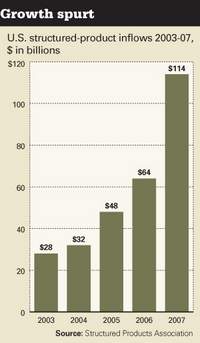
The use of structured products has grown rapidly, with their total value more than quadrupling, from $28 billion in 2003 to $114 billion in 2007. About half of that $114 billion was sold to individuals by brokers or financial advisers. The number of notes is growing as well. In May, 2007, there were 437 structured products aimed at individual investors, valued at $2.4 billion; in May, 2008, there were 634, with a total value of $4.2 billion, according to data from StructuredRetailProducts.com.
While it's smart to be wary when pitched complex products, it's easy to see why more investors are intrigued. The notes can be designed for almost any goal, from protecting retirement dollars to aiming aggressively at high returns. "There's a seemingly endless amount of them out there," says adviser Brent McQuiston of Scottsdale-based Wealth Trust-Arizona.
Principal protection notes, geared to insure against market losses, are popular now. They let you participate in some of the upside of a stock index, and if the index drops, you don't take a loss. "Investors don't want to lose money, even if it means giving up some gains," says Neel Tiku, a financial planner at Peak Financial Management in Waltham, Mass.
Notes that offer double-digit yields, but come with far higher risks than typical fixed-income products, are also strong sellers.
For the full article in Business Week, click here.
Subscribe to:
Posts (Atom)