By Saijel Kishan
May 2, 2008
Commodity assets under management expanded by a record in the first quarter to $225 billion as prices for energy, metals and agriculture increased to all-time highs, Barclays Capital said.
Assets climbed by $28 billion, almost three times the gain in the same year-earlier period, the bank said in a report e-mailed late yesterday. Rising prices accounted for about half of the growth, it said. The figures exclude hedge funds' direct holdings in futures markets.
``The investment community as a whole is still underinvested in commodities,'' Kevin Norrish, analyst at Barclays Capital, the securities unit of London-based Barclays Plc, said by telephone.
Pension funds and other money mangers boosted holdings of commodities as the asset class outperformed stocks and bonds, and the dollar fell to a record low against the euro. Prices for oil, wheat and gold climbed to all-time highs this year.
The Astmax Commodity Index, the best-performing commodity index of those tracked by Bloomberg, climbed 14 percent in the first quarter, while the Standard & Poor's 500 Index of stocks declined 9.9 percent. U.S. Treasuries have returned investors 2.6 percent in the period, according to Merrill Lynch & Co. indexes.
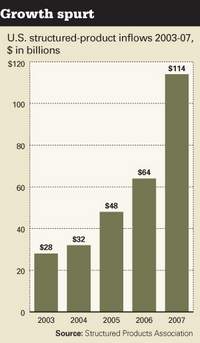
Investments in funds tracking commodity indexes rose by $14 billion to $139 billion, while holdings in exchange-traded commodity products grew by almost $7 billion to $45.8 billion, Barclays said. . . . More than $4 billion was invested in so-called structured products linked to commodities, the bank said. Such products are tailor-made securities designed for clients when standardized contracts and indexes won't fulfill their needs, or when investors are restricted from using derivatives to gain access to a particular asset class.
For access to the full story on Bloomberg News, click here.
SPA-2008


Friday, May 2, 2008


Thursday, May 1, 2008
Barclays' Philippe El-Asmar on ETNs (IndexUniverse.com)
Straight From The Source:
Written by Heather Bell
Tuesday, 29 April 2008 11:19
Index Universe (IU): Why did Barclays Capital create its family of ETNs?
Philippe El-Asmar (El-Asmar): We created the iPath family to complement the existing iShares ETFs that Barclays Global Investors were offering. They are meant to give access to more difficult-to-reach asset classes.
IU: How does a decision get made as to whether an index will be used to underlie an ETF or an ETN?
El-Asmar: It's a very close collaboration and partnership that we have between BGI and Barclays Capital, and we regularly meet to discuss the plans for the next three-to-six months, or the next year or possibly even longer-term plans. The first priority is to basically give investors choices and respond to the needs of clients. The primary driver for us in launching a product is not our agenda, but more the response to feedback we've collected from clients over time. We're pretty agnostic with regard to the choice between one instrument and the other. Often there is value in each of the instruments depending on what the investor really wants, and in the past, we have offered an ETN and an ETF tracking the same underlying index. Generally speaking, we collaboratively try to fill the gaps using ETNs as a means to access more difficult-to-reach markets and ETFs as the traditional vehicle.
IU: Beyond the collaboration with BGI, what is driving the expansion of the iPath ETN family?
El-Asmar: The primary driver here is providing the clients with what they want and giving them choices. We didn't try to launch hundreds of ETNs and just hope that some will succeed. We've always been very cautious about providing investment products that we think will see long-term demand from investors. Commodities, for example, are in everybody's mind as an established asset class, but four years ago. very few people had exposure to commodities. We're not saying when we launch a commodity ETN that right now is the right time to invest in commodities. What we're saying is if you decided to invest in commodities, this is the best way you can access the data class-a very simple, transparent, cost-efficient way, with the convenience of trading on an exchange.
IU: Barclays Bank was the first in the ETN space. Do you see a lot of new players coming into the field beyond the ones that are currently there now?
El-Asmar: Yes; we know of at least two other banks that are working very seriously on their exchange-traded note platforms. We've had, since we entered the market in 2006, about six or seven separate issuers create ETNs themselves as well.
IU: Are there high barriers to entry to the market? Barclays was kind of out there by itself for a while.
El-Asmar: I think it does take a lot of time and energy and effort to create the architecture around an exchanged-traded note program, and often the first is the most difficult to do. So yes, it does take time for other issuers to catch up, but relatively speaking, we were in the market uncontested for about a year, and that might have been a little bit longer than what we anticipated. Typically speaking, it would have taken maybe six months for the competition to copy us.
For the full interview on IndexUniverse.com, click here.
Written by Heather Bell
Tuesday, 29 April 2008 11:19
Index Universe (IU): Why did Barclays Capital create its family of ETNs?
Philippe El-Asmar (El-Asmar): We created the iPath family to complement the existing iShares ETFs that Barclays Global Investors were offering. They are meant to give access to more difficult-to-reach asset classes.
IU: How does a decision get made as to whether an index will be used to underlie an ETF or an ETN?
El-Asmar: It's a very close collaboration and partnership that we have between BGI and Barclays Capital, and we regularly meet to discuss the plans for the next three-to-six months, or the next year or possibly even longer-term plans. The first priority is to basically give investors choices and respond to the needs of clients. The primary driver for us in launching a product is not our agenda, but more the response to feedback we've collected from clients over time. We're pretty agnostic with regard to the choice between one instrument and the other. Often there is value in each of the instruments depending on what the investor really wants, and in the past, we have offered an ETN and an ETF tracking the same underlying index. Generally speaking, we collaboratively try to fill the gaps using ETNs as a means to access more difficult-to-reach markets and ETFs as the traditional vehicle.
IU: Beyond the collaboration with BGI, what is driving the expansion of the iPath ETN family?
El-Asmar: The primary driver here is providing the clients with what they want and giving them choices. We didn't try to launch hundreds of ETNs and just hope that some will succeed. We've always been very cautious about providing investment products that we think will see long-term demand from investors. Commodities, for example, are in everybody's mind as an established asset class, but four years ago. very few people had exposure to commodities. We're not saying when we launch a commodity ETN that right now is the right time to invest in commodities. What we're saying is if you decided to invest in commodities, this is the best way you can access the data class-a very simple, transparent, cost-efficient way, with the convenience of trading on an exchange.
IU: Barclays Bank was the first in the ETN space. Do you see a lot of new players coming into the field beyond the ones that are currently there now?
El-Asmar: Yes; we know of at least two other banks that are working very seriously on their exchange-traded note platforms. We've had, since we entered the market in 2006, about six or seven separate issuers create ETNs themselves as well.
IU: Are there high barriers to entry to the market? Barclays was kind of out there by itself for a while.
El-Asmar: I think it does take a lot of time and energy and effort to create the architecture around an exchanged-traded note program, and often the first is the most difficult to do. So yes, it does take time for other issuers to catch up, but relatively speaking, we were in the market uncontested for about a year, and that might have been a little bit longer than what we anticipated. Typically speaking, it would have taken maybe six months for the competition to copy us.
For the full interview on IndexUniverse.com, click here.
Sunday, April 27, 2008
Morgan Stanley Cuts 34 of 40 SP Pros: Overreaction?
Last week, US structured products professionals were stunned by the news that Morgan Stanley let go 34 of its 40 structured products personnel on Tuesday (April 22).
While The Street has grown accustomed to news of cuts in profitable structured products groups of the "lower" 5% to 10% of personnel (Lehman, Citigroup for example) given the deep pain most firms are experiencing as a result of proprietary subprime losses. But the Morgan Stanley news has profound reverberations and defies conventional thinking.
At first blush, it appears that the terminations involve mostly "inside" marketers -- those responsible for sales of structured investments to the former Dean Witter and Morgan Stanley private banking distribution channels. The surviving six appear to be third-party marketers, those responsible for developing new lines of business through independent RIA and regional BDs (a highly coveted group, that represents about 40% of structured products sales).
Bottom line: Morgan Stanley appears to be making a strategic decision that, internally, structured products can be still be sold effectively without the intermediation of 34 internal marketers -- but, as is often said, structured products are not bought; they are sold. The Morgan Stanley experiment will be closely watched by others with internal distribution to see if this is an astute cost-cutting move . . . or a misplaced over-reaction occasioned by its ongoing subprime woes.
While The Street has grown accustomed to news of cuts in profitable structured products groups of the "lower" 5% to 10% of personnel (Lehman, Citigroup for example) given the deep pain most firms are experiencing as a result of proprietary subprime losses. But the Morgan Stanley news has profound reverberations and defies conventional thinking.
At first blush, it appears that the terminations involve mostly "inside" marketers -- those responsible for sales of structured investments to the former Dean Witter and Morgan Stanley private banking distribution channels. The surviving six appear to be third-party marketers, those responsible for developing new lines of business through independent RIA and regional BDs (a highly coveted group, that represents about 40% of structured products sales).
Bottom line: Morgan Stanley appears to be making a strategic decision that, internally, structured products can be still be sold effectively without the intermediation of 34 internal marketers -- but, as is often said, structured products are not bought; they are sold. The Morgan Stanley experiment will be closely watched by others with internal distribution to see if this is an astute cost-cutting move . . . or a misplaced over-reaction occasioned by its ongoing subprime woes.
USA Today: "Gimmicks Not Good Investments"
Exchange-traded notes: Don't even think about it
by John Waggoner, USA Today
April 27, 2008
Wall Street has many useful maxims, such as "Don't catch a falling knife," "Don't fight the Fed," and "Count the silverware after the CEO visits." Now, it's time to add another: Beware of complex investments with cute names.
 Wall Street has created a new generation of investments, called exchange-traded notes, or ETNs, which go by names such as BOXES, LUNARS, MITTS, PERQS and PISTONS. Except for the plainest of plain-vanilla ETNs, you should handle them like XPLOSIVs.
ETNs are a relatively new development. The value of an ETN depends on the movements of a stock index or, sometimes, even an individual stock. And, as you might have guessed from their name, ETNs trade on the stock exchange — typically, the American Stock Exchange.
In those respects, ETNs are fairly similar to their cousins, exchange-traded funds. But ETNs have a big difference: They are debt securities, not equity securities. When you buy an exchange-traded fund, you're buying a slice of a diversified portfolio of stocks. When you buy an ETN, you're buying a promise — specifically, the promise that the issuer will pay the note according to the terms laid out in the ETN's prospectus.
Those terms can be simple or complex. Let's start with a simple one: The iPath Dow Jones-AIG Commodity Index Total Return ETN, which trades under the ticker DJP. The note pays no interest, but the issuer, Barclays, will pay a cash payment at maturity equal to the gain on the Dow Jones-AIG Commodity Index total return. The maturity date is June 12, 2036.
You can sell the note before it matures, at which point you'll get whatever other investors feel it's worth. As of Thursday, its value was up 9.2% in 2008.
Jeffrey Ptak, Morningstar's director of ETF research, likes DJP because it does a better job tracking the index than an ETF can. A fund has to use futures and other investments to track the commodity index. Because a note isn't a fund, it doesn't have to line up investments that mirror the index. All it needs is the promise to pay according to the index's movements.
As a way to get broad exposure to commodities, Ptak says, DJP isn't bad. The index the note uses is well-diversified, and the overall cost to investors is decent. "I think it could be cheaper, but it's hardly expensive," he says.
The more complex ETNs can be complex indeed. Consider the Capital Protected Notes based on the Morgan Stanley Capital International Europe, Australasia and Far East stock index. The notes trade under the ticker EEC.
Here's the deal: Like DJP, EEC pays no interest over its term, which began May 23, 2005. Each note was issued at $10. When the note matures on Dec. 30, 2008, the underwriters will pay note holders $10 per note. This is where the "capital protected" part comes in: If you hang onto the note, you'll get your money back.
The trade-off is that you give up some of the potential gains from the EAFE index in return for the capital protection. In this case, you give up quite a bit. The note takes the index level at four different dates and averages them together. The percentage difference between the average of the four dates and the starting date is your return.
In a rising market, your gains from this ETN will be considerably lower than if you had simply bought an ETF that tracked the index. (The average will be smaller than the difference between the start and end point.) Given this snakebit market, you might think that the smaller returns are a good trade for preserving your principal. Should the market soar, however, you'll probably feel considerable buyer's remorse.
ETNs have a few other considerations:
• Counterparty risk. As we mentioned earlier, an ETN is backed by a promise. Although the issuers of these notes are large, financially strong firms, you should be aware that, at least until recently, everyone thought that investment bank Bear Stearns was financially strong, too.
• Tax risk. The IRS is reviewing the tax treatment of ETNs and may consider taxing ETN profits as interest, rather than at lower capital gains rates. Already, the IRS has ruled that single-currency ETNs will be taxed at ordinary income rates.
• Commissions and expenses. ETNs are generally cheaper than mutual funds, but you'll have to pay a commission. Your broker may tell you that you can buy an ETN on its initial offering with no commission, but that's not entirely true: The commission is part of the initial offering price.
Generally speaking, the more complex the deal, the more you should avoid it. "The structured notes are getting gimmicky," says Harold Evensky, a financial planner in Coral Gables, Fla. Gimmicks are not good investments.
Although you may well find notes that suit your overall investment outlook, bear in mind that the firms that offer ETNs aren't looking to lose money on the deal. It's a bit like betting against the house at a casino. So stick with simple ETNs, or stick with ETFs. The top-performing ETFs are in the chart.
John Waggoner is a personal finance columnist for USA TODAY. His e-mail is jwaggoner@usatoday.com. The source for this article can be found by clicking here.
by John Waggoner, USA Today
April 27, 2008
Wall Street has many useful maxims, such as "Don't catch a falling knife," "Don't fight the Fed," and "Count the silverware after the CEO visits." Now, it's time to add another: Beware of complex investments with cute names.
 Wall Street has created a new generation of investments, called exchange-traded notes, or ETNs, which go by names such as BOXES, LUNARS, MITTS, PERQS and PISTONS. Except for the plainest of plain-vanilla ETNs, you should handle them like XPLOSIVs.
ETNs are a relatively new development. The value of an ETN depends on the movements of a stock index or, sometimes, even an individual stock. And, as you might have guessed from their name, ETNs trade on the stock exchange — typically, the American Stock Exchange.
In those respects, ETNs are fairly similar to their cousins, exchange-traded funds. But ETNs have a big difference: They are debt securities, not equity securities. When you buy an exchange-traded fund, you're buying a slice of a diversified portfolio of stocks. When you buy an ETN, you're buying a promise — specifically, the promise that the issuer will pay the note according to the terms laid out in the ETN's prospectus.
Those terms can be simple or complex. Let's start with a simple one: The iPath Dow Jones-AIG Commodity Index Total Return ETN, which trades under the ticker DJP. The note pays no interest, but the issuer, Barclays, will pay a cash payment at maturity equal to the gain on the Dow Jones-AIG Commodity Index total return. The maturity date is June 12, 2036.
You can sell the note before it matures, at which point you'll get whatever other investors feel it's worth. As of Thursday, its value was up 9.2% in 2008.
Jeffrey Ptak, Morningstar's director of ETF research, likes DJP because it does a better job tracking the index than an ETF can. A fund has to use futures and other investments to track the commodity index. Because a note isn't a fund, it doesn't have to line up investments that mirror the index. All it needs is the promise to pay according to the index's movements.
As a way to get broad exposure to commodities, Ptak says, DJP isn't bad. The index the note uses is well-diversified, and the overall cost to investors is decent. "I think it could be cheaper, but it's hardly expensive," he says.
The more complex ETNs can be complex indeed. Consider the Capital Protected Notes based on the Morgan Stanley Capital International Europe, Australasia and Far East stock index. The notes trade under the ticker EEC.
Here's the deal: Like DJP, EEC pays no interest over its term, which began May 23, 2005. Each note was issued at $10. When the note matures on Dec. 30, 2008, the underwriters will pay note holders $10 per note. This is where the "capital protected" part comes in: If you hang onto the note, you'll get your money back.
The trade-off is that you give up some of the potential gains from the EAFE index in return for the capital protection. In this case, you give up quite a bit. The note takes the index level at four different dates and averages them together. The percentage difference between the average of the four dates and the starting date is your return.
In a rising market, your gains from this ETN will be considerably lower than if you had simply bought an ETF that tracked the index. (The average will be smaller than the difference between the start and end point.) Given this snakebit market, you might think that the smaller returns are a good trade for preserving your principal. Should the market soar, however, you'll probably feel considerable buyer's remorse.
ETNs have a few other considerations:
• Counterparty risk. As we mentioned earlier, an ETN is backed by a promise. Although the issuers of these notes are large, financially strong firms, you should be aware that, at least until recently, everyone thought that investment bank Bear Stearns was financially strong, too.
• Tax risk. The IRS is reviewing the tax treatment of ETNs and may consider taxing ETN profits as interest, rather than at lower capital gains rates. Already, the IRS has ruled that single-currency ETNs will be taxed at ordinary income rates.
• Commissions and expenses. ETNs are generally cheaper than mutual funds, but you'll have to pay a commission. Your broker may tell you that you can buy an ETN on its initial offering with no commission, but that's not entirely true: The commission is part of the initial offering price.
Generally speaking, the more complex the deal, the more you should avoid it. "The structured notes are getting gimmicky," says Harold Evensky, a financial planner in Coral Gables, Fla. Gimmicks are not good investments.
Although you may well find notes that suit your overall investment outlook, bear in mind that the firms that offer ETNs aren't looking to lose money on the deal. It's a bit like betting against the house at a casino. So stick with simple ETNs, or stick with ETFs. The top-performing ETFs are in the chart.
John Waggoner is a personal finance columnist for USA TODAY. His e-mail is jwaggoner@usatoday.com. The source for this article can be found by clicking here.
Tuesday, April 22, 2008
Tim Andrews on the Structured Funds' Landscape (Euromoney)
By Timothy Andrews, Scotia Capital
Special to Euromoney, Published April 2008
The structured fund derivatives landscape has evolved substantially in recent years with an estimated current notional size of over US$700bn globally. An increasing number of treasurers, portfolio managers and other investors are seeking increased returns through exposure to alternative assets via a variety of fund-linked derivatives products. Common fund-linked derivatives products include various options, total return swaps, portable alpha strategies and structured notes. These products can be linked to single hedge funds, fund of funds, fund indices or a basket of the same (each a ‘reference fund asset’).
1. Black-Scholes call options
In the basic form of a ‘plain vanilla’ or ‘black-scholes’ call option referencing a reference fund asset, an investor purchases an over-the-counter call option by paying a premium amount to the financial institution (the ‘bank’) on the trade date. The strike price of the call option is typically fixed either ‘at’ or ‘out of the money’ at inception. The call option is structured to be ‘European style’ which means the investor can exercise the option only at maturity. The cash settlement amount, if any, owed by the bank to the investor at maturity is equal to the amount by which the net asset value of the reference fund asset exceeds the strike price of the call option. In some cases, the call option may also be physically settled where the investor would pay the strike price to the bank and receive physical delivery of the reference fund asset. To the extent that the net asset value of the reference fund asset was less than the strike price, the option would expire worthless and the investor would lose the premium paid at inception.
2. Accreting strike call option structures
The accreting strike call option (‘ASCO’) is among the most widely used fund-linked derivatives today. Take the example of an investment manager looking to launch a leveraged fund (the ‘leveraged fund’) to raise additional capital. Assume the leveraged fund offers investors US$3 of exposure to the underlying reference fund assets for every US$1 invested, or ‘three times’ leverage. Suppose the leveraged fund has US$100m in new subscriptions.
Under an ASCO structure, the leveraged fund would purchase a cash settled over-the-counter call option from the bank for premium amount equal to the US$100m in subscription monies and receive a notional exposure to a basket of reference fund assets equal to US$300m, equating to three times leverage. The bank would most likely hedge its position on a ‘delta one’ basis by purchasing US$300m of the reference fund assets, but could also hedge via another derivative.
For Tim Andrews' full article on the structured fund landscape, click here.
Special to Euromoney, Published April 2008
The structured fund derivatives landscape has evolved substantially in recent years with an estimated current notional size of over US$700bn globally. An increasing number of treasurers, portfolio managers and other investors are seeking increased returns through exposure to alternative assets via a variety of fund-linked derivatives products. Common fund-linked derivatives products include various options, total return swaps, portable alpha strategies and structured notes. These products can be linked to single hedge funds, fund of funds, fund indices or a basket of the same (each a ‘reference fund asset’).
1. Black-Scholes call options
In the basic form of a ‘plain vanilla’ or ‘black-scholes’ call option referencing a reference fund asset, an investor purchases an over-the-counter call option by paying a premium amount to the financial institution (the ‘bank’) on the trade date. The strike price of the call option is typically fixed either ‘at’ or ‘out of the money’ at inception. The call option is structured to be ‘European style’ which means the investor can exercise the option only at maturity. The cash settlement amount, if any, owed by the bank to the investor at maturity is equal to the amount by which the net asset value of the reference fund asset exceeds the strike price of the call option. In some cases, the call option may also be physically settled where the investor would pay the strike price to the bank and receive physical delivery of the reference fund asset. To the extent that the net asset value of the reference fund asset was less than the strike price, the option would expire worthless and the investor would lose the premium paid at inception.
2. Accreting strike call option structures
The accreting strike call option (‘ASCO’) is among the most widely used fund-linked derivatives today. Take the example of an investment manager looking to launch a leveraged fund (the ‘leveraged fund’) to raise additional capital. Assume the leveraged fund offers investors US$3 of exposure to the underlying reference fund assets for every US$1 invested, or ‘three times’ leverage. Suppose the leveraged fund has US$100m in new subscriptions.
Under an ASCO structure, the leveraged fund would purchase a cash settled over-the-counter call option from the bank for premium amount equal to the US$100m in subscription monies and receive a notional exposure to a basket of reference fund assets equal to US$300m, equating to three times leverage. The bank would most likely hedge its position on a ‘delta one’ basis by purchasing US$300m of the reference fund assets, but could also hedge via another derivative.
For Tim Andrews' full article on the structured fund landscape, click here.
Subscribe to:
Posts (Atom)