SPA-2008

Structured Products News from SPA

Monday, April 21, 2008

Andrew Scherr on the Agony and Ecstasy of Structured Products (Euromoney)


by Andrew Scherr
Special to Euromoney Publications
with the Structured Products Association

“Financial weapons of mass destruction ” in the eyes of Warren Buffett, feared by government regulators, banned from the general public, and lampooned by politicians, academics and media, Structured Products are a market under assault. Even the name, “Structured Products” connotes something unnatural concocted in Dr. Frankenstein’s laboratory. Academics and populists have lined up pointing at fees, disclosures, return characteristics, and relative performance. Structured Products are held responsible for market dislocations, bank failings and all forms of economic turmoil including the current credit crises.

This fear and finger pointing is a natural response to the sweeping growth of the sometimes complex products that regulators, the media and some academics may not fully understand. When we see major hedge funds, banks and other participants disappear or become impaired overnight, it is enough to give even the most seasoned market participant pause and any segment of the market we do not fully understand becomes suspect.

And the U.S. Structured Product market has certainly blossomed. While already fundamental to European Investing, Structured Products have stormed Asia and are just taking a foothold in the U.S. where the market has been growing consistently at 60 to 80% per annum. Structured Products became deeply rooted in Europe during Unification as retail investors sought yield enhancement to counter falling bank interest rates. Next came Asia, as institutions sought principal protection on new asset classes. Canada and Latin America quickly followed. The U.S. however has been the slowest to adopt Structured Products in much the same way as it was late on the adoption of wireless telephony. With a well established infrastructure in place, it seemed less urgent to adopt the newest technology.

Furthermore, for Americans, Structured Products do not seem to make sense in the context of modern portfolio theory. To the extent that portfolios are allocated across markets based on their beta exposures, there is little room or understanding for an alpha exposure. After all, alpha is a zero sum game – or at least that is what the academics have said – and every positive alpha is offset by a negative alpha elsewhere. This is where the pendulum of active versus passive portfolios has again swung. Simply put, if you know a particular investment will pay off then go invest – otherwise, diversify.

And yet, despite all of the foregoing . . . the U.S. Structured Products industry is . . . well, exploding.

(Full article can be found on the StructuredProducts.org website by clicking here.)

Some RIAs See Structured Products as Key Strategy (Investment News)

Embracing strategies based on derivatives
Some advisers turn to structured products for risk management

By Jeff Benjamin
Investment News, April 21, 2008

A small but growing number of advisers are turning to derivatives-based strategies to help manage increased levels of market risk.

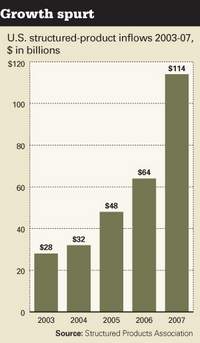
The structured-products industry, which experienced a 78% increase in sales last year to a record $114 billion, is uniquely poised for a growth surge, according to industry observers.

In the most general sense, structured products, which are created and backed by investment banks, involve the use of derivatives to meet specific investment objectives. Primary distinctions between structured products and mutual funds or exchange traded funds include a defined maturity date, a principal-protection option and the ability to be customized to a specific investor's view of the market.

The idea behind the strategy is to protect portfolios from a declining market.

"We're taking risk off the table by replacing equity exposure with principal protection and buffered notes" that are designed to limit downside risk, said Frederick Wright, chief investment officer at Smith & Howard Wealth Management LLC in Atlanta.

Mr. Wright, whose firm oversees $250 million in assets, was first introduced to structured products in 1999 but didn't get seriously involved until last year.

"It's a great risk-management tool, and it's an opportunity to be out on the leading edge as an adviser," he said.

Some advisers remain skeptical about the use of structured products as a risk-management tool.

For the full article in Investment News, click here.

SPA-2008 Day 2: Future Challenges, Opportunities (Prospect News Special Coverage)

By Aaron Hochman-Zimmerman
Prospect News Special Coverage

Structured Products Association Annual Conference 2008
For full coverage of SPA-2008 from Prospect News:
Click here for Day One (Wednesday, April 9, 2008)
Click here for Day Two (Thursday, April 10, 2008)

New York, April 10 – Moving into 2008 structured products issuers and dealers will have to ensure that clients are kept informed of what structured products can offer as well as deal with attacks from competitors, a panel said at the second day of the Structured Products Association summit.

Externally, the sector has come under fire by proponents of mutual funds who have put up a "very aggressive lobbying position" against exchange-traded notes (ETNs), which are not required to distribute income annually, said Adrienne Browning of Deutsche Bank.

Mutual funds are required to distribute earnings annually and are taxed accordingly. "In Congress right now, the fight is going on," said Ray Shirazi of Cadwalader, Wickersham & Taft LLP.

The Internal Revenue Service and the Treasury Department are currently accepting comments on ETNs and pre-paid forward contracts, Browning said.

Meanwhile, Rep. Richard Neal, D-Mass., who is "in the mutual fund district," according to Browning, has already introduced and is pushing HR 4912, which would require all ETNs to be taxed similarly to a mutual fund. "So that’s a big heads-up," Browning added.

‘Innumerable combinations’

Structured products must also contend with a supply chain that is unaware of the possibilities the products may offer or the pace of the new issue market. "Structured products really has arrived … Structured products has beaten closed-end funds in terms of size and issuance," said Eric Miller of HSBC.

"Investors do have a very good reason to look into structured products," he said, whether they want safety in terms of protection or FDIC insurance.

"As the baby boom generation ages, they will become more beta-phobic," said William Bamber of Bear Stearns, and a structured product could be engineered to suit that specific need.

"There’s almost innumerable combinations and permutations that we can dream up," he said.

Still, "education is what we all need to focus on before we can move to the next step," said Alexandre Ecot of Societe Generale.

Investors are becoming more sophisticated, Miller said.

Recently, "for the first time someone asked me what the CDS [credit default swap] is" for a structured product issuer, he said.

Many feel that "the Street has a better idea than the rating agencies" of an issuer’s credit, he said.

Favoring the simple

The panelists agreed that education is important, but creating products that are simple and transparent is important as well, said Stephanie Bosio of Calyon Securities. "Simple is beautiful," she said. Investors "tend to go for products that are all-in-one."

Success depends on innovation from issuer to wholesalers, brokers and investment manager, "the way it is in Europe and Asia. I actually believe there is not enough competition," she said, as it fosters innovation in a market that is far from saturated. "It all depends on us to make this U.S. market a big one," she added.

SPA president Keith Styrcula described the current credit crunch as a watershed event which may force investors to look away from traditional securities to more adaptive and flexible instruments going forward.

"We really have not come close to tapping the investor pool in this sort of market," HSBC’s Miller said.

SPA-2008 LeadingEdge Award Winners (Prospect News Special Coverage)

Improve education, standardize nomenclature, say investment advisors as issuer risks gain prominence

STRUCTURED PRODUCTS ASSOCIATION 2008 CONFERENCE
By Kenneth Lim
Prospect News, April 9, 2008

Issuers need to improve education resources, standardize nomenclature and address concerns about credit risk, a panel of investment advisors said at the fourth annual Structured Products Association Conference in New York on Wednesday, April 9.

Steve Braverman of MyCFO Harris Bank, Frederick Wright of Smith & Howard Wealth management, Tom Balcom of Financial Planning Association, Tony Proctor of Proctor Financial and J. Scott Miller of Blue Bell Private Wealth Management spoke to conference attendees shortly after winning in the first SPA LeadingEdge Advisors Awards.

Echoing sentiments mentioned by several other speakers at the conference, the advisors mentioned education as a key priority for issuers in reaching out to the advisor community. Many advisors remain unaware of structured products, the panelists said.

Many investors are also unfamiliar with structured products. For example, a common misconception is that a structured product is a win-lose battle between buyer and issuer, where a buyer’s loss is an issuer’s gain, Wright and Proctor said.

“I think there’s a need to address that skewed perspective,” said Proctor, who quipped that less education would actually keep his competitors away, on the sidelines of the conference. “The issuer is not taking a position . . . it’s not like in Vegas, where the house always wins. They [issuers] need to explain that we are simply providing a transaction.”

But getting issuers involved in education can be tricky, Miller said.

“Most of the education is done by someone who has something to sell,” he said. “And RIAs [registered investment advisors] are a special group of people, they all think they are smarter than everyone else.”

‘Too cute by half’

One way to ease the learning process is to standardize and simplify nomenclature. “Keep it simple,” Balcom said.

“Some of these are too cute by half,” Proctor said of the product names. “We are coming up with all these acronyms.”

Proctor added later: “One firm may call the buffered securities BUYS, another may call it something completely different. It makes our jobs so much more difficult…It’s not like just because you call it BUYS investors are going to want to buy it.”

The panelists nevertheless praised issuers for stepping up education efforts and helping to raise awareness of structured products.

“Now when I tell people about structured products, people are not saying that I have three heads,” he said.

Marketing material improves

Proctor also noted the growth in more-accessible marketing material.

“I think the issuers are creating client-friendly brochures more than they used to,” he told Prospect News.

Bear raises credit concerns

Issuer risk has reemerged as a key concern especially after Bear Stearns almost collapsed, the buysiders said.

“The biggest fear that I have . . . is the credit risk,” Miller said. “Thank goodness we have always been concerned about credit because we did own Bear.”

Miller said he was going to Hawaii when news broke that Bear Stearns credit was in trouble, and almost canceled his trip. But his clients’ credit exposure had been diversified beyond Bear Stearns and the bank was eventually bailed out, so Miller stayed in Hawaii.

But he said the important lesson for advisors is to spread their eggs. “There is no worse feeling when you are trying to hedge risks for your client,” he said.

For full coverage of SPA-2008 from Prospect News:
Click here for Day One (Wednesday, April 9, 2008)
Click here for Day Two (Thursday, April 10, 2008)

Sunday, April 20, 2008

SPA-2008 - Distributors: SPs Market 'Vibrant, Innovative' (Prospect News)

Structured products distributors see ETNs and Structured Products ‘vibrant’ despite competition, look for more innovation

By Aaron Hochman-Zimmerman
Prospect News Special Coverage
Structured Products Association SPA-2008 Conference

New York, April 9, 2008 – Structured products issues have seen competition from other types of securities as well as within structured products itself, a panel said at the 2008 Structured Products Association Summit on Wednesday, April 9.

Exchange-traded notes (ETNs) have come under fire for what are seen by some as unfair tax advantages, but Mike Forstl of Nuveen Investments said he feels internally “fully supported” to encourage the sale of ETNs.

“The ETN market is something we do see as a growing vibrant area of focus,” said Som Seif of Claymore Investments in Canada.

Currently, Canada and particularly Europe have allowed more innovative products to develop. “I would like to see some of that stuff in North America,” he said specifically about the European products.

Despite rising innovation, the market is still generally driven by the more traditional reverse convertible, said Guy Gregoire of Pershing LLC.

Also, many distributors of structured products work in open architecture or near-open architecture environments in which “there is no proprietary product,” said Gregoire. The system allows the freedom to select the product which will fill a gap in an investor’s portfolio, rather than favoring one over the other, he said.

The flexibility of structured products is, at times, undercut by wholesalers’ reluctance to change, Seif said.

The future of structured products is tied tightly to education and strong relationships between wholesalers and distributors, he added.

Structured Products on . . . the Job Market? (Business Week)

A New Way To Play The Job Market -- But Will The CME's New Futures Product, Based On Nonfarm Payrolls Data, Allow Investors To Hedge Against Stock, Bond, Or Currency Market Jitters?

You may already feel your own job prospects are a toss of the dice. Soon, though, you'll be able to bet on the state of the whole U.S. job market.

Starting in April, average investors can express their views about where the economy stands through a new futures product based on one of the most closely watched economic indicators: the nonfarm payrolls data contained in the Labor Dept.'s monthly employment report. It is the first of several financial derivatives based on economic indicators the Chicago Mercantile Exchange plans to launch.

The exchange says the payroll futures will let investors hedge against stock, bond, or currency market jitters amid worries about an economic downturn.

Many traders and analysts, however, are skeptical the new product will be very popular beyond pure speculators.The nonfarm payrolls number instantly joins such unsexy futures products as butter, soybeans, and random length lumber. Released by the Bureau of Labor Statistics [BLS] the first Friday of every month, the payroll number measures the total number of U.S. workers, except those in government, farms, some nonprofits, and working for themselves at home. As such, it is seen by economists as a timely, reliable indicator of the health of the broad U.S. economy. When released by the BLS, the monthly payrolls figure often moves the stock market, especially if it offers up a surprise.

Future ChallengesFutures traders, of course, already bet on all sorts of predictable events: inches of snowfall, frost days, hurricanes. The concept of trading economic indicators is not new, either. Back in 2002, options based on the BLS jobs data were first traded in auctions hosted by Deutsche Bank (DB) and Goldman Sachs (GS). Today, a few economic and housing derivatives are traded on over-the-counter markets among banks and funds. But the price of those products can be skewed by things such as a participant's credit position and the limited number of possible buyers.

"What happens [with the OTC market] is that it's bilateral, and when credit dries up and you have less counterparties, the market becomes illiquid and less efficient," says Felix Carabello, director of alternative investment products at CME Group (CME), which is the newly merged Chicago Mercantile Exchange and Chicago Board of Trade.

Some argue the opaque and concentrated nature of the over-the-counter market for many derivatives products is partly responsible for the plunging values of many housing-related securities held by banks.

But there are other challenges for an economics-oriented futures product. Most obviously, there is no tangible underlying asset for the contract, like there is for gold or corn. A company that uses the futures contract's underlying product -- say, oil -- could take delivery of the commodity, though it rarely happens. No one produces or consumes the nonfarm payroll number. Hence, there is no steady demand from businesses who must buy the futures in order to keep their operations running risk-free.

(To read the complete article from BusinessWeek.com, click here.)

Thursday, April 17, 2008

Structured Commodities Boom: Buyer Beware (Reuters)

Tue Apr 8, 2008 7:40pm BST
By Barani Krishnan

NEW YORK, April 8 (Reuters) - Investors are pouring money into structured investment products linked to booming commodities like oil, gold and grains, drawn to features that protect capital from the volatility common in these markets.

But the global credit crunch means the safety of capital-protected products relies upon the credit-worthiness of the issuer. That could be a concern after last month's collapse of Bear Stearns (BSC.N: Quote, Profile, Research), once the No. 5 U.S. investment bank.

Also, some financial experts caution that the risk-prevention feature in such structured products will limit investors' gains if the bull market in commodities continues.

"Managing the credit risk in the structured products environment is critical, certainly in this environment," said David Krein, president at DTB Capital, a New York firm that specializes in putting together such products for clients.

The global financial crisis linked to defaults in U.S. subprime loans already has cost banks worldwide nearly $400 billion in write-offs. Analysts see no clear end in sight to the problem, even after casualties like Bear.

"To see Bear die wasn't surprising as almost every global financial stress kills off one big bank," said Richard Kang, a Toronto-based independent risk consultant for fund management companies. "But if another big bank goes, then the market for Wall Street-backed structured products might take a whack."

The Structured Products Association, an industry group in New York, says there is about $114 billion invested in the products now, up from just around $28 billion in 2003.

Commodity-related products account for about $55 billion of the market, says Barclays Capital, the biggest issuer of such products in the United States. The rest are linked to stocks, bonds and other securities.

For the full article by Barani Krishnan, click here.

ETNs' Steady Growth Pose Threat to ETFs, MFs (Investment News)

By David Hoffman, Investment News, April 14, 2008

As more companies begin to offer exchange traded notes, it's beginning to look like the small but growing ETN universe could one day be a competitor to mutual funds and exchange traded funds.

"ETNs are definitely a threat," said Jeff Ptak, director of exchange traded securities analysis at Morningstar Inc. of Chicago.

That's a problem for traditional asset managers because unless they partner with an investment bank, they may not be able to offer ETNs, which are actually debt instruments linked to an index.

Consequently, it's easier for an investment bank to bring an ETN to market than it is for a traditional asset manager.

A look at some of the companies offering ETNs illustrates the point.

UBS Investment Bank of New York, a unit of Zurich, Switzerland-based UBS AG, launched eight ETNs earlier this month. The UBS E-TRACS ETNs are the first of many the company hopes to launch before the end of the year, said Kurt Nelson, a managing director and head of ETNs at UBS.

Last month, Morgan Stanley of New York listed its first ETNs, the Market Vectors-Chinese Renminbi/ USD ETN and the Market Vectors-Renminbi/USD ETN.

Lehman Brothers Holdings Inc. of New York stirred things up in February when it launched Opta, an ETN platform, and three Opta exchange traded notes. The launch of Lehman's ETN platform followed the launch of the Elements ETN platform last August.

For David Hoffman's full article, click here.

SPA-2008: ETNs Elude Tax Strictures (Investment News)

By Jeff Benjamin April 10, 2008

Despite the best efforts of the Investment Company Institute to convince lawmakers to strip away the tax advantages of exchange traded notes, the structured products industry isn’t losing any sleep over the issue ... yet.

“You are not likely to see anything happen on this in 2008,” said Thomas Humphreys, a partner at Morrison & Foerster LLP in New York.

Speaking today at the Structured Products Association’s annual convention in New York, Mr. Humphreys explained that by zeroing in on ETNs, the mutual funds industry has effectively opened a broader debate over the tax treatment of all investment products.

The Washington-based ICI has been lobbying lawmakers to close a tax loophole that it claims gives ETNs an unfair advantage over mutual funds.

This effort was bolstered in December when Rep. Richard E. Neal, D-Mass., introduced federal legislation that would end the tax deferrals of ETNs.

The Internal Revenue Service has since opened the issue up to public comment until May 15, which Mr. Humphreys interpreted as meaning the IRS “doesn’t really know what to do.”

Part of the challenge of closing the loophole involves the link to a vast universe of other derivative products, according to Keith Styrcula, chairman of the New York-based Structured Products Association.

“The mutual fund industry was hoping for a rifle shot to take out ETNs, but it has instead introduced a wholesale look at all financial products,” he said.

“They’re now essentially faced with the challenge of going after a $500 trillion global derivatives market,” Mr. Styrcula added.

For the original source for this article, click here.

Goldman's Golden Duo to Form $1B Hedge Fund (Bloomberg)

April 17 (Bloomberg) -- Josh Birnbaum, one of the traders who led Goldman Sachs Group Inc.'s push into bets against subprime-mortgage bonds, has left the world's biggest securities firm and plans to form a $1 billion hedge fund.

Birnbaum, 35, confirmed his departure and declined to elaborate on his plans. He has told colleagues he expects his new fund will invest in mortgage assets, according to two people familiar with his thinking who declined to be identified.

At least 70 funds have been established during the past year by firms such as New York-based Goldman, Blackstone Group LP and Pacific Investment Management Co. to snap up cheap home-loan debt amid the steepest drop in U.S. home values since the Great Depression. Birnbaum helped Goldman offset losses on mortgage holdings and earn a record $11.6 billion last year.

``The question is really, `What's his encore?''' said Geoff Bobroff, a consultant in East Greenwich, Rhode Island, who advises asset managers.

Birnbaum and Michael Swenson, another structured-products trader, pushed for New York-based Goldman's bets on a subprime collapse with backing from Dan Sparks, its mortgage-department head, the Wall Street Journal reported in December. Michael Duvally, a company spokesman, declined to comment.

Reporting by Bloomberg's Jody Shenn. For the full article, click here.