December 4, 2008 at 4:15 PM EST.
SPA-2008


Monday, December 1, 2008


Wednesday, November 5, 2008
Nov-5: WSJ Publishes Special Section on Structured Products
The Structured Products Association offers its congratulations to everyone who participated in the Special Section on Structured Investment Products on page C-11 of today's Wall Street Journal.
As written by StructuredRetailProducts.com's reporter Lori Pizzani, the one-page special section provided an important primer on what structured products are -- as well as what they are not. It was an exceptionally well-balanced piece that included a chart on the various types of structured products, including the risks and attributes of each category.
The story included quotes from DWS Scudder's Chris Warren, Eksportfinans' Martine Mills Hagan, SPA Leading Edge Advisor award-winner Tony Proctor of Proctor Financial and Dean Erickson of Erickson Capital.
Given the post-Presidential election excitement, this issue of the Wall Street Journal is likely to be the most highly read issue of the entire year. Typically, the Journal reaches more than 2 million readers.
The SPA acknowledges Eksportfinans' contribution as a lead sponsor of the section and its role as a catalyst for what we expect to be the first of an annual tradition.
For those who missed the article in the print version, click here for a PDF of the section.
As written by StructuredRetailProducts.com's reporter Lori Pizzani, the one-page special section provided an important primer on what structured products are -- as well as what they are not. It was an exceptionally well-balanced piece that included a chart on the various types of structured products, including the risks and attributes of each category.
The story included quotes from DWS Scudder's Chris Warren, Eksportfinans' Martine Mills Hagan, SPA Leading Edge Advisor award-winner Tony Proctor of Proctor Financial and Dean Erickson of Erickson Capital.
Given the post-Presidential election excitement, this issue of the Wall Street Journal is likely to be the most highly read issue of the entire year. Typically, the Journal reaches more than 2 million readers.
The SPA acknowledges Eksportfinans' contribution as a lead sponsor of the section and its role as a catalyst for what we expect to be the first of an annual tradition.
For those who missed the article in the print version, click here for a PDF of the section.
MTN-i: Obama's Victory and Structured Notes
Barack Obama has won the U.S. presidency with an historic 21-month march to the White House. But as the next U.S. president, his inevitable changes to the federal tax system will have implications for how efficiently structured notes produce returns -- as well as the desirability of
structured notes as an investment alternative.
In a special report being made vailable to SPA members, mtn-i's Thomas Reggiori Wilkes explores how the likely scenarios for capital gains and income tax reform may alter how notes are structured and the effect of tax treatment on the relationship between capital appreciation and coupon driven returns.
To access this report, click here.
For a special free trial subscription to mtn-i's US structured note news and data service either email us@mtn-i.com, or click here: http://www.usmtn-i.com/.
An excerpt from the report:
Trading tax treatments
Currently, structured products are taxed under a combination of capital gains and income tax codes. Non-principal protected products, and some partially protected products are subject to capital gains tax and are currently tax efficient versus their principal protected peers. Principal protected products, including FDIC insured structured certificates of deposit pay ordinary income tax on coupon payments. Regardless of whether Obama won the election, changes to tax rates will have an impact on structured notes.
“Higher tax rates are an assault on the investor class and structured products will no doubt feel the resultant pain. There may be nuanced increases or decreases on issuance of different species of structured products as tax policies may favor interest income over capital gains exposure. However, there may be very real differences in issuance levels of structured products given whether the election cuts to the left or the right,” said one broker dealer.
Thomas A. Humphreys, a tax partner at Morrison & Foerster, who specialises in the U.S. federal income taxation of capital markets transactions explains that the relationship between the two taxes is a key determinant of which instrument investors chose to invest in. "Should a higher tax environment include both higher capital gains and higher income tax rates, say from the current 15% to 20% and 35% to 40% respectively, then the relative benefits of investments that produce capital gain over those that produce ordinary income should remain the same."
"Historically there has always been a gap between the two tax rates. However, should the case be that the capital gains rate rises and moves closer to the ordinary income tax rate, the relative benefit of investments that produce capital gains decreases. There would be less of an incentive for opting for one type of investment over the other," says Humphreys.
structured notes as an investment alternative.
In a special report being made vailable to SPA members, mtn-i's Thomas Reggiori Wilkes explores how the likely scenarios for capital gains and income tax reform may alter how notes are structured and the effect of tax treatment on the relationship between capital appreciation and coupon driven returns.
To access this report, click here.
For a special free trial subscription to mtn-i's US structured note news and data service either email us@mtn-i.com, or click here: http://www.usmtn-i.com/.
An excerpt from the report:
Trading tax treatments
Currently, structured products are taxed under a combination of capital gains and income tax codes. Non-principal protected products, and some partially protected products are subject to capital gains tax and are currently tax efficient versus their principal protected peers. Principal protected products, including FDIC insured structured certificates of deposit pay ordinary income tax on coupon payments. Regardless of whether Obama won the election, changes to tax rates will have an impact on structured notes.
“Higher tax rates are an assault on the investor class and structured products will no doubt feel the resultant pain. There may be nuanced increases or decreases on issuance of different species of structured products as tax policies may favor interest income over capital gains exposure. However, there may be very real differences in issuance levels of structured products given whether the election cuts to the left or the right,” said one broker dealer.
Thomas A. Humphreys, a tax partner at Morrison & Foerster, who specialises in the U.S. federal income taxation of capital markets transactions explains that the relationship between the two taxes is a key determinant of which instrument investors chose to invest in. "Should a higher tax environment include both higher capital gains and higher income tax rates, say from the current 15% to 20% and 35% to 40% respectively, then the relative benefits of investments that produce capital gain over those that produce ordinary income should remain the same."
"Historically there has always been a gap between the two tax rates. However, should the case be that the capital gains rate rises and moves closer to the ordinary income tax rate, the relative benefit of investments that produce capital gains decreases. There would be less of an incentive for opting for one type of investment over the other," says Humphreys.
SPA-MoFo: Special NYC Event on Thurs. Dec-4
Dec. 4: SPA / Morrison & Foerster to Host Special Event and 5th Annual SPA Holiday Toast
Save the date for a special final event of the year from the Structured Products Association and Morrison & Foerster.
Given the litigation climate and the tax/regulatory changes expected from a transitioning presidency, the SPA and MoFo will host a year-end round-up of the extensive changes sweeping the structured products industry's legal-compliance-regulatory environment.
Prior to the event, the SPA will be holding its first full meeting of the SPA Legal and Compliance Committee -- with the purpose of getting out in front of critical regulatory issues that will soon be confronting the industry.
Two panels will present in the one-hour session:1) external counsel on the sweeping changes and status of class action lawsuits targeting the financial services industry; and 2) in-house counsel/compliance departments, and how they are contending with the rapidly changing environment.
The session will conclude with the fifth annual SPA Members' Holiday Toast -- hosted at the offices of Morrison & Foerster. More details to follow.
In the meantime, save the date: Thursday, December 4, 2008. For more details or to register, email MoFo's Michelle Paitich at mpaitich@mofo.com.
Save the date for a special final event of the year from the Structured Products Association and Morrison & Foerster.
Given the litigation climate and the tax/regulatory changes expected from a transitioning presidency, the SPA and MoFo will host a year-end round-up of the extensive changes sweeping the structured products industry's legal-compliance-regulatory environment.
Prior to the event, the SPA will be holding its first full meeting of the SPA Legal and Compliance Committee -- with the purpose of getting out in front of critical regulatory issues that will soon be confronting the industry.
Two panels will present in the one-hour session:1) external counsel on the sweeping changes and status of class action lawsuits targeting the financial services industry; and 2) in-house counsel/compliance departments, and how they are contending with the rapidly changing environment.
The session will conclude with the fifth annual SPA Members' Holiday Toast -- hosted at the offices of Morrison & Foerster. More details to follow.
In the meantime, save the date: Thursday, December 4, 2008. For more details or to register, email MoFo's Michelle Paitich at mpaitich@mofo.com.
Saturday, October 25, 2008
SRP: US, Canada Exclude Structured Notes from Gov't Guarantees
by Lori Pizzani
StructuredRetailProducts.com
US and Canadian officials have clarified the terms of their temporary liquidity guarantee programmes, each of which excludes traditional structured products from the list of debt securities qualifying for insurance coverage.
SRP has confirmed with both the Federal Deposit Insurance Corporation (FDIC) in the US and the Department of Finance in Canada that structured notes and other structured investments issued by banks and bank holding companies will not qualify for the temporary insurance coverage afforded to other senior unsecured debt over the next three years.
The US FDIC clarified its position in a board meeting yesterday afternoon, at which Art Murton, the FDIC’s director of the Division of Insurance & Research, explained “Not covered are contingent liabilities, derivatives, derivative-linked securities such as structured products and a variety of other instruments outlined…” Later in the day FDIC issued an official interim rule reiterating this position.
FDIC announced the liquidity guarantee programme on 14 October, saying at the time it would include senior unsecured debt issued by qualified banks. That memorandum raised the hopes of members of the US structured products industry that its investment products would be included under the plan.
On 21 October the Structured Products Association (SPA) sent a letter to the FDIC noting that with $120bn in new issuance per year, the issuance of structured products represents a significant component of issuers' funding operations and requesting specific clarification.
“I think reasonable minds can differ. I do respect their opinion,” SPA founder and chairman Keith Styrcula told SRP. “I hope they’re open to hearing our comments,” he added, in response to the FDIC’s simultaneous announcement that it will open a 15-day comment period.
Separately, the Department of Finance Canada yesterday announced a similar, parallel, 'lenders assurance facility' to provide temporary insurance for “new issues of certain senior unsecured marketable wholesale debt instruments…” SRP’s request for clarification prompted a spokesman for Finance Canada to confirm “The plan will not extend to retail structured investments issued by Canadian banks – only to non-complex wholesale debt obligations.”
For a free trial to the Structured Retail Products website, click here.
StructuredRetailProducts.com
US and Canadian officials have clarified the terms of their temporary liquidity guarantee programmes, each of which excludes traditional structured products from the list of debt securities qualifying for insurance coverage.
SRP has confirmed with both the Federal Deposit Insurance Corporation (FDIC) in the US and the Department of Finance in Canada that structured notes and other structured investments issued by banks and bank holding companies will not qualify for the temporary insurance coverage afforded to other senior unsecured debt over the next three years.
The US FDIC clarified its position in a board meeting yesterday afternoon, at which Art Murton, the FDIC’s director of the Division of Insurance & Research, explained “Not covered are contingent liabilities, derivatives, derivative-linked securities such as structured products and a variety of other instruments outlined…” Later in the day FDIC issued an official interim rule reiterating this position.
FDIC announced the liquidity guarantee programme on 14 October, saying at the time it would include senior unsecured debt issued by qualified banks. That memorandum raised the hopes of members of the US structured products industry that its investment products would be included under the plan.
On 21 October the Structured Products Association (SPA) sent a letter to the FDIC noting that with $120bn in new issuance per year, the issuance of structured products represents a significant component of issuers' funding operations and requesting specific clarification.
“I think reasonable minds can differ. I do respect their opinion,” SPA founder and chairman Keith Styrcula told SRP. “I hope they’re open to hearing our comments,” he added, in response to the FDIC’s simultaneous announcement that it will open a 15-day comment period.
Separately, the Department of Finance Canada yesterday announced a similar, parallel, 'lenders assurance facility' to provide temporary insurance for “new issues of certain senior unsecured marketable wholesale debt instruments…” SRP’s request for clarification prompted a spokesman for Finance Canada to confirm “The plan will not extend to retail structured investments issued by Canadian banks – only to non-complex wholesale debt obligations.”
For a free trial to the Structured Retail Products website, click here.
Prospect News: Structured industry grapples with FDIC exclusion from debt guarantee program
by Kenneth Lim
Prospect News
Boston, Oct. 24 – The Federal Deposit Insurance Corp.’s decision to exclude structured notes from its temporary liquidity guarantee program could encourage more structured certificates of deposit and a rethink of nomenclature, industry practitioners said Friday.
The FDIC this week issued an interim ruling that structured notes will be excluded from the temporary liquidity guarantee program. The program was set up to guarantee senior debt issued by U.S. banking institutions until 2012. Non-U.S. banks are not covered under the program, and structured certificates of deposit, which are already insured by FDIC under most circumstances, are not affected.
“The primary purpose of the program is to provide liquidity to the interbank lending market and promote stability in the unsecured funding market for banks,” said FDIC spokesman David Barr. “The purpose is not to encourage innovative, exotic or complex funding structures or to protect lenders who make high risk loans in hopes of high returns.”
The public has 15 days after the rule appears in the Federal Register – expected to be early next week – to comment, after which “you’re probably stuck with it,” said Morrison & Foerster attorney Oliver Ireland.
“After that, you can go back and ask them to change the rule, but whether you’re going to get it changed at that point is a lot tougher,” Ireland told Prospect News after a conference call hosted by his firm and the Structured Products Association.
Trying to get FDIC to possibly include some structured notes could be worth the effort because the insurer’s ruling appears to have room for clarification, Ireland said.
“The line they’ve drawn, in my opinion, is arbitrary at best,” he said.
Noting that FDIC is necessarily creating and adjusting rules on the fly, Ireland said the structured products industry can help the insurer to make a clearer distinction.
“What they say in the rule is that they’re not trying to encourage innovative or exotic or complex funding structures,” he said. “They don’t present an analysis of what kind of funding structures are being used, what roles they have…it’s not a data-based distinction.” But getting the FDIC to change its mind may not be easy.
"There’s a suspicion especially among the bank regulators about derivative products even today…You’re probably working against some old prejudices,” he said.
Keith Styrcula, chairman of the Structured Products Association, acknowledged that not all structured notes will probably be included even if FDIC can be persuaded to extend the scope of the program.
“The objective is to enhance liquidity for the banks,” he said at the conference call.
“I think some structured products arguably more than others achieve that goal.”
Language, CDs in spotlight
Styrcula also noted that this could be an opportune time to rethink the nomenclature that is typically used with structured products so pertinent distinctions between different types of products are clearer.
“The concept to non-structured product practitioners is that these are complex products,” he said. “Maybe we should be paying attention to nomenclature…to align it more with what they’re trying to do.” Styrcula also said that the ruling could hasten the growth of structured certificates of deposit, which enjoy FDIC insurance coverage, as an alternative to principal-protected structured notes.
“I think you’ll see more of a shift toward CDs,” he said.
But the impact of the ruling on the market may not be significant, a structured products distributor told Prospect News.
“The way I understand it, it’s basically business as usual for us, right?” the distributor said.
“Structured notes weren’t guaranteed in the past, now they’re still not guaranteed. It’s not like they took away guarantees.” Structured notes could, when compared to other investments that enjoy FDIC insurance, appear less attractive, but the wrapper is not going anywhere, the distributor said.
“If you want a structured product that’s guaranteed by the FDIC, you’ll have and always have had CDs,” the distributor said. “But there are well-known limitations to CDs. There’s a cost to providing the insurance, and there’s a limit to how much can be insured. So I don’t think structured notes will become obsolete. I do think CDs, which have been growing recently, will continue to grow regardless of whether they ruled one way or the other.” As to whether FDIC can be swayed to include structured notes, the issuing banks of structured products are likely in the driving position, the distributor said.
“The FDIC is concerned about market liquidity and creating market stability, and the bottom line is they’ll need to be convinced that the banks really need this source of capital to be guaranteed,” the distributor said.
“I don’t know if anyone other than the banks will be able to convince them about that. The banks have to take the lead on this one.” A participant in the conference call also wondered if the FDIC could be persuaded to include some structured notes.
“There’s a distinction that they’re trying to draw, which is the types of funding that are essential to maintaining the liquidity of banks…I think it would be hard to argue that structured funding does that,” the participant said.
For a free trial to Prospect News’ Structured Products Daily, click here.
Prospect News
Boston, Oct. 24 – The Federal Deposit Insurance Corp.’s decision to exclude structured notes from its temporary liquidity guarantee program could encourage more structured certificates of deposit and a rethink of nomenclature, industry practitioners said Friday.
The FDIC this week issued an interim ruling that structured notes will be excluded from the temporary liquidity guarantee program. The program was set up to guarantee senior debt issued by U.S. banking institutions until 2012. Non-U.S. banks are not covered under the program, and structured certificates of deposit, which are already insured by FDIC under most circumstances, are not affected.
“The primary purpose of the program is to provide liquidity to the interbank lending market and promote stability in the unsecured funding market for banks,” said FDIC spokesman David Barr. “The purpose is not to encourage innovative, exotic or complex funding structures or to protect lenders who make high risk loans in hopes of high returns.”
The public has 15 days after the rule appears in the Federal Register – expected to be early next week – to comment, after which “you’re probably stuck with it,” said Morrison & Foerster attorney Oliver Ireland.
“After that, you can go back and ask them to change the rule, but whether you’re going to get it changed at that point is a lot tougher,” Ireland told Prospect News after a conference call hosted by his firm and the Structured Products Association.
Trying to get FDIC to possibly include some structured notes could be worth the effort because the insurer’s ruling appears to have room for clarification, Ireland said.
“The line they’ve drawn, in my opinion, is arbitrary at best,” he said.
Noting that FDIC is necessarily creating and adjusting rules on the fly, Ireland said the structured products industry can help the insurer to make a clearer distinction.
“What they say in the rule is that they’re not trying to encourage innovative or exotic or complex funding structures,” he said. “They don’t present an analysis of what kind of funding structures are being used, what roles they have…it’s not a data-based distinction.” But getting the FDIC to change its mind may not be easy.
"There’s a suspicion especially among the bank regulators about derivative products even today…You’re probably working against some old prejudices,” he said.
Keith Styrcula, chairman of the Structured Products Association, acknowledged that not all structured notes will probably be included even if FDIC can be persuaded to extend the scope of the program.
“The objective is to enhance liquidity for the banks,” he said at the conference call.
“I think some structured products arguably more than others achieve that goal.”
Language, CDs in spotlight
Styrcula also noted that this could be an opportune time to rethink the nomenclature that is typically used with structured products so pertinent distinctions between different types of products are clearer.
“The concept to non-structured product practitioners is that these are complex products,” he said. “Maybe we should be paying attention to nomenclature…to align it more with what they’re trying to do.” Styrcula also said that the ruling could hasten the growth of structured certificates of deposit, which enjoy FDIC insurance coverage, as an alternative to principal-protected structured notes.
“I think you’ll see more of a shift toward CDs,” he said.
But the impact of the ruling on the market may not be significant, a structured products distributor told Prospect News.
“The way I understand it, it’s basically business as usual for us, right?” the distributor said.
“Structured notes weren’t guaranteed in the past, now they’re still not guaranteed. It’s not like they took away guarantees.” Structured notes could, when compared to other investments that enjoy FDIC insurance, appear less attractive, but the wrapper is not going anywhere, the distributor said.
“If you want a structured product that’s guaranteed by the FDIC, you’ll have and always have had CDs,” the distributor said. “But there are well-known limitations to CDs. There’s a cost to providing the insurance, and there’s a limit to how much can be insured. So I don’t think structured notes will become obsolete. I do think CDs, which have been growing recently, will continue to grow regardless of whether they ruled one way or the other.” As to whether FDIC can be swayed to include structured notes, the issuing banks of structured products are likely in the driving position, the distributor said.
“The FDIC is concerned about market liquidity and creating market stability, and the bottom line is they’ll need to be convinced that the banks really need this source of capital to be guaranteed,” the distributor said.
“I don’t know if anyone other than the banks will be able to convince them about that. The banks have to take the lead on this one.” A participant in the conference call also wondered if the FDIC could be persuaded to include some structured notes.
“There’s a distinction that they’re trying to draw, which is the types of funding that are essential to maintaining the liquidity of banks…I think it would be hard to argue that structured funding does that,” the participant said.
For a free trial to Prospect News’ Structured Products Daily, click here.
MoFo Report: FDIC Issues Interim Rule to Implement Temporary Liquidity Guarantee Program
On October 23, 2008, the Board of Directors of the Federal Deposit Insurance Corporation (the “FDIC”) announced that it had approved an interim rule under the FDIC’s systemic risk exception process (the “Interim Rule”) to govern its newly created Temporary Liquidity Guarantee Program (the “TLGP”).
The Interim Rule is effective immediately but comments will be taken for the 15-day period after publication in the Federal Register. The Interim Rule provides further detail on the operation of the TLGP, and this Client Alert expands upon and supersedes the discussion contained in our earlier Client Alert about the TLGP. Further, some of the provisions of the Interim Rule are different from those discussed by the FDIC in its informational briefings (the “Technical Briefings”) and it is important to review the rule carefully. We have noted certain of those changes in the Morrison & Foerster Client Alert.
To read the Morrison & Foerster client alert, click here.
The Interim Rule is effective immediately but comments will be taken for the 15-day period after publication in the Federal Register. The Interim Rule provides further detail on the operation of the TLGP, and this Client Alert expands upon and supersedes the discussion contained in our earlier Client Alert about the TLGP. Further, some of the provisions of the Interim Rule are different from those discussed by the FDIC in its informational briefings (the “Technical Briefings”) and it is important to review the rule carefully. We have noted certain of those changes in the Morrison & Foerster Client Alert.
To read the Morrison & Foerster client alert, click here.
Tuesday, October 21, 2008
SPA Seeks Confirmation from FDIC on Liquidity Guarantee for SPs
[The following is the text of an October 21, 2008 letter the Structured Products Association's Law and Compliance Committee submitted to the FDIC seeking confirmiation that the recently announced Temporary Liquidity Guarantee Program applies to debt-based structured products.]
The Structured Products Association (the “Association”) seeks confirmation from the FDIC regarding an aspect of the announced FDIC Temporary Liquidity Guarantee Program (the “Temporary Guarantee Program”). As to eligible institutions that are participating, the FDIC guarantee would apply to all newly issued senior unsecured debt of those entities issued on or before June 30, 2009. The Association seeks confirmation that structured products are indeed included within the scope of the "senior, unsecured debt obligations" to which the FDIC guarantee would be applicable. Structured products predominantly are senior, unsecured debt obligations and clearly fit within this definition.
The Structured Products Association is a New York-based trade group. The Association’s mission includes positioning structured products as a distinct investment class, developing model “best practices” for members and their firms, and identifying legal, tax, compliance and regulatory challenges to the structured products industry. The Association was the first trade organization for structured products in the United States and now has more than 4,200 members, including members from securities exchanges, self-regulatory organizations, law firms, compliance professionals, investor networks, family offices, and buy-side and sell-side structured products firms. The Association counts among its members some of the largest and most active international banks, investment banks and distributors in the U.S. structured products market.
The Association is committed to promoting the development and growth of the structured products market in the United States, and to ensuring that investors in structured products understand the terms and risks of their investments.
We believe that structured products fall within the scope of the FDIC’s Temporary Guarantee Program and that it is important that the FDIC provide confirmation of this to the structured products market. Financial holding companies are some of the most prolific issuers of structured products. The market for structured products in the United States is $120 billion in new issuances per annum, on a percentage basis the fastest growing investment class in the United States. Most financial holding companies have financed some of their operations through the issuance to the public of structured products that are debt securities (usually through medium-term note programs, or other continuous offering programs) that derive some or all of their value based on the performance of a reference asset. For example, a debt security for which interest payments are linked to the performance of the S&P index. The range of reference assets is varied and includes equities, interest rates, commodities, currencies, indices, as well as other economic measures. Some of these senior, unsecured debt obligations are principal protected, while some have limited principal protection. Structured products also provide an important means for both retail and institutional investors to access investment classes that they otherwise would not be able to access and to diversify their holdings.
For many financial institutions, the issuance of structured products represents a significant component of their funding operations. In return for responding to investors’ demand for exposure to certain reference assets, structured products issuers often are able to obtain medium term financing at advantageous funding rates. Confirming the status of structured notes under the Temporary Guarantee Program will help preserve this low cost funding source at a time when the lack of interbank liquidity and access to credit make such sources all the more important. Such confirmation also would prevent unnecessary confusion and instability in the structured products market, which generally has presumed that structured products, as senior unsecured obligations, would benefit from the Temporary Guarantee Program (not unlike the way in which indexed certificates of deposit, a type of structured product, have for many years benefited from the FDIC deposit insurance program). Finally, by confirming the widely held view of the investment community, the FDIC will alleviate the otherwise significant potential for market confusion and uncertainty that would likely otherwise result given the difficulty in defining what is or is not a senior, unsecured debt obligation.
Very truly yours,
/s/ Keith A. Styrcula
Chairman and Founder
Structured Products Association
/s/ Anna T. Pinedo
Co-head of the Structured Products Association
Law and Compliance Committee
/s/ Joseph Inzerillo
Co-head of the Structured Products Association
Law and Compliance Committee
The Structured Products Association (the “Association”) seeks confirmation from the FDIC regarding an aspect of the announced FDIC Temporary Liquidity Guarantee Program (the “Temporary Guarantee Program”). As to eligible institutions that are participating, the FDIC guarantee would apply to all newly issued senior unsecured debt of those entities issued on or before June 30, 2009. The Association seeks confirmation that structured products are indeed included within the scope of the "senior, unsecured debt obligations" to which the FDIC guarantee would be applicable. Structured products predominantly are senior, unsecured debt obligations and clearly fit within this definition.
The Structured Products Association is a New York-based trade group. The Association’s mission includes positioning structured products as a distinct investment class, developing model “best practices” for members and their firms, and identifying legal, tax, compliance and regulatory challenges to the structured products industry. The Association was the first trade organization for structured products in the United States and now has more than 4,200 members, including members from securities exchanges, self-regulatory organizations, law firms, compliance professionals, investor networks, family offices, and buy-side and sell-side structured products firms. The Association counts among its members some of the largest and most active international banks, investment banks and distributors in the U.S. structured products market.
The Association is committed to promoting the development and growth of the structured products market in the United States, and to ensuring that investors in structured products understand the terms and risks of their investments.
We believe that structured products fall within the scope of the FDIC’s Temporary Guarantee Program and that it is important that the FDIC provide confirmation of this to the structured products market. Financial holding companies are some of the most prolific issuers of structured products. The market for structured products in the United States is $120 billion in new issuances per annum, on a percentage basis the fastest growing investment class in the United States. Most financial holding companies have financed some of their operations through the issuance to the public of structured products that are debt securities (usually through medium-term note programs, or other continuous offering programs) that derive some or all of their value based on the performance of a reference asset. For example, a debt security for which interest payments are linked to the performance of the S&P index. The range of reference assets is varied and includes equities, interest rates, commodities, currencies, indices, as well as other economic measures. Some of these senior, unsecured debt obligations are principal protected, while some have limited principal protection. Structured products also provide an important means for both retail and institutional investors to access investment classes that they otherwise would not be able to access and to diversify their holdings.
For many financial institutions, the issuance of structured products represents a significant component of their funding operations. In return for responding to investors’ demand for exposure to certain reference assets, structured products issuers often are able to obtain medium term financing at advantageous funding rates. Confirming the status of structured notes under the Temporary Guarantee Program will help preserve this low cost funding source at a time when the lack of interbank liquidity and access to credit make such sources all the more important. Such confirmation also would prevent unnecessary confusion and instability in the structured products market, which generally has presumed that structured products, as senior unsecured obligations, would benefit from the Temporary Guarantee Program (not unlike the way in which indexed certificates of deposit, a type of structured product, have for many years benefited from the FDIC deposit insurance program). Finally, by confirming the widely held view of the investment community, the FDIC will alleviate the otherwise significant potential for market confusion and uncertainty that would likely otherwise result given the difficulty in defining what is or is not a senior, unsecured debt obligation.
Very truly yours,
/s/ Keith A. Styrcula
Chairman and Founder
Structured Products Association
/s/ Anna T. Pinedo
Co-head of the Structured Products Association
Law and Compliance Committee
/s/ Joseph Inzerillo
Co-head of the Structured Products Association
Law and Compliance Committee
Sunday, October 19, 2008
SPA Announces Call for Nominees in 2nd Annual Leading Edge Advisors Awards
NEW YORK, October 17 -- The Structured Products Association (SPA) is pleased to announce its nationwide call for nominees for the Second Annual Leading Edge Advisors Awards beginning today.
With the LeadingEdge Awards, the SPA seeks to commemorate financial advisors who recognize that a fiduciary responsibility to clients can be well-served by utilizing structured investments in a diversified portfolio.
On Monday, February 23, 2009, five honorees will receive the crystal awards at the sixth annual SPA-2009 event at the Grand Hyatt hotel. The recipients will be chosen by an executive committee, based on strategic use of structured products to enhance yield, magnify returns, preserve principal or manage tax efficiencies -- all while setting a "leading edge" standard for the next generation of modern portfolio theory.
The nomination form for the LeadingEdge awards can be accessed on the LeadingEdge Awards website. Both self- and third-party nominations are acceptable.
The process of nomination customarily takes less than 10 minutes to complete. The first deadline is December 1, 2008, but additional nominations may be considered through January 3, 2009. Click here to access the nomination form.
Last year's winners were: SPA CHAIRMAN'S AWARD: J. Scott Miller (Blue Bell Private Wealth Management); Thomas Balcom (Foldes Financial Management); Steve Braverman (Harris myCFO Investment Advisory Services); Tony Proctor (Proctor Financial) and Frederick S. Wright (Smith and Howard Wealth Management).
For the May 20, 2008 press release on last year's winners, click here. The SPA coverage of the awards can be found by clicking here.
US Structured Products Move Toward CD Form
Investment is FDIC-insured up to $100K
By Jeff Benjamin
Investment News
The structured-products industry, which has proved to be uniquely vulnerable to recent Wall Street meltdowns, is expected to promote increased shelter and regain some momentum by wrapping certificates of deposit around debt instruments.
"We'll likely see an increase in CD wrappers around structured products going forward," said Mark Kolodzinski, director of structured products at Bonds.com Inc. in Boca Raton, Fla.
Lehman Brothers Holdings Inc.'s filing for bankruptcy protection this month was a "game-changing event," he said.
"Lehman failed the first stress test on principal-protection products," Mr. Kolomynski added. "People will be paying a lot more attention to the credit quality of the issuing firms from now on."
While New York-based Lehman's problems are still a long way from being settled, the idea of an issuing firm going belly up ranks among the worst-case scenarios for structured-product investors.
"[Expect to see] a massive paradigm shift toward CD wrappers," said Keith Styrcula, chairman of the Structured Products Association in New York. "The dealers are already shifting toward CD wrappers as a market reaction."
CREDITWORTHINESS
As debt instruments that use derivatives to achieve various investment objectives, structured products are dependent on the creditworthiness of the issuing firms. In the event of a default, as is potentially the case with Lehman, holders of structured products fall in line along with all other creditors.
But by placing certain structured-product strategies inside CDs, the investment is insured like any other bank deposit for up to $100,000 by the Federal Deposit Insurance Corp. in Washington.
For example, a CD could be wrapped around a structured product that offered upside of an equity index such as the Dow Jones Industrial Average.
As with plain-vanilla CDs, the investment returns are determined by the terms of the agreement. The performance of the underlying structured product is affected to reflect the FDIC insurance feature.
Unlike an ordinary CD, which will lock in a designated rate of return for a specific term, the structured-product feature includes the risk of zero return beyond the guarantee of principal.
FDIC-INSURED
The initial investment of up to $100,000 is guaranteed by the FDIC, but the performance of the underlying structured product is dependent on the market.
For instance, a six-year note inside a CD might offer an investor a 10% return depending on the performance of the index. In the event that the index underperforms, the investor receives just his or her principal.
Compare that with a non-CD structured product, where a principal-protection guarantee is tied to the strength of the issuing company's balance sheet.
"I would never say a CD wrapper is the end-all, but they are very attractive for investors that need market exposure but are concerned about the risks," said Brad Livingston, vice president at Advisors Asset Management Inc., a Boerne, Texas-based platform that distributes structured products to brokers and advisers.
The CD wrappers were first introduced to the U.S. market a few years ago by European banks looking for access to the structured-product market.
Since CDs are exempt from U.S. securities laws, some foreign banks found that opening a commercial-bank branch here was the easiest means of selling structured products in the U.S. market, Mr. Styrcula said.
Prior to the CD wrapper, there was even a short-lived effort by some firms to wrap structured products with private insurance as a way to guarantee principal, according to Mr. Kolodzinski.
These days, virtually every commercial bank is equipped to offer CD wrappers around structured products.
Meanwhile, as the structured-product industry enjoyed a couple of years of explosive growth, the CD wrapper lost some of its appeal — until recently.
"I've been gravitating toward the strongest names and looking at CD-backed products, but I made that decision before the latest disaster," said Frederick Wright, chief investment officer at Smith & Howard Wealth Management LLC, an Atlanta-based firm with $225 million under advisement.
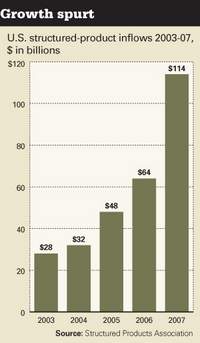
The structured-product industry enjoyed record sales of $114 billion last year, reflecting a 78% increase over 2006 and a 300% increase over 2003.
The financial crisis has already derailed much of the industry's momentum, but as the dust settles, the hope is that the CD wrapper will gain appeal among financial advisers and brokers — the primary distribution channel for structured products.
"Right now, we're seeing a lot of paralysis, period," Mr. Livingston said. "But banks issue CDs because they need money, and we're hoping there will be enough banks to issue enough CDs."
For the original story in Investment News, click here.
By Jeff Benjamin
Investment News
The structured-products industry, which has proved to be uniquely vulnerable to recent Wall Street meltdowns, is expected to promote increased shelter and regain some momentum by wrapping certificates of deposit around debt instruments.
"We'll likely see an increase in CD wrappers around structured products going forward," said Mark Kolodzinski, director of structured products at Bonds.com Inc. in Boca Raton, Fla.
Lehman Brothers Holdings Inc.'s filing for bankruptcy protection this month was a "game-changing event," he said.
"Lehman failed the first stress test on principal-protection products," Mr. Kolomynski added. "People will be paying a lot more attention to the credit quality of the issuing firms from now on."
While New York-based Lehman's problems are still a long way from being settled, the idea of an issuing firm going belly up ranks among the worst-case scenarios for structured-product investors.
"[Expect to see] a massive paradigm shift toward CD wrappers," said Keith Styrcula, chairman of the Structured Products Association in New York. "The dealers are already shifting toward CD wrappers as a market reaction."
CREDITWORTHINESS
As debt instruments that use derivatives to achieve various investment objectives, structured products are dependent on the creditworthiness of the issuing firms. In the event of a default, as is potentially the case with Lehman, holders of structured products fall in line along with all other creditors.
But by placing certain structured-product strategies inside CDs, the investment is insured like any other bank deposit for up to $100,000 by the Federal Deposit Insurance Corp. in Washington.
For example, a CD could be wrapped around a structured product that offered upside of an equity index such as the Dow Jones Industrial Average.
As with plain-vanilla CDs, the investment returns are determined by the terms of the agreement. The performance of the underlying structured product is affected to reflect the FDIC insurance feature.
Unlike an ordinary CD, which will lock in a designated rate of return for a specific term, the structured-product feature includes the risk of zero return beyond the guarantee of principal.
FDIC-INSURED
The initial investment of up to $100,000 is guaranteed by the FDIC, but the performance of the underlying structured product is dependent on the market.
For instance, a six-year note inside a CD might offer an investor a 10% return depending on the performance of the index. In the event that the index underperforms, the investor receives just his or her principal.
Compare that with a non-CD structured product, where a principal-protection guarantee is tied to the strength of the issuing company's balance sheet.
"I would never say a CD wrapper is the end-all, but they are very attractive for investors that need market exposure but are concerned about the risks," said Brad Livingston, vice president at Advisors Asset Management Inc., a Boerne, Texas-based platform that distributes structured products to brokers and advisers.
The CD wrappers were first introduced to the U.S. market a few years ago by European banks looking for access to the structured-product market.
Since CDs are exempt from U.S. securities laws, some foreign banks found that opening a commercial-bank branch here was the easiest means of selling structured products in the U.S. market, Mr. Styrcula said.
Prior to the CD wrapper, there was even a short-lived effort by some firms to wrap structured products with private insurance as a way to guarantee principal, according to Mr. Kolodzinski.
These days, virtually every commercial bank is equipped to offer CD wrappers around structured products.
Meanwhile, as the structured-product industry enjoyed a couple of years of explosive growth, the CD wrapper lost some of its appeal — until recently.
"I've been gravitating toward the strongest names and looking at CD-backed products, but I made that decision before the latest disaster," said Frederick Wright, chief investment officer at Smith & Howard Wealth Management LLC, an Atlanta-based firm with $225 million under advisement.
The structured-product industry enjoyed record sales of $114 billion last year, reflecting a 78% increase over 2006 and a 300% increase over 2003.
The financial crisis has already derailed much of the industry's momentum, but as the dust settles, the hope is that the CD wrapper will gain appeal among financial advisers and brokers — the primary distribution channel for structured products.
"Right now, we're seeing a lot of paralysis, period," Mr. Livingston said. "But banks issue CDs because they need money, and we're hoping there will be enough banks to issue enough CDs."
For the original story in Investment News, click here.
Subscribe to:
Posts (Atom)