[The following is the text of an October 21, 2008 letter the Structured Products Association's Law and Compliance Committee submitted to the FDIC seeking confirmiation that the recently announced Temporary Liquidity Guarantee Program applies to debt-based structured products.]
The Structured Products Association (the “Association”) seeks confirmation from the FDIC regarding an aspect of the announced FDIC Temporary Liquidity Guarantee Program (the “Temporary Guarantee Program”). As to eligible institutions that are participating, the FDIC guarantee would apply to all newly issued senior unsecured debt of those entities issued on or before June 30, 2009. The Association seeks confirmation that structured products are indeed included within the scope of the "senior, unsecured debt obligations" to which the FDIC guarantee would be applicable. Structured products predominantly are senior, unsecured debt obligations and clearly fit within this definition.
The Structured Products Association is a New York-based trade group. The Association’s mission includes positioning structured products as a distinct investment class, developing model “best practices” for members and their firms, and identifying legal, tax, compliance and regulatory challenges to the structured products industry. The Association was the first trade organization for structured products in the United States and now has more than 4,200 members, including members from securities exchanges, self-regulatory organizations, law firms, compliance professionals, investor networks, family offices, and buy-side and sell-side structured products firms. The Association counts among its members some of the largest and most active international banks, investment banks and distributors in the U.S. structured products market.
The Association is committed to promoting the development and growth of the structured products market in the United States, and to ensuring that investors in structured products understand the terms and risks of their investments.
We believe that structured products fall within the scope of the FDIC’s Temporary Guarantee Program and that it is important that the FDIC provide confirmation of this to the structured products market. Financial holding companies are some of the most prolific issuers of structured products. The market for structured products in the United States is $120 billion in new issuances per annum, on a percentage basis the fastest growing investment class in the United States. Most financial holding companies have financed some of their operations through the issuance to the public of structured products that are debt securities (usually through medium-term note programs, or other continuous offering programs) that derive some or all of their value based on the performance of a reference asset. For example, a debt security for which interest payments are linked to the performance of the S&P index. The range of reference assets is varied and includes equities, interest rates, commodities, currencies, indices, as well as other economic measures. Some of these senior, unsecured debt obligations are principal protected, while some have limited principal protection. Structured products also provide an important means for both retail and institutional investors to access investment classes that they otherwise would not be able to access and to diversify their holdings.
For many financial institutions, the issuance of structured products represents a significant component of their funding operations. In return for responding to investors’ demand for exposure to certain reference assets, structured products issuers often are able to obtain medium term financing at advantageous funding rates. Confirming the status of structured notes under the Temporary Guarantee Program will help preserve this low cost funding source at a time when the lack of interbank liquidity and access to credit make such sources all the more important. Such confirmation also would prevent unnecessary confusion and instability in the structured products market, which generally has presumed that structured products, as senior unsecured obligations, would benefit from the Temporary Guarantee Program (not unlike the way in which indexed certificates of deposit, a type of structured product, have for many years benefited from the FDIC deposit insurance program). Finally, by confirming the widely held view of the investment community, the FDIC will alleviate the otherwise significant potential for market confusion and uncertainty that would likely otherwise result given the difficulty in defining what is or is not a senior, unsecured debt obligation.
Very truly yours,
/s/ Keith A. Styrcula
Chairman and Founder
Structured Products Association
/s/ Anna T. Pinedo
Co-head of the Structured Products Association
Law and Compliance Committee
/s/ Joseph Inzerillo
Co-head of the Structured Products Association
Law and Compliance Committee
SPA-2008


Tuesday, October 21, 2008


Sunday, October 19, 2008
SPA Announces Call for Nominees in 2nd Annual Leading Edge Advisors Awards
NEW YORK, October 17 -- The Structured Products Association (SPA) is pleased to announce its nationwide call for nominees for the Second Annual Leading Edge Advisors Awards beginning today.
With the LeadingEdge Awards, the SPA seeks to commemorate financial advisors who recognize that a fiduciary responsibility to clients can be well-served by utilizing structured investments in a diversified portfolio.
On Monday, February 23, 2009, five honorees will receive the crystal awards at the sixth annual SPA-2009 event at the Grand Hyatt hotel. The recipients will be chosen by an executive committee, based on strategic use of structured products to enhance yield, magnify returns, preserve principal or manage tax efficiencies -- all while setting a "leading edge" standard for the next generation of modern portfolio theory.
The nomination form for the LeadingEdge awards can be accessed on the LeadingEdge Awards website. Both self- and third-party nominations are acceptable.
The process of nomination customarily takes less than 10 minutes to complete. The first deadline is December 1, 2008, but additional nominations may be considered through January 3, 2009. Click here to access the nomination form.
Last year's winners were: SPA CHAIRMAN'S AWARD: J. Scott Miller (Blue Bell Private Wealth Management); Thomas Balcom (Foldes Financial Management); Steve Braverman (Harris myCFO Investment Advisory Services); Tony Proctor (Proctor Financial) and Frederick S. Wright (Smith and Howard Wealth Management).
For the May 20, 2008 press release on last year's winners, click here. The SPA coverage of the awards can be found by clicking here.
US Structured Products Move Toward CD Form
Investment is FDIC-insured up to $100K
By Jeff Benjamin
Investment News
The structured-products industry, which has proved to be uniquely vulnerable to recent Wall Street meltdowns, is expected to promote increased shelter and regain some momentum by wrapping certificates of deposit around debt instruments.
"We'll likely see an increase in CD wrappers around structured products going forward," said Mark Kolodzinski, director of structured products at Bonds.com Inc. in Boca Raton, Fla.
Lehman Brothers Holdings Inc.'s filing for bankruptcy protection this month was a "game-changing event," he said.
"Lehman failed the first stress test on principal-protection products," Mr. Kolomynski added. "People will be paying a lot more attention to the credit quality of the issuing firms from now on."
While New York-based Lehman's problems are still a long way from being settled, the idea of an issuing firm going belly up ranks among the worst-case scenarios for structured-product investors.
"[Expect to see] a massive paradigm shift toward CD wrappers," said Keith Styrcula, chairman of the Structured Products Association in New York. "The dealers are already shifting toward CD wrappers as a market reaction."
CREDITWORTHINESS
As debt instruments that use derivatives to achieve various investment objectives, structured products are dependent on the creditworthiness of the issuing firms. In the event of a default, as is potentially the case with Lehman, holders of structured products fall in line along with all other creditors.
But by placing certain structured-product strategies inside CDs, the investment is insured like any other bank deposit for up to $100,000 by the Federal Deposit Insurance Corp. in Washington.
For example, a CD could be wrapped around a structured product that offered upside of an equity index such as the Dow Jones Industrial Average.
As with plain-vanilla CDs, the investment returns are determined by the terms of the agreement. The performance of the underlying structured product is affected to reflect the FDIC insurance feature.
Unlike an ordinary CD, which will lock in a designated rate of return for a specific term, the structured-product feature includes the risk of zero return beyond the guarantee of principal.
FDIC-INSURED
The initial investment of up to $100,000 is guaranteed by the FDIC, but the performance of the underlying structured product is dependent on the market.
For instance, a six-year note inside a CD might offer an investor a 10% return depending on the performance of the index. In the event that the index underperforms, the investor receives just his or her principal.
Compare that with a non-CD structured product, where a principal-protection guarantee is tied to the strength of the issuing company's balance sheet.
"I would never say a CD wrapper is the end-all, but they are very attractive for investors that need market exposure but are concerned about the risks," said Brad Livingston, vice president at Advisors Asset Management Inc., a Boerne, Texas-based platform that distributes structured products to brokers and advisers.
The CD wrappers were first introduced to the U.S. market a few years ago by European banks looking for access to the structured-product market.
Since CDs are exempt from U.S. securities laws, some foreign banks found that opening a commercial-bank branch here was the easiest means of selling structured products in the U.S. market, Mr. Styrcula said.
Prior to the CD wrapper, there was even a short-lived effort by some firms to wrap structured products with private insurance as a way to guarantee principal, according to Mr. Kolodzinski.
These days, virtually every commercial bank is equipped to offer CD wrappers around structured products.
Meanwhile, as the structured-product industry enjoyed a couple of years of explosive growth, the CD wrapper lost some of its appeal — until recently.
"I've been gravitating toward the strongest names and looking at CD-backed products, but I made that decision before the latest disaster," said Frederick Wright, chief investment officer at Smith & Howard Wealth Management LLC, an Atlanta-based firm with $225 million under advisement.
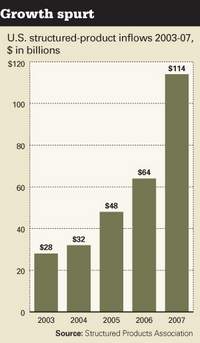
The structured-product industry enjoyed record sales of $114 billion last year, reflecting a 78% increase over 2006 and a 300% increase over 2003.
The financial crisis has already derailed much of the industry's momentum, but as the dust settles, the hope is that the CD wrapper will gain appeal among financial advisers and brokers — the primary distribution channel for structured products.
"Right now, we're seeing a lot of paralysis, period," Mr. Livingston said. "But banks issue CDs because they need money, and we're hoping there will be enough banks to issue enough CDs."
For the original story in Investment News, click here.
By Jeff Benjamin
Investment News
The structured-products industry, which has proved to be uniquely vulnerable to recent Wall Street meltdowns, is expected to promote increased shelter and regain some momentum by wrapping certificates of deposit around debt instruments.
"We'll likely see an increase in CD wrappers around structured products going forward," said Mark Kolodzinski, director of structured products at Bonds.com Inc. in Boca Raton, Fla.
Lehman Brothers Holdings Inc.'s filing for bankruptcy protection this month was a "game-changing event," he said.
"Lehman failed the first stress test on principal-protection products," Mr. Kolomynski added. "People will be paying a lot more attention to the credit quality of the issuing firms from now on."
While New York-based Lehman's problems are still a long way from being settled, the idea of an issuing firm going belly up ranks among the worst-case scenarios for structured-product investors.
"[Expect to see] a massive paradigm shift toward CD wrappers," said Keith Styrcula, chairman of the Structured Products Association in New York. "The dealers are already shifting toward CD wrappers as a market reaction."
CREDITWORTHINESS
As debt instruments that use derivatives to achieve various investment objectives, structured products are dependent on the creditworthiness of the issuing firms. In the event of a default, as is potentially the case with Lehman, holders of structured products fall in line along with all other creditors.
But by placing certain structured-product strategies inside CDs, the investment is insured like any other bank deposit for up to $100,000 by the Federal Deposit Insurance Corp. in Washington.
For example, a CD could be wrapped around a structured product that offered upside of an equity index such as the Dow Jones Industrial Average.
As with plain-vanilla CDs, the investment returns are determined by the terms of the agreement. The performance of the underlying structured product is affected to reflect the FDIC insurance feature.
Unlike an ordinary CD, which will lock in a designated rate of return for a specific term, the structured-product feature includes the risk of zero return beyond the guarantee of principal.
FDIC-INSURED
The initial investment of up to $100,000 is guaranteed by the FDIC, but the performance of the underlying structured product is dependent on the market.
For instance, a six-year note inside a CD might offer an investor a 10% return depending on the performance of the index. In the event that the index underperforms, the investor receives just his or her principal.
Compare that with a non-CD structured product, where a principal-protection guarantee is tied to the strength of the issuing company's balance sheet.
"I would never say a CD wrapper is the end-all, but they are very attractive for investors that need market exposure but are concerned about the risks," said Brad Livingston, vice president at Advisors Asset Management Inc., a Boerne, Texas-based platform that distributes structured products to brokers and advisers.
The CD wrappers were first introduced to the U.S. market a few years ago by European banks looking for access to the structured-product market.
Since CDs are exempt from U.S. securities laws, some foreign banks found that opening a commercial-bank branch here was the easiest means of selling structured products in the U.S. market, Mr. Styrcula said.
Prior to the CD wrapper, there was even a short-lived effort by some firms to wrap structured products with private insurance as a way to guarantee principal, according to Mr. Kolodzinski.
These days, virtually every commercial bank is equipped to offer CD wrappers around structured products.
Meanwhile, as the structured-product industry enjoyed a couple of years of explosive growth, the CD wrapper lost some of its appeal — until recently.
"I've been gravitating toward the strongest names and looking at CD-backed products, but I made that decision before the latest disaster," said Frederick Wright, chief investment officer at Smith & Howard Wealth Management LLC, an Atlanta-based firm with $225 million under advisement.
The structured-product industry enjoyed record sales of $114 billion last year, reflecting a 78% increase over 2006 and a 300% increase over 2003.
The financial crisis has already derailed much of the industry's momentum, but as the dust settles, the hope is that the CD wrapper will gain appeal among financial advisers and brokers — the primary distribution channel for structured products.
"Right now, we're seeing a lot of paralysis, period," Mr. Livingston said. "But banks issue CDs because they need money, and we're hoping there will be enough banks to issue enough CDs."
For the original story in Investment News, click here.
Saturday, October 18, 2008
SRP League Tables: 6,000 Deals YTD on Structured Products
At the request of the Structured Products Association, structuredretailproducts.com has provided a summary of the structured products deals done year-to-date. The survey contained several surprises:
::: Despite market conditions, the number of deals done in the first three quarters is just under 6,000 (total = 5,942).
::: SRP now counts 75 issuers of structured products in the United States, with new regional banks coming into the structured CD market.
::: The Top Three players accounted for 48% of all new deals -- nearly half the market of issuances (Barclays, JPMorgan and ABNAmro/Royal Bank of Scotland). On a monthly basis, Barclays is averaging over 130 deals; JPMorgan, 80; ABNAmro, 75.
::: The Top 20 players accounted for 4,953 deals, or 84% of all new deals done. The remaining 55 issuers only accounted for the remaining 16% of deals.
::: Lehman Brothers continues to remain in the Top 5 issuers of structured products even though it is no longer in the business.
The following league table was provided by structuredretailproducts.com. For a free 14-day trial, please click here.
SRP Structured Products League Tables
(by number of deals)
through October 15, 2008
Issuer ................................Deals ..... % of Mkt
Barclays Bank ......................1274 ........21%
JPMorgan Chase ..................804 ........14%
ABN Amro Bank ...................748 ........13%
HSBC Bank ............................322 .........5%
Lehman Brothers .................247 ..........4%
Morgan Stanley ....................244 ..........4%
Eksportfinans ........................225 .........4%
UBS .........................................193 ..........3%
Deutsche Bank .......................182 .........3%
Credit Suisse ..........................126 .........2%
Merrill Lynch .........................125 .........2%
Goldman Sachs...................... 104 .........2%
Citigroup ...................................92 .........2%
Fortis Bank ...............................76 .........1%
Swedish Export ........................66 .........1%
SG Str Pdts ...............................61 .........1%
Bank of America .......................39 .........1%
Bear Stearns .............................25 .........1%
TOTAL of Top 20 Issuers
4953 deals . . . . 84% of overall issuance.
::: Despite market conditions, the number of deals done in the first three quarters is just under 6,000 (total = 5,942).
::: SRP now counts 75 issuers of structured products in the United States, with new regional banks coming into the structured CD market.
::: The Top Three players accounted for 48% of all new deals -- nearly half the market of issuances (Barclays, JPMorgan and ABNAmro/Royal Bank of Scotland). On a monthly basis, Barclays is averaging over 130 deals; JPMorgan, 80; ABNAmro, 75.
::: The Top 20 players accounted for 4,953 deals, or 84% of all new deals done. The remaining 55 issuers only accounted for the remaining 16% of deals.
::: Lehman Brothers continues to remain in the Top 5 issuers of structured products even though it is no longer in the business.
The following league table was provided by structuredretailproducts.com. For a free 14-day trial, please click here.
SRP Structured Products League Tables
(by number of deals)
through October 15, 2008
Issuer ................................Deals ..... % of Mkt
Barclays Bank ......................1274 ........21%
JPMorgan Chase ..................804 ........14%
ABN Amro Bank ...................748 ........13%
HSBC Bank ............................322 .........5%
Lehman Brothers .................247 ..........4%
Morgan Stanley ....................244 ..........4%
Eksportfinans ........................225 .........4%
UBS .........................................193 ..........3%
Deutsche Bank .......................182 .........3%
Credit Suisse ..........................126 .........2%
Merrill Lynch .........................125 .........2%
Goldman Sachs...................... 104 .........2%
Citigroup ...................................92 .........2%
Fortis Bank ...............................76 .........1%
Swedish Export ........................66 .........1%
SG Str Pdts ...............................61 .........1%
Bank of America .......................39 .........1%
Bear Stearns .............................25 .........1%
TOTAL of Top 20 Issuers
4953 deals . . . . 84% of overall issuance.
Thursday, October 9, 2008
SPA AutumnExpo: Oct 2 Event Draws Record Crowd to Assess "Challenges and Opportunities"
By Kenneth Lim, Prospect News
New York , Oct. 2 – The structured products market is going through an industry-changing period and must grapple with investor risk aversion, greater concern about credit risks and challenges in education and transparency, panelists at the Structured Products Association fall conference said Thursday.
But the future also presents oppor tunities in up-and-coming products and new distribution channels, the panelists said.
Train went off-track
The collapse of Lehman Brothers Holdings Inc. in September and the domino-restructuring of U.S. banks that followed have created a significant “disruption event” for the structured product industry, SPA chairman Keith Styrcula said in the conference opening address.
The events were not the making of the industry but are likely to cause major changes, he said. “We know that the landscape will never be the same,” Styrcula said.
Drop in volume
Many industry insiders at the conference reported that volume had slowed after Lehman Brothers’ bankruptcy.
One distributor said the distributor’s firm was mostly in “service mode” because the investment advisors who had taken a hit were “shellshocked” and not doing much.
Mark Kolodzinski, who holds the newly created post of director of structured products at Bonds.com, Inc., acknowledged that the current market problems hit at a bad time for him. “It’s certainly slowed things down,” he said.
Brad Livingston, vice president of structured products for Advisors Asset Management, said many investors were not sure about where to put their money and were awaiting greater clarity in the markets. Many of the wary investors are still waiting to understand the fallout from the Lehman collapse, which has left holders of the bank’s structured notes unsure about where they stand in the bankruptcy proceedings, Livingston added.
Capital protection gains ground
Principal-protected products are experiencing a surge in demand, many panelists said.
Certificates of deposit, in particular, which are insured by the FDIC, are on the rise.
“Having that FDIC insurance in a very challenging environment is very important,” Livingston said. “We can go out with a triple A rating andthey don’t want to hear about it.” Other panelists also reported better interest in some absolute return structures, such as long-short products, negative correlation asset classes and strategy-replicating indexes.
One issuer noted that some clients, rather than shying away from capital-at-risk products, were seeking leveraged notes that could allowthem to pursue opportunities thrown up in the turbulence.
An industry-supported ETN?
Joe Inzerillo, a legal executive at BNP Paribas who focuses on structured products, also suggested the possibility of a “next generation”exchange-traded note.
The idea would be to offer the same product through multiple issuers withissuers guaranteeing one another’s ETNs. If one of those issuers defaulted, the rest could help to support the product, Inzerillo said.
Transparency, simplicity key
Some distributors saw the current slowdown as an opportunity to improve education efforts. Transparency and simplicity were also repeatedly highlighted as key challenges for the industry to gain better acceptance.
Inzerillo noted that the industry has made “tremendous progress” over the past years in terms of documentation, with greater consistency ofnomenclature and more reader-friendly brochures and prospectuses.
But fellow panelist Anna Pinedo of Morrison & Foerster also said better standardization of nomenclature would make it easier for investors tounderstand structured products and help to reduce any misunderstandings about the complexity and risks of structured products.
Panelists also warned of closer scrutiny from regulators. The Financial Industry Regulatory Authority (Finra) was drafting an investment alert on structured products. Finra could not be reached for confirmation.
From hedge funds to bank branches
The industry continues to explore new ways to offer structured products to issuers. Wavecrest Asset Management, a new investment firm believed to be one ofthe first that will focus on structured investments, launched its firsthedge fund earlier in the week.
Wavecrest managing partner and co-founder Jeremy Berman said the new fund, called Wavecrest Partners Fund I and with less than $10 million in assets under management, was started even in these tough fundraising times so that he could establish a track record.
Ideon, a relatively young entrant to the U.S. market from Spain , is also hoping to open new channels through commercial banking retail branches. The company is working with commercial banks to offer simply structured products – structured CDs, for example – linked to well-followed indexes that can be customized for clients through a convenient system, Ideon managing director Matt Murphy said.
For a free trial subscription to Prospect News, please click here.
New York , Oct. 2 – The structured products market is going through an industry-changing period and must grapple with investor risk aversion, greater concern about credit risks and challenges in education and transparency, panelists at the Structured Products Association fall conference said Thursday.
But the future also presents oppor
 tunities in up-and-coming products and new distribution channels, the panelists said.
Train went off-track
The collapse of Lehman Brothers Holdings Inc. in September and the domino-restructuring of U.S. banks that followed have created a significant “disruption event” for the structured product industry, SPA chairman Keith Styrcula said in the conference opening address.
The events were not the making of the industry but are likely to cause major changes, he said. “We know that the landscape will never be the same,” Styrcula said.
Drop in volume
Many industry insiders at the conference reported that volume had slowed after Lehman Brothers’ bankruptcy.
One distributor said the distributor’s firm was mostly in “service mode” because the investment advisors who had taken a hit were “shellshocked” and not doing much.
Mark Kolodzinski, who holds the newly created post of director of structured products at Bonds.com, Inc., acknowledged that the current market problems hit at a bad time for him. “It’s certainly slowed things down,” he said.
Brad Livingston, vice president of structured products for Advisors Asset Management, said many investors were not sure about where to put their money and were awaiting greater clarity in the markets. Many of the wary investors are still waiting to understand the fallout from the Lehman collapse, which has left holders of the bank’s structured notes unsure about where they stand in the bankruptcy proceedings, Livingston added.
Capital protection gains ground
Principal-protected products are experiencing a surge in demand, many panelists said.
Certificates of deposit, in particular, which are insured by the FDIC, are on the rise.
“Having that FDIC insurance in a very challenging environment is very important,” Livingston said. “We can go out with a triple A rating andthey don’t want to hear about it.” Other panelists also reported better interest in some absolute return structures, such as long-short products, negative correlation asset classes and strategy-replicating indexes.
One issuer noted that some clients, rather than shying away from capital-at-risk products, were seeking leveraged notes that could allowthem to pursue opportunities thrown up in the turbulence.
An industry-supported ETN?
Joe Inzerillo, a legal executive at BNP Paribas who focuses on structured products, also suggested the possibility of a “next generation”exchange-traded note.
The idea would be to offer the same product through multiple issuers withissuers guaranteeing one another’s ETNs. If one of those issuers defaulted, the rest could help to support the product, Inzerillo said.
Transparency, simplicity key
Some distributors saw the current slowdown as an opportunity to improve education efforts. Transparency and simplicity were also repeatedly highlighted as key challenges for the industry to gain better acceptance.
Inzerillo noted that the industry has made “tremendous progress” over the past years in terms of documentation, with greater consistency ofnomenclature and more reader-friendly brochures and prospectuses.
But fellow panelist Anna Pinedo of Morrison & Foerster also said better standardization of nomenclature would make it easier for investors tounderstand structured products and help to reduce any misunderstandings about the complexity and risks of structured products.
Panelists also warned of closer scrutiny from regulators. The Financial Industry Regulatory Authority (Finra) was drafting an investment alert on structured products. Finra could not be reached for confirmation.
From hedge funds to bank branches
The industry continues to explore new ways to offer structured products to issuers. Wavecrest Asset Management, a new investment firm believed to be one ofthe first that will focus on structured investments, launched its firsthedge fund earlier in the week.
Wavecrest managing partner and co-founder Jeremy Berman said the new fund, called Wavecrest Partners Fund I and with less than $10 million in assets under management, was started even in these tough fundraising times so that he could establish a track record.
Ideon, a relatively young entrant to the U.S. market from Spain , is also hoping to open new channels through commercial banking retail branches. The company is working with commercial banks to offer simply structured products – structured CDs, for example – linked to well-followed indexes that can be customized for clients through a convenient system, Ideon managing director Matt Murphy said.
For a free trial subscription to Prospect News, please click here.
Wednesday, October 8, 2008
SPA AutumnExpo: Panelist Presentations
Anna Pinedo
Morrison & Foerster
"Structured Products and Market Turbulence"
David Blitzer
Standard & Poor's Indexes
"Indexing in the Current Market Environment"
Joseph Inzerillo
BNP Paribas
"Market Turbulence and the Legal, Regulatory and Compliance Landscape"
Lori Barnes
City Securities
"Growth in Alternative Investments"
Morrison & Foerster
"Structured Products and Market Turbulence"
David Blitzer
Standard & Poor's Indexes
"Indexing in the Current Market Environment"
Joseph Inzerillo
BNP Paribas
"Market Turbulence and the Legal, Regulatory and Compliance Landscape"
Lori Barnes
City Securities
"Growth in Alternative Investments"
Monday, September 29, 2008
Bloomberg: Lehman 100% Protection = Pennies
Lehman's `100% Principal Protection' Means Pennies for Notes
By Bradley Keoun
Sept. 29 (Bloomberg) -- A brochure pitching $1.84 million of notes sold by Lehman Brothers Holdings Inc. in August, a month before the firm filed for bankruptcy, promised ``100 percent principal protection.''
Buyers had ``uncapped appreciation potential'' pegged to gains in the Standard & Poor's 500 Index, the brochure said. In the worst case, they would get back their $1,000-per-note investment in three years. Only the last in a list of 15 risk factors mentioned the biggest danger:
``An investment in the notes will be subject to the credit risk of Lehman Brothers.''
Lehman's Sept. 15 bankruptcy leaves holders of the notes waiting in line with other unsecured creditors for what's left of their money. The collapse has rattled Wall Street's $114 billion structured-notes business, which Lehman, Merrill Lynch & Co., Morgan Stanley and Goldman Sachs Group Inc., all based in New York, used to raise cheaper funding as the credit crisis drove bond yields higher. About three-fifths of the $68.1 billion sold this year were bought by individual investors, according to data compiled by mtn-i, a London-based firm that tracks the market.
``Investors are going to be a lot more concerned about the credit of the issuers of these notes,'' said James Angel, an associate professor of finance at Georgetown University in Washington. Until recently, ``the buyers may have been mesmerized by the bells and the whistles,'' he said.
The market for structured notes -- constructed by Wall Street firms from a combination of bonds, stocks, commodities, currencies and derivatives -- has mostly avoided fallout from the slump in sales of mortgage-backed collateralized debt obligations and auction-market preferred securities.
For the full article from Bloomberg, click here.
By Bradley Keoun
Sept. 29 (Bloomberg) -- A brochure pitching $1.84 million of notes sold by Lehman Brothers Holdings Inc. in August, a month before the firm filed for bankruptcy, promised ``100 percent principal protection.''
Buyers had ``uncapped appreciation potential'' pegged to gains in the Standard & Poor's 500 Index, the brochure said. In the worst case, they would get back their $1,000-per-note investment in three years. Only the last in a list of 15 risk factors mentioned the biggest danger:
``An investment in the notes will be subject to the credit risk of Lehman Brothers.''
Lehman's Sept. 15 bankruptcy leaves holders of the notes waiting in line with other unsecured creditors for what's left of their money. The collapse has rattled Wall Street's $114 billion structured-notes business, which Lehman, Merrill Lynch & Co., Morgan Stanley and Goldman Sachs Group Inc., all based in New York, used to raise cheaper funding as the credit crisis drove bond yields higher. About three-fifths of the $68.1 billion sold this year were bought by individual investors, according to data compiled by mtn-i, a London-based firm that tracks the market.
``Investors are going to be a lot more concerned about the credit of the issuers of these notes,'' said James Angel, an associate professor of finance at Georgetown University in Washington. Until recently, ``the buyers may have been mesmerized by the bells and the whistles,'' he said.
The market for structured notes -- constructed by Wall Street firms from a combination of bonds, stocks, commodities, currencies and derivatives -- has mostly avoided fallout from the slump in sales of mortgage-backed collateralized debt obligations and auction-market preferred securities.
For the full article from Bloomberg, click here.
Monday, September 22, 2008
New Restrictions
On September 18, the SEC issued a series of emergency orders to address short sales and reporting of short positions. Click here for the full version provided by Morrison and Foerster.
Tuesday, September 16, 2008
SPA Statement on Structured Products Careers
The extraordinary events of the last several days have reshaped our industry in ways that were once unimaginable. The Structured Products Association is working to find opportunities for highly talented professionals in the US structured products industry who are being displaced in the wake of the reshaping of our business.
If you are an internal human resources professional or a recruiter with opportunities in the structured products arena -- whether in the US or not, kindly email career.opportunities@structuredproducts.org. The SPA will make the opportunities available on its website, and -- if permissible -- via email to its 8,000 members.
The SPA's October 2, 2008 AutumnExpo at New York's Grand Hyatt Hotel will also feature a panel on the reshaping of the financial services industry and how it will impact careers in structured products.
Click here for the agenda.
Click here for the form to sign up for the single-day October 2, 2008 event.
For the New York Times' blog on this post, click here.
If you are an internal human resources professional or a recruiter with opportunities in the structured products arena -- whether in the US or not, kindly email career.opportunities@structuredproducts.org. The SPA will make the opportunities available on its website, and -- if permissible -- via email to its 8,000 members.
The SPA's October 2, 2008 AutumnExpo at New York's Grand Hyatt Hotel will also feature a panel on the reshaping of the financial services industry and how it will impact careers in structured products.
Click here for the agenda.
Click here for the form to sign up for the single-day October 2, 2008 event.
For the New York Times' blog on this post, click here.
Subscribe to:
Posts (Atom)