By IAN SALISBURY
July 17, 2008
This might have been the year of the exchange-traded note, with fund firms and investment banks launching more than 60 new ETNs.
As it turns out, investors have so far turned up their noses at most of these complicated ETF-like securities. While the bulk of new products focus on red-hot assets like oil and other commodities, drawbacks such as credit risk, complicated strategies and uncertainty about the securities' tax status have kept many investors on the sidelines.
"I've talked with a lot of [financial advisors] and they've been staying away," says Ronald DeLegge, a former financial advisor who now offers ETF investing advice to online subscribers. "You've got a lot of risks with these things."
Exchange-traded notes have collected about $7.2 billion in assets since the first ones were launched in 2006, according to fund researcher Morningstar Inc. But the bulk of that, about $6 billion, is in 30 ETNs by Barclays PLC, which invented the product.
Another 59 ETNs created by eight other providers, mostly this year, hold just $1.29 billion, collectively, or about $22 million on average.
In all, 78 of the 89 ETNs on the market have less than $100 million. Barclays couldn't be reached for comment.
Investors, of course, could warm to new ETNs over time. It sometimes takes new funds several years to build a following. Still, ETNs' struggles seem to mirror those of their close cousins exchange-traded funds, where fund companies launched hundreds of products hoping to replicate success of a few early blockbusters and garnered only mixed results.
For the full article from the Wall Street Journal, click here.
SPA-2008


Monday, July 21, 2008


Thursday, July 10, 2008
Final: SP Principles Released For Individual Investors
Five leading trade associations, co-sponsors of the Joint Associations Committee (JAC), today released “Structured Products: Principles for Managing the Distributor-Individual Investor Relationship.” The global, non-binding Principles address a wide range of issues affecting distribution of retail structured products to individual investors.
The Principles complement the JAC’s “Principles for Managing the Provider-Distributor Relationship,” which were released in July 2007. The Associations issued the Principles for public comment on May 12 and are today publishing them in final form.
"The second set of JAC Principles represents many months of thorough memberdiscussion and wider syndication, and articulates the values that market participants share as they promote the continued development of a healthy market in retail structured products,” said JAC’s Chairman, Timothy Hailes, Managing Director and Associate General Counsel at JP Morgan Chase in London.
“As with the July 2007 Provider-Distributor Principles, the key will be intelligent and proportionate application to local regimes."
The JAC comprises the following trade associations: European Securitisation Forum (ESF), International Capital Market Association (ICMA), London Investment Banking Association (LIBA), the International Swaps and Derivatives Association (ISDA®) and Securities Industry and Financial Markets Association (SIFMA).
The principles were based on extensive work and collaboration with the associations’ member firms, and on consultation with distributor associations.
The Principles can be accessed by clicking here.
Bloomberg: Bridgewater predicts $1.6 trillion in subprime losses
Bridgewater Associates has warned of a massive $1,600bn (€1,020bn) of banking losses from the global credit crunch, four times official projections, according to a report in Swiss newspaper SonntagsZeitung.
The US hedge fund said true losses would swell if banks were forced to adopt "mark-to-market" methods of valuing structured credit instead of the "mark-to-model" currently being used.
“We are facing an avalanche of bad assets. We have big doubts as to whether financial institutions will be able to obtain enough new capital to cover their losses. The credit crisis is going to get worse," Bridgewater was quoted as saying the report.
UK: Wealth advisers and private banks turn to structured products
Wealth advisers are increasingly turning to structured products in an effort to protect clients from stormy markets while offering the potential for capital growth, according to the chief executive of Blue Sky Asset Management, a UK-based structured products specialist set up last year.
Blue Sky is launching a third issue of its Asset Allocation Accelerated Growth Plan, which enables investors to construct their own portfolio split between UK, US, European and Japanese equity markets, while receiving capital protection and leveraged returns.
Chris Taylor, chief executive, said: "We are laying down the gauntlet to the traditional mutual fund and index tracker world. We think the features of the plan question the rationale for investing in those products."
He pointed out that traditional mutual funds had haemorraged assets in the first quarter in the both the UK and US, while demand for cautiously managed and structured products had been robust. "Investors are voting with their feet, and walking out of traditional mutual funds into structured investments that can alter the risk and return profile of their portfolio."
While the firm is focussing its efforts on high-end intermediaries, which are increasingly targeting high net worth investors, it is also seeing interest from private banks.
Taylor said it recently structured a sophisticated product based on a distressed debt hedge fund which was being sold by a Swiss private bank. "We are seeing interest from the more open-minded private banks which are prepared to talk to an independent provider," he added.
Blue Sky is increasingly building inflation protection into its structures. "While a lot of people are talking about how to structure portfolios to hedge against rising inflation, we think there is no better protection that a direct link to the retail price index. It doesn't get much cleaner than that," said Taylor.
For the original article in Wealth Bulletin, click here.
Monday, July 7, 2008
Financial Times: Downside protection gains popularity
By Steve Johnson
Published: July 7 2008 03:00
One of the key selling points of structured products is that, in many cases, they offer risk-averse investors the chance to shield themselves from falling markets.
The capital guarantees embedded in structured products can be absolute, promising the investor all their money back irrespective of the losses suffered by the underlying assets. However, to stand a stronger chance of delivering meaningful returns, more often than not the downside protection is limited - if asset markets suffer particularly sharp falls, the end investor will suffer as well.
For example, equity-linked products may offer capital protection providing an underlying equity market does not fall by more than 50 per cent during the fixed term life of the product.
If this "soft floor" protection barrier is breached, and the market fails to recover during the product term, the investor may end up shouldering losses on a one-for-one basis, just as they would had they entered the market in a traditional, naked, manner.
Some products, such as many of the precipice bonds sold en masse to UK retail investors in the early years of the millennium, had an even nastier trick in the smallprint.
When these soft barriers were breached, as they were in many cases, investors often lost money on a leveraged two-for-one basis - losing up to 80 per cent of their investment in some cases.
The industry has cleaned up its act since then, and few reputable issuers would market such leveraged downside products to retail investors, certainly not without adequate risk warnings.
But despite this episode, the provision of downside protection is a crucial selling point for the structured products industry, particularly when investors are cautious, as they are at present.
For the full article from Financial Times, click here.
Financial Times: Fledgling SPs flying into a harsher climate
By Hannah Glover
July 7 2008 03:00
Structured products have established a foothold in the US retail markets, but some analysts say even leading issuers such as DWS parent Deutsche Bank, UBS, Barclays and Citigroup may struggle to maintain momentum.
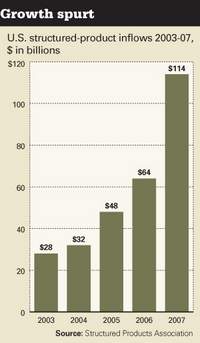
Indeed, the fledgling industry has gained traction in recent years, growing from $64bn (£32bn, €40bn) to $114bn between 2006 and 2007, according to estimates from the Structured Products Association. But tax issues, distribution challenges and investor mindset will make it difficult for banks offering the products to keep that growth going.
Current markets and investor perception of the products pose one challenge. "With all the negative perception of derivatives, they really have fallen out of favour in the US," says Darlene DeRemer, who leads the advisory practice at Boston-based Grail Partners, a merchant bank specialising in the investment management industry.
"Clients don't really understand the products; therefore, financial advisers might not want to sell them," she says.
Adviser advocacy is critical to the sale of structured products in the US, where distribution is dominated by financial advisers and retail brokerage houses. By contrast, in Germany and France, retail investors can buy structured notes from local banks, post offices, or even using their mobile phones.
The US system required the first firms to try to break into the American market - mainly banks with European parents - to pay for shelf-space, sometimes even paying a third-party broker to access their broker-dealer clients. The result was higher costs and compressed profit margins.
Christopher Warren, managing director and head of structured products at DWS Scudder in New York, says: "We weren't talking to the end client, and we didn't know what they wanted."
Financial Times: High SP inflows show US playing catch-up
By Paul O'Dowd
Published: July 7 2008
Structured products, long popular in Europe, are now taking hold in the US as markets spook investors and baby boomers look to protect their wealth. Last year, assets in structured products climbed to $114bn (£57bn, €72bn) in the US, up from $64bn in 2006, according to the Structured Products Association.
Last year, Merrill Lynch was the top issuer with $6.1bn in sales followed by Citigroup with $3.1bn, Morgan Stanley with $3bn, Barclays with $2.6bn and UBS with $2.3bn. These numbers represent the above firms selling only their notes and not competing firms' notes.
Some examples of structured products are: principal-protected notes, index-linked notes, performance-leveraged upside securities and reversed-convertible notes.
This year's inflows are so far keeping pace with last year, says Philippe El-Asmar, head of solution sales for the Americas at Barclays.
Structured products, formerly investments mainly for the wealthy, have since come down-market and are now available in the retail space.
Generally these products are created by combining or snapping-on additional financial products to a traditional security, such as a bond.
These snap-on products can be selected to have low correlation to the underlying investment, which gives the advantage of increasing diversification of the final structured product. If one component of the structure deteriorates, other components will serve to offset or dilute this loss, providing a safety net to investors.
The primary driver behind the high inflows into structured products seems to be that brokers and registered investment advisers (RIAs) are embracing the investment for the first time.
For the full article in Financial Times, click here.
Thursday, July 3, 2008
Derivatives Week: Global Principles for SPs Go Final Next Week
by Sam Mamudi
The final version of a new set of principles for the structured product industry is due to be released early next week.
The Principles for Managing the Distributor-Individual Investor Relationship follows last year’s retail structured products provider-distributor principles. While those principles were focused on the relationships between firms, the latest principles address interactions with clients.
As with the previous principles, the new ones will be jointly released by five trade associations, the European Securitisation Forum, International Capital Market Association, International Swaps and Derivatives Association, London Investment Banking Association and Securities Industry and Financial Markets Association.
Timothy Hailes, managing director and associate general counsel at JPMorgan and Chairman of the Joint Associations Committee on Retail Structured Products who produced the principles, said in producing the latest set he had spoken with various regulators, including the U.S. Securities and Exchange Commission and Hong Kong’s Securities and Futures Commission.
He said the they should be read as a list of desirable outcomes, rather than a document that prescribes how things should be done.
The principles call for measures such as adequate risk disclosure to clients and training for financial advisors. “Although these principles are non-binding…and do not create enforceable obligations or duties, firms…are encouraged to reflect these principles in their policies and procedures,” states the document.
Anna Pinedo, partner at Morrison & Foerster in New York, said the document will not give firms in the U.S. reason to pause or reassess compliance procedures. “These are a nice reminder, nothing more than that,” she said.
However, the principles are “ahead of the curve in a number of [other] jurisdictions,” said Hailes.
Australia: Choosing products that are structurally sound
by David Jones-Prichard
LAST year Australians invested some $4 billion, with new products and providers continuing to emerge.
No longer confined to a simple choice between stocks, bonds and mutual funds, today's retail investors are using structured products to access a greater variety of asset classes previously the preserve of professionals.
Now, in one straightforward transaction, retail investors can use structured products to buy or leverage into international stocks, emerging markets, currencies, hedge funds, exchange traded funds and others.
The broad and growing appeal of structured products can be attributed to the careful balance between the exotic and the familiar. High gearing potential and capital protection offer the additional benefits of a tax-efficient strategy with built-in buffers.
Given this variety and "balance", it is not surprising that investors vary in their own individual circumstances and financial goals. However, to illustrate, two typical investor profiles are the High-Roller and the Saver.
For the full article in The Australian, click here.
Business Week: Absolute Return Notes Rule As Bear Mkt Scares Off Optimists
By Matthew Goldstein, Ben Steverman and Ben Levisohn
The first six months of 2008 ended with U.S. stock markets in the dumps. Now, with the major indexes in or near bear market territory after touching highs in October, hopes for a happier second half are fading fast.
 A toxic brew of sluggish economic growth, rising unemployment, and spiking inflation-otherwise known as stagflation-is prompting market watchers to backpedal furiously on earlier predictions of a rally later this year. Noticeably absent from the discussion are the traditional stock market drivers of strong earnings and interest-rate cuts, neither of which seem to be on the horizon.
Economists, meanwhile, are beginning to tamp down expectations for global growth not only for the rest of this year but for 2009 as well-especially with oil surging to new heights.
All of which is leaving traders tossing around adjectives like "tired," "nervous," and "depressed" to describe the mood heading into the slow July-August months. "The market is in for a rough summer," says Gary Wolfer, chief economist with Univest's Wealth Management & Trust Group, who has been dialing down his once-optimistic outlook for corporate profits. Some pros are even seeking refuge in newfangled instruments known as absolute return barrier notes, designed to protect principal first and allow for capital gains second. In this environment, one can't be too safe.
If history is any guide, investors might need to hunker down for a while. James Swanson, chief investment strategist for mutual fund firm MFS Investment Management, notes that the average bear market lasts 406 days, during which stocks fall 31%, on average. Using that benchmark, we're only halfway through the pain.
Unhappy Anniversary
Much of the malaise, of course, stems from the credit crunch, which will soon mark its one-year anniversary. Banks are expected to notch an additional $600 billion in losses in coming quarters from the mortgage mess and the resulting economic troubles, bringing the total to $1 trillion. They're still ducking for cover: In a recent Federal Reserve survey, 70% of banks had tightened their lending standards for home equity loans.
Whether it's technically a recession or not, it certainly feels like one for many individuals and businesses. Credit-card delinquencies are on the rise, meaning banks will have to set aside money to cover a new round of losses from troubled loans. American Express (AXP), for example, issued a sobering statement on June 25, noting that the business environment in the U.S. continues to weaken as "credit indicators deteriorate beyond our expectations."
That's bad news for the broader stock market. Usually, financials and consumer discretionary stocks lead the way in a recovery, but both sectors are heading south now.
The Philadelphia KBW Bank Index, which tracks banking stocks, was down 34% in the first half of 2008, compared with 12.8% for the Standard & Poor's 500-stock index. And consumer-related companies from Starbucks to Kohl's are reeling.
In fact, few sectors are showing signs of life. Technology-industry analysts are fretting about a slowdown in corporate spending, while health-care stocks are being pummeled on fears of policy changes in Washington after the 2008 election.
On July 2, for example, medical insurer UnitedHealth Group cut its profit outlook for the year. The lone bright spot: energy, especially coal stocks and oil drillers.
With so much uncertainty swirling, some money managers are pushing instruments designed to limit investors' exposure to volatility.
Absolute return barrier notes tie up a wealthy client's money for 18 months. If a specific benchmark, such as the Dow Jones industrial average, stays within a certain range over that period the notes pay a hefty interest rate.
Should the index deviate from the target range, the investor in these sophisticated products doesn't collect the yield, but the principal remains intact. "It's an opportunity to get an above-market return with protection," says Keith Styrcula, chairman of the Structured Products Assn. "You either get everything or nothing but your principal." Given the way the market has been performing, just treading water may be enough for many investors.
For the full Business Week article, click here.
Subscribe to:
Posts (Atom)