Advisors name ETFs as most innovative investment vehicle of the last two decades -- Products have become an increasingly vital investment vehicle
Tuesday, June 10, 2008
By James Langton, Investment Executive Magazine
Exchange-traded funds (ETFs) are changing the financial advisory business, according to new research from State Street Global Advisors and Knowledge@Wharton, the online business journal of The Wharton School at the University of Pennsylvania. The survey of 840 investment professionals found that 67% identified ETFs as the most innovative investment vehicle of the last two decades, and 60% reported that ETFs have fundamentally changed the way they construct investment portfolios.
Also, 76% of advisors believe the use of ETFs encourages fee-based models; 76% identified themselves as light-to-moderate users of ETFs, indicating that less than 50% of their portfolios utilize ETFs, just 4% report they do not use the instruments at all; 60% of respondents said they knew what exchange traded notes are, and 29% indicated that they plan on increasing their use of ETFs in the future; only 31% of advisors are currently using inverse ETFs, which allow investors to bet against a market index. However, nearly 40% report that they plan to increase their use of inverse ETFs in the future.
Advisors identified the top five most appealing characteristics of ETFs, as: low cost, liquidity, intra-day trading capability, tax efficiency, and investment style purity. The greatest disadvantages of ETFs were identified as: “unknown/untested indexes and/or portfolio methodologies” or the, “overwhelming number of choices.”
“Exchange traded products have become an increasingly vital investment vehicle for financial intermediaries,” says Anthony Rochte, senior managing director of State Street Global Advisors.
“By incorporating exchange-traded products into sector rotation, core-satellite, tax management, and portfolio completion strategies, advisors are simultaneously managing costs and risk, which helps underscore their value proposition and strengthen relationships with clients.”
“The pace at which new ETFs and indices are entering the market is clearly a concern,” said Rochte. “In light of these findings and the increasing importance of understanding index methodologies, the role of responsible product development and educational support cannot be overstated.”
SPA-2008


Tuesday, June 10, 2008


Robert Spicer: Market-Linked CDs
"Only thing we have to fear is fear itself". Franklin D. Roosevelt, March 4th, 1933
FDR gave this famous quote during his inaugural speech. Many people today erroneously believe he was talking about the threat of WWII. Not true. He was talking about the economy of the United States of America and the financial crisis it was facing at the time. Banks were particularly hard hit. Confidence was so shaken that a rumor could create a run on a banks assets and it could be closed overnight. However, by innovative and somewhat dramatic actions he regained the confidence of the American people in the U.S. banking system. One such step was the Nationwide Bank Holiday, closing every bank in America for an entire week. Every U.S. bank, while closed, was inspected by government examiners who would only open the bank if it was given a sound fiscal bill of health by the US Government.
This type of American ingenuity and will power changed the fabric of our financial system and allowed the United States to become the financial powerhouse it has become. Yet, today, our current stock market volatility and credit crunch has again created overblown fear. A fear that may be self defeating in the long run.
The world’s largest banks have devised a way for most investors to participate in the appreciation of the equity markets while protecting the principal invested with FDIC insurance.
Even the most conservative of investors now have the ability to participate in most, if not all, of the upside potential of a variety of markets (such as the S&P 500, DJIA or a basket of stocks or commodities) without the risk of losing any principal provided the investment is held to maturity. Typical maturities range from one year to seven years. Participation rates on the upside vary with each issue and can reach 100%.
These investments are called structured Certificates of Deposit or Market Linked CD’s. They are issued by some of the largest banks in the world and linked to indices or investments. The investor’s principal is protected (insured) up to $100,000 per depositor or up to $250,000 for certain qualified retirement plans such as an IRA account, per depositor per insured bank. FDIC insurance is backed by the full faith and credit of the United States Government. For more information on FDIC Insurance go to www.FDIC.gov. Unlike ordinary CD’s, these do not pay current income and the investor has to hold the investment to maturity for the strategy to be successful. If the investor liquidates before the stated maturity they may receive back less than their original principal.
Most individual investment portfolios are limited to a combination of cash, bonds, equities, real estate and perhaps some managed futures. In today’s markets too many investors are reducing their equity exposure due to a fear of losing principal. Fear drives overweighed allocations to cash and bonds. While past performance is not indicative of future performance, it is a well known axiom that equities have outperformed cash and bonds in the past, especially over the last 60 years. In my opinion, most investors today, after a careful review of their portfolio and risk tolerance, need equity exposure to achieve their long-term investment goals. Market Linked CD’s offer conservative investors a new vehicle to participate in the markets while reducing principal risk.
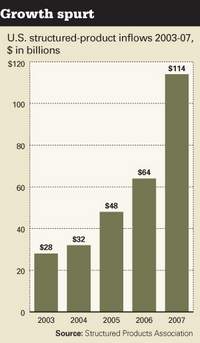
In the past only institutions and very high net worth individuals have been able to access these complex, performance-linked investments in a variety of asset classes that offer in tandem 100% principal protection on the downside combined with the upside potential of the linked asset class. According to the trade group Structured Product Association new issuance of all structured products in the U.S. has risen from $28 billion in 2003 to $114 billion in 2007.
FDR proclaimed in his first fireside chat “Let us unite in banishing fear” March 12th, 1933. We are fortunate to have new financial tools to help accomplish financial security in today’s market environment.
It is important you talk to your financial advisor before you invest. Some topics to discuss are your tolerance for risk, time horizon, your market outlook, and interest in particular asset classes, expenses, taxes, computation variations and participation rate, maximum and minimum interest rates, prepayment penalties, current income requirements and secondary market activity if any.
Open architecture is also a concern. When an investor is only offered the in-house brand he or she may be at a disadvantage. It is generally better when banks compete. Typically, independent broker dealers can secure CD’s, bias free, from many different issuing banks.
This is not intended to be an offer or solicitation for the purchase or sale of any investment.
Robert Spicer is an Executive Vice President at First Financial Equity Corporation in Greenwood Village, CO. He can be reached at 303-643-5959 or rspicer@ffec.com. Member FINRA/SIPC
FDR gave this famous quote during his inaugural speech. Many people today erroneously believe he was talking about the threat of WWII. Not true. He was talking about the economy of the United States of America and the financial crisis it was facing at the time. Banks were particularly hard hit. Confidence was so shaken that a rumor could create a run on a banks assets and it could be closed overnight. However, by innovative and somewhat dramatic actions he regained the confidence of the American people in the U.S. banking system. One such step was the Nationwide Bank Holiday, closing every bank in America for an entire week. Every U.S. bank, while closed, was inspected by government examiners who would only open the bank if it was given a sound fiscal bill of health by the US Government.
This type of American ingenuity and will power changed the fabric of our financial system and allowed the United States to become the financial powerhouse it has become. Yet, today, our current stock market volatility and credit crunch has again created overblown fear. A fear that may be self defeating in the long run.
The world’s largest banks have devised a way for most investors to participate in the appreciation of the equity markets while protecting the principal invested with FDIC insurance.
Even the most conservative of investors now have the ability to participate in most, if not all, of the upside potential of a variety of markets (such as the S&P 500, DJIA or a basket of stocks or commodities) without the risk of losing any principal provided the investment is held to maturity. Typical maturities range from one year to seven years. Participation rates on the upside vary with each issue and can reach 100%.
These investments are called structured Certificates of Deposit or Market Linked CD’s. They are issued by some of the largest banks in the world and linked to indices or investments. The investor’s principal is protected (insured) up to $100,000 per depositor or up to $250,000 for certain qualified retirement plans such as an IRA account, per depositor per insured bank. FDIC insurance is backed by the full faith and credit of the United States Government. For more information on FDIC Insurance go to www.FDIC.gov. Unlike ordinary CD’s, these do not pay current income and the investor has to hold the investment to maturity for the strategy to be successful. If the investor liquidates before the stated maturity they may receive back less than their original principal.
Most individual investment portfolios are limited to a combination of cash, bonds, equities, real estate and perhaps some managed futures. In today’s markets too many investors are reducing their equity exposure due to a fear of losing principal. Fear drives overweighed allocations to cash and bonds. While past performance is not indicative of future performance, it is a well known axiom that equities have outperformed cash and bonds in the past, especially over the last 60 years. In my opinion, most investors today, after a careful review of their portfolio and risk tolerance, need equity exposure to achieve their long-term investment goals. Market Linked CD’s offer conservative investors a new vehicle to participate in the markets while reducing principal risk.
In the past only institutions and very high net worth individuals have been able to access these complex, performance-linked investments in a variety of asset classes that offer in tandem 100% principal protection on the downside combined with the upside potential of the linked asset class. According to the trade group Structured Product Association new issuance of all structured products in the U.S. has risen from $28 billion in 2003 to $114 billion in 2007.
FDR proclaimed in his first fireside chat “Let us unite in banishing fear” March 12th, 1933. We are fortunate to have new financial tools to help accomplish financial security in today’s market environment.
It is important you talk to your financial advisor before you invest. Some topics to discuss are your tolerance for risk, time horizon, your market outlook, and interest in particular asset classes, expenses, taxes, computation variations and participation rate, maximum and minimum interest rates, prepayment penalties, current income requirements and secondary market activity if any.
Open architecture is also a concern. When an investor is only offered the in-house brand he or she may be at a disadvantage. It is generally better when banks compete. Typically, independent broker dealers can secure CD’s, bias free, from many different issuing banks.
This is not intended to be an offer or solicitation for the purchase or sale of any investment.
Robert Spicer is an Executive Vice President at First Financial Equity Corporation in Greenwood Village, CO. He can be reached at 303-643-5959 or rspicer@ffec.com. Member FINRA/SIPC
Tuesday, June 3, 2008
Open-Architecture in Slo-Mo: Investment News
Structured market leery of open systems
Yet brokerage firms' proprietary-only policy sparks risk concerns amid credit crisis
By Dan Jamieson June 2, 2008
Open architecture has been slow to come to the structured products market.
Structured products are unsecured debt obligations of the issuing brokerage firms, and despite growing concerns about Wall Street's financial strength, only one wirehouse sells outside products.
UBS Financial Services Inc. of New York has given its brokers a choice of issuers since 2006, said UBS spokeswoman Karina Byrne.
In addition to its own products, UBS offers products from Lehman Brothers Holdings Inc. of New York, Deutsche Bank AG of Frankfurt, Germany, HSBC Holdings PLC of London, and Barclays Capital, the New York-based investment-banking division of London-based Barclays Bank PLC.
Other than UBS, there's been no movement to open the doors.
Flows into structured products have almost doubled from $64 billion in 2006 to $114 billion in assets in 2007. Five years ago, in 2003, it was $28 billion.
The risk from a proprietary-only policy is that clients may not get the diversification they need, and they may pay too much when issuers don't have to compete.
Other than UBS, the only other traditional firms offering outside products are the private banking units at JPMorgan Chase & Co. of New York and Credit Suisse Group of Zurich, Switzerland, Mr. Styrcula said.
"If they did [use outside issuers], I would probably consider [structured products] a lot more seriously," said a Smith Barney rep who asked not to be identified.
For the full article, click here.
Yet brokerage firms' proprietary-only policy sparks risk concerns amid credit crisis
By Dan Jamieson June 2, 2008
Open architecture has been slow to come to the structured products market.
Structured products are unsecured debt obligations of the issuing brokerage firms, and despite growing concerns about Wall Street's financial strength, only one wirehouse sells outside products.
UBS Financial Services Inc. of New York has given its brokers a choice of issuers since 2006, said UBS spokeswoman Karina Byrne.
In addition to its own products, UBS offers products from Lehman Brothers Holdings Inc. of New York, Deutsche Bank AG of Frankfurt, Germany, HSBC Holdings PLC of London, and Barclays Capital, the New York-based investment-banking division of London-based Barclays Bank PLC.
Other than UBS, there's been no movement to open the doors.
Flows into structured products have almost doubled from $64 billion in 2006 to $114 billion in assets in 2007. Five years ago, in 2003, it was $28 billion.
The risk from a proprietary-only policy is that clients may not get the diversification they need, and they may pay too much when issuers don't have to compete.
Other than UBS, the only other traditional firms offering outside products are the private banking units at JPMorgan Chase & Co. of New York and Credit Suisse Group of Zurich, Switzerland, Mr. Styrcula said.
"If they did [use outside issuers], I would probably consider [structured products] a lot more seriously," said a Smith Barney rep who asked not to be identified.
For the full article, click here.
NASDAQ to Host SPA Press Event on June 11
On June 11, 2008, the NASDAQ and the Structured Products Association (SPA) will co-host a media briefing to discuss why "structured products" represent the fastest growing investment vehicle for American investors.
With nearly 7,000 structured products sold in the United States in the last year, this investment class has been resilient in turbulent markets and nimble in monetizing current market opportunities.
The Structured Product investment class outsold closed-end funds and convertible securities last year and was third behind hedge funds and exchange traded funds in new assets. Structured Products are rapidly becoming a mainstream investment instrument for millions of American investors, taking its place along side mutual funds, exchange traded funds, closed-end funds and stocks and bonds in well-diversified portfolios. This presentation is intended to provide the press with an overview of the structured products investment class and this rapidly developing industry.
WHO:
John Radtke, Executive Director, Incapital LLC
Karen Fang, Managing Director, Goldman Sachs
Matt Ginsburg, Executive Vice President, Wells Fargo
Nikki Tippins, Managing Director, J.P. Morgan
Philippe El-Asmar, Managing Director, Barclays Capital
With nearly 7,000 structured products sold in the United States in the last year, this investment class has been resilient in turbulent markets and nimble in monetizing current market opportunities.
The Structured Product investment class outsold closed-end funds and convertible securities last year and was third behind hedge funds and exchange traded funds in new assets. Structured Products are rapidly becoming a mainstream investment instrument for millions of American investors, taking its place along side mutual funds, exchange traded funds, closed-end funds and stocks and bonds in well-diversified portfolios. This presentation is intended to provide the press with an overview of the structured products investment class and this rapidly developing industry.
WHO:
John Radtke, Executive Director, Incapital LLC
Karen Fang, Managing Director, Goldman Sachs
Matt Ginsburg, Executive Vice President, Wells Fargo
Nikki Tippins, Managing Director, J.P. Morgan
Philippe El-Asmar, Managing Director, Barclays Capital
IHT: U.S. to toughen regulation of commodities markets
by Diana B. Henriques
International Herald Tribune
Regulators of the nation's commodity markets will demand more information about investors to determine whether they are evading market limits on speculation and artificially driving up world food prices.
The regulatory agency, the Commodity Futures Trading Commission, also plans to initiate talks with bank regulators to ensure that adequate credit is available for the farm economy.
Finally, in an unusual departure from the secrecy that usually cloaks its enforcement actions, the commission will confirm that it is investigating the price spike that hit the cotton futures market in late February, a step demanded by cotton industry executives at a commission hearing on April 22.
The commodity futures markets play a key role in establishing worldwide prices for wheat, corn, soybeans and other foodstuffs, as well as energy products like crude oil and natural gas.
But in recent years, these markets have also become an attractive haven for investors seeking both profits from rising prices and protection against inflation and a withering dollar. As a result, billions of dollars have poured into the commodity futures market — from pension funds, endowments and a host of other institutional investors — through the new conduit of commodity index funds.
Billions more have come in from investment banks that are hedging the risk of complex bets, called swaps, that these same investors have made in the unregulated international swaps market, which dwarfs the regulated markets supervised by the CFTC
The commission has come under fire, most recently at a hearing on May 20 before the Senate Committee on Homeland Security and Governmental Affairs, for not doing enough to monitor the impact of these investors on markets that have such influence on family budgets nationwide.
Specifically, the commission will start requiring more information about index funds and, more significantly, about the clients on the other side of the unregulated swaps deals that are being hedged on the regulated futures exchanges.
The swaps market has traditionally be seen as off limits for U.S. commodity regulators, but the commission clearly is responding to congressional concern that investors may be using swaps dealers to evade rules that limit the size of their speculative role in regulated markets.
The commission is also putting the brakes on granting waivers that have exempted some commodity index funds from speculative limits, and is formally dropping proposed rule changes that would have extended a blanket exemption to all index funds.
In recent years, more than a dozen commodity index fund companies have been granted individual waivers, after successfully arguing that they were using the futures markets exclusively to hedge their obligations to the people who have invested in their index funds. But the commission now intends to "be cautious and guarded before granting additional exemptions in the area," according to the draft proposal.
The full article can be accessed by clicking here.
International Herald Tribune
Regulators of the nation's commodity markets will demand more information about investors to determine whether they are evading market limits on speculation and artificially driving up world food prices.
The regulatory agency, the Commodity Futures Trading Commission, also plans to initiate talks with bank regulators to ensure that adequate credit is available for the farm economy.
Finally, in an unusual departure from the secrecy that usually cloaks its enforcement actions, the commission will confirm that it is investigating the price spike that hit the cotton futures market in late February, a step demanded by cotton industry executives at a commission hearing on April 22.
The commodity futures markets play a key role in establishing worldwide prices for wheat, corn, soybeans and other foodstuffs, as well as energy products like crude oil and natural gas.
But in recent years, these markets have also become an attractive haven for investors seeking both profits from rising prices and protection against inflation and a withering dollar. As a result, billions of dollars have poured into the commodity futures market — from pension funds, endowments and a host of other institutional investors — through the new conduit of commodity index funds.
Billions more have come in from investment banks that are hedging the risk of complex bets, called swaps, that these same investors have made in the unregulated international swaps market, which dwarfs the regulated markets supervised by the CFTC
The commission has come under fire, most recently at a hearing on May 20 before the Senate Committee on Homeland Security and Governmental Affairs, for not doing enough to monitor the impact of these investors on markets that have such influence on family budgets nationwide.
Specifically, the commission will start requiring more information about index funds and, more significantly, about the clients on the other side of the unregulated swaps deals that are being hedged on the regulated futures exchanges.
The swaps market has traditionally be seen as off limits for U.S. commodity regulators, but the commission clearly is responding to congressional concern that investors may be using swaps dealers to evade rules that limit the size of their speculative role in regulated markets.
The commission is also putting the brakes on granting waivers that have exempted some commodity index funds from speculative limits, and is formally dropping proposed rule changes that would have extended a blanket exemption to all index funds.
In recent years, more than a dozen commodity index fund companies have been granted individual waivers, after successfully arguing that they were using the futures markets exclusively to hedge their obligations to the people who have invested in their index funds. But the commission now intends to "be cautious and guarded before granting additional exemptions in the area," according to the draft proposal.
The full article can be accessed by clicking here.
Saturday, May 24, 2008
Structured Products All The Rage (Hartford Courant)
But Consider Cost, Liquidity, Complexity
It seems like the perfect pitch for retirees: a financial product that protects principal and offers some growth potential to help fight inflation.
Or, still a decade or so from retirement but needing to boost returns to hit your number? Another product won't protect your downside but promises twice the market's positive return.
These are just two examples of the booming structured-products industry, which last year saw new U.S. issuances jump 44 percent from 2006, to $114 billion, according to the Structured Products Association, a New York-based trade group.
Behind the appeal of enhanced returns or insuring investors' principal, however, are concerns about the products' cost, liquidity and complexity for retail investors.
Financial institutions sell the notes under a variety of names in increments as low as $1,000, offering returns linked to particular market results over a period of time, say, three to eight years. One type of note might offer twice the return of the Standard & Poor's 500 index if it goes up (subject to a cap), but would have full exposure to any decline.
Another type might cap positive returns at a slightly lower figure but offer some downside protection — say, covering the first 10 percentage points of loss.
In the case of principal-protected notes, the contracts might be a hybrid of an FDIC-insured certificate of deposit issued by a bank and an option on the S&P 500 index issued by a brokerage firm. The investor essentially would receive the return on whichever performed better.
Many mutual fund companies and brokerages offer structured products on their trading desks, though often it involves a phone call to a representative to get to a full menu of all the notes being provided. Big players include JPMorgan Chase, HSBC, Morgan Stanley and Merrill Lynch.
Fees typically are embedded into the products, so consumers may find it difficult to comprehend total costs. There are underwriting fees to the banking firm that creates the product and brokerage commissions that combined could exceed 3 percent of an initial investment. Tack on ongoing management fees and the implied costs of caps on earnings.Some buyers have taken to the secondary market — financial exchanges — to escape the issue costs, but the flip side is that sellers trying to unload the products before the term expires have at times been stung by that illiquidity.
One concern is issuer risk. Given the problems in mortgage-related and other derivatives, consumer advocates worry that retail investors could get swallowed up in a round of defaults.
The derivative products also don't pay dividends like you'd receive if you made a direct investment in a stock-index mutual fund.
It seems like the perfect pitch for retirees: a financial product that protects principal and offers some growth potential to help fight inflation.
Or, still a decade or so from retirement but needing to boost returns to hit your number? Another product won't protect your downside but promises twice the market's positive return.
These are just two examples of the booming structured-products industry, which last year saw new U.S. issuances jump 44 percent from 2006, to $114 billion, according to the Structured Products Association, a New York-based trade group.
Behind the appeal of enhanced returns or insuring investors' principal, however, are concerns about the products' cost, liquidity and complexity for retail investors.
Financial institutions sell the notes under a variety of names in increments as low as $1,000, offering returns linked to particular market results over a period of time, say, three to eight years. One type of note might offer twice the return of the Standard & Poor's 500 index if it goes up (subject to a cap), but would have full exposure to any decline.
Another type might cap positive returns at a slightly lower figure but offer some downside protection — say, covering the first 10 percentage points of loss.
In the case of principal-protected notes, the contracts might be a hybrid of an FDIC-insured certificate of deposit issued by a bank and an option on the S&P 500 index issued by a brokerage firm. The investor essentially would receive the return on whichever performed better.
Many mutual fund companies and brokerages offer structured products on their trading desks, though often it involves a phone call to a representative to get to a full menu of all the notes being provided. Big players include JPMorgan Chase, HSBC, Morgan Stanley and Merrill Lynch.
Fees typically are embedded into the products, so consumers may find it difficult to comprehend total costs. There are underwriting fees to the banking firm that creates the product and brokerage commissions that combined could exceed 3 percent of an initial investment. Tack on ongoing management fees and the implied costs of caps on earnings.Some buyers have taken to the secondary market — financial exchanges — to escape the issue costs, but the flip side is that sellers trying to unload the products before the term expires have at times been stung by that illiquidity.
One concern is issuer risk. Given the problems in mortgage-related and other derivatives, consumer advocates worry that retail investors could get swallowed up in a round of defaults.
The derivative products also don't pay dividends like you'd receive if you made a direct investment in a stock-index mutual fund.
Thursday, May 22, 2008
DJI's PRESTBO: SPs are "Ingenious, Fascinating Vehicles"
NEW YORK (MarketWatch) -- One unique type of indexed investment is rapidly gaining popularity: "Structured products" are short-term to intermediate-term notes, which normally would pay interest. These don't. Instead, their payoff usually depends on the performance of an index, or maybe a commodity price such as oil or gold.
The required performance is specified in the offering documents for these products. For instance, one product may pay off if the Dow Jones Industrial Average exceeds a particular level by the maturity date, while another pays if the Dow falls below a certain level. It's all in how an investment bank structures the product -- which is another way of saying what the bankers think will sell.
Actually, the Dow examples are of the plain-vanilla variety. Many structured products nowadays are increasingly sophisticated, not to say complex, and are incorporating strategies as well as securities.
Consider, for example, a $2.2 million issue of "Buffered Return Enhanced Notes" that J.P. Morgan Chase & Co.issued last month.
This product essentially is a bet that the commercial and residential real estate markets will recover by April 10, 2010, when the notes mature. The index-linked assets in this product consist of a basket of three ETFs: iShares Dow Jones U.S. Real Estate Index Fund, Financial Select Sector SPDR Fund,
This basket -- in which the iShares real-estate fund accounts for 60% and the other two ETFs are 20% each -- was priced on April 2. J.P. Morgan Chase set this level (a total of $51.24 for the basket) at 100. If the basket price level is higher in two years, investors get their principal back plus two times the percentage gain of the basket.
This is the "enhanced" part of the structure. If the basket ends up at 112, the note would pay out $1,240 for each $1,000 invested, or a 24% total return. The upside potential return is capped at 42%, which means anything more than a 21% increase in the basket does nothing for the investor.
But what if the bottom falls out and the basket ends 30% lower at 70? The investor receives $850 for each $1,000 invested. That's only half of the basket's drop because the note offers protection against a decline of 15% -- the "buffered" part of the structure. If the basket fell to zero, the investor would still get $150 for each $1,000 face amount.
Structured products appeal to investors for a variety of reasons, not least of which is the usually relatively short wait to find out if they've won or lost. According to the Structured Products Association, $114 billion of these instruments were issued last year, up from $64 billion in 2006. So far, this year is on track to reach $120 billion, a 5% increase.
That's impressive growth during a time of turbulence in many markets and asset classes. Keith A. Styrcula, chairman and founder of the association, says one of the driving factors is a "profound shift in investor thinking -- that active management isn't worth the extra cost."
Individual investors take about 45% of structured products and 55% go to institutions, Mr. Styrcula says. "Only 5% to 10% of the investment advisers and brokers are familiar with structured products now. As more of them become so, we'll see growth in the number of individuals participating either directly or through certain mutual funds," he adds.
Rules and caveats
If you're considering a structured product, what should you be aware of?
1. Structured products are sold, not bought. The broker, adviser or somebody similar is going to pitch these investments, and until that happens you probably wouldn't even know they exist. These people want a piece of your investment capital, and most likely haven't given your goals or risk appetite much thought. It's up to you to decide whether the product being offered fits your portfolio and investment strategy. If you can't decide, just say "no."
Indeed, Norway's regulators recently banned structured products from being offered to most individual investors because their "risks are not well understood." This move came after some Norwegian municipalities were burned in the subprime mortgage debacle.
2. Only about 10% of structured products are listed on exchanges. The rest exist in a dimly lit over-the-counter realm. That means you will not necessarily be able to follow the interim pricing of these products, although you could track the publicly traded components such as ETFs.
And there isn't a liquid aftermarket in case you want to -- or need to -- bail before the products mature. Some investment banks say they will buy back the products they created from investors, but you may have noticed that some of these banks run out of money occasionally. In our example above, J.P. Morgan Chase declares it "intends to offer to purchase the notes in the secondary market but is not required to do so."
One notable exception is the growing number of exchange-traded notes. These ETNs were introduced to establish access to markets that are not readily available to many investors, such as commodities and currencies. They are notes structured with distant maturities that allow for exchange trading, and some of them have built up a decent daily volume.
3. Structured notes introduce credit risk into investments that otherwise wouldn't have any. The vast majority of these products are notes that are backed by the issuing banks. If the bank goes belly-up, structured-note investors are left holding the bag. Ideally, you'd perform due diligence on the bank's credit rating before you put money into one of its structured notes.
4. Many structured products offer "principal protection." That is, the investor is guaranteed to get capital back with possibly some extra kicker if the linked index performs favorably. The J.P Morgan Chase example above isn't one of these, but many investors insist on this protection. It changes the risk factor from one of potential loss to one of tying up your money for a period without any recompense.
This kind of structured product plays into what many behavioral finance professors have been telling us: Some people hate to lose money more than they hate to not make money.
Structured products are ingenious, fascinating vehicles. They require careful thought on your end about whether you should take them for a spin, or kick the tires and walk away.
John Prestbo is editor and executive director of Dow Jones Indexes.
The required performance is specified in the offering documents for these products. For instance, one product may pay off if the Dow Jones Industrial Average exceeds a particular level by the maturity date, while another pays if the Dow falls below a certain level. It's all in how an investment bank structures the product -- which is another way of saying what the bankers think will sell.
Actually, the Dow examples are of the plain-vanilla variety. Many structured products nowadays are increasingly sophisticated, not to say complex, and are incorporating strategies as well as securities.
Consider, for example, a $2.2 million issue of "Buffered Return Enhanced Notes" that J.P. Morgan Chase & Co.issued last month.
This product essentially is a bet that the commercial and residential real estate markets will recover by April 10, 2010, when the notes mature. The index-linked assets in this product consist of a basket of three ETFs: iShares Dow Jones U.S. Real Estate Index Fund, Financial Select Sector SPDR Fund,
This basket -- in which the iShares real-estate fund accounts for 60% and the other two ETFs are 20% each -- was priced on April 2. J.P. Morgan Chase set this level (a total of $51.24 for the basket) at 100. If the basket price level is higher in two years, investors get their principal back plus two times the percentage gain of the basket.
This is the "enhanced" part of the structure. If the basket ends up at 112, the note would pay out $1,240 for each $1,000 invested, or a 24% total return. The upside potential return is capped at 42%, which means anything more than a 21% increase in the basket does nothing for the investor.
But what if the bottom falls out and the basket ends 30% lower at 70? The investor receives $850 for each $1,000 invested. That's only half of the basket's drop because the note offers protection against a decline of 15% -- the "buffered" part of the structure. If the basket fell to zero, the investor would still get $150 for each $1,000 face amount.
Structured products appeal to investors for a variety of reasons, not least of which is the usually relatively short wait to find out if they've won or lost. According to the Structured Products Association, $114 billion of these instruments were issued last year, up from $64 billion in 2006. So far, this year is on track to reach $120 billion, a 5% increase.
That's impressive growth during a time of turbulence in many markets and asset classes. Keith A. Styrcula, chairman and founder of the association, says one of the driving factors is a "profound shift in investor thinking -- that active management isn't worth the extra cost."
Individual investors take about 45% of structured products and 55% go to institutions, Mr. Styrcula says. "Only 5% to 10% of the investment advisers and brokers are familiar with structured products now. As more of them become so, we'll see growth in the number of individuals participating either directly or through certain mutual funds," he adds.
Rules and caveats
If you're considering a structured product, what should you be aware of?
1. Structured products are sold, not bought. The broker, adviser or somebody similar is going to pitch these investments, and until that happens you probably wouldn't even know they exist. These people want a piece of your investment capital, and most likely haven't given your goals or risk appetite much thought. It's up to you to decide whether the product being offered fits your portfolio and investment strategy. If you can't decide, just say "no."
Indeed, Norway's regulators recently banned structured products from being offered to most individual investors because their "risks are not well understood." This move came after some Norwegian municipalities were burned in the subprime mortgage debacle.
2. Only about 10% of structured products are listed on exchanges. The rest exist in a dimly lit over-the-counter realm. That means you will not necessarily be able to follow the interim pricing of these products, although you could track the publicly traded components such as ETFs.
And there isn't a liquid aftermarket in case you want to -- or need to -- bail before the products mature. Some investment banks say they will buy back the products they created from investors, but you may have noticed that some of these banks run out of money occasionally. In our example above, J.P. Morgan Chase declares it "intends to offer to purchase the notes in the secondary market but is not required to do so."
One notable exception is the growing number of exchange-traded notes. These ETNs were introduced to establish access to markets that are not readily available to many investors, such as commodities and currencies. They are notes structured with distant maturities that allow for exchange trading, and some of them have built up a decent daily volume.
3. Structured notes introduce credit risk into investments that otherwise wouldn't have any. The vast majority of these products are notes that are backed by the issuing banks. If the bank goes belly-up, structured-note investors are left holding the bag. Ideally, you'd perform due diligence on the bank's credit rating before you put money into one of its structured notes.
4. Many structured products offer "principal protection." That is, the investor is guaranteed to get capital back with possibly some extra kicker if the linked index performs favorably. The J.P Morgan Chase example above isn't one of these, but many investors insist on this protection. It changes the risk factor from one of potential loss to one of tying up your money for a period without any recompense.
This kind of structured product plays into what many behavioral finance professors have been telling us: Some people hate to lose money more than they hate to not make money.
Structured products are ingenious, fascinating vehicles. They require careful thought on your end about whether you should take them for a spin, or kick the tires and walk away.
John Prestbo is editor and executive director of Dow Jones Indexes.
Tuesday, May 20, 2008
Alice Yurke: Leveling the SP Playing Field
As growth in the European markets in particular continues, Alice Yurke on behalf of the Structured Products Association maps out the road ahead for Structured Products…
The last two years have seen unprecedented growth in the development and distribution of structured products in the United Kingdom, the United States and Europe.
Once exclusively the province of banks and securities firms marketing to institutional and ultra-high net worth individuals, the retail market for these products is developing globally at breakneck speed. A key to this rapid growth is continued marketplace innovation and positioning of structured products in both the retail and institutional arenas. However, the rewards of innovation and positioning are not without their legal and credit risks.
The most critical legal concerns in the development and distribution of structured products in the United States will continue to revolve around disclosure and suitability, particularly in the retail arena. These concerns heighten the need for diligence on the part of broker-dealers, in terms of both fully understanding their customers and highlighting the risks involved on a product-by-product basis. In-depth analysis and understanding of the products, followed by balanced explanation of the risks and rewards, will become increasingly more important as issuers offer complex products whose features may elusively appear to be only slightly different from those offered by a competitor.
For the full article, click here.
The last two years have seen unprecedented growth in the development and distribution of structured products in the United Kingdom, the United States and Europe.
Once exclusively the province of banks and securities firms marketing to institutional and ultra-high net worth individuals, the retail market for these products is developing globally at breakneck speed. A key to this rapid growth is continued marketplace innovation and positioning of structured products in both the retail and institutional arenas. However, the rewards of innovation and positioning are not without their legal and credit risks.
The most critical legal concerns in the development and distribution of structured products in the United States will continue to revolve around disclosure and suitability, particularly in the retail arena. These concerns heighten the need for diligence on the part of broker-dealers, in terms of both fully understanding their customers and highlighting the risks involved on a product-by-product basis. In-depth analysis and understanding of the products, followed by balanced explanation of the risks and rewards, will become increasingly more important as issuers offer complex products whose features may elusively appear to be only slightly different from those offered by a competitor.
For the full article, click here.
Structured Products Association Announces Winners of the 2008 First Annual LeadingEdge Awards for Investment Professionals
Five top investments advisors are experts in using structured products for asset allocation; consider the use of the investment class as a "competitive advantage"
NEW YORK, May 20 -- The Structured Products Association (SPA) today announced the five winners of the First Annual LeadingEdge Advisor Awards. The winners were chosen at the SPA-2008 Fifth Annual Conference at the Grand Hyatt Hotel in New York. Societe Generale Corporate & Investment Banking sponsored the awards presentation.
NEW YORK, May 20 -- The Structured Products Association (SPA) today announced the five winners of the First Annual LeadingEdge Advisor Awards. The winners were chosen at the SPA-2008 Fifth Annual Conference at the Grand Hyatt Hotel in New York. Societe Generale Corporate & Investment Banking sponsored the awards presentation.
The LeadingEdge awards are given to the top investment advisors, brokers and professionals in the Americas who have demonstrated superior results for clients in using investments known as "structured products" in managed portfolios.
"After 50 years, 'modern portfolio theory' can no longer be characterized as the cutting-edge," says Keith A. Styrcula, Chairman and Founder of the SPA. "Simple asset allocation is no longer the optimal solution. The LeadingEdge Awards are bestowed to advisors who expertly used structured products to dial out volatility in portfolios, to add 100 to 250 basis points in additional annual returns, to protect assets against losses, and to access alternative asset classes from around the world that are available exclusively through structured investments."
"For the last five years, structured products have been Wall Street's best kept, $120 billion secret," Styrcula added. "But the five winners of the LeadingEdge awards are among the elite 5% of their profession whose expertise in this investment class has given them a clear competitive advantage."
The LeadingEdge winners were rigorously judged on the effectiveness, creativity and sophistication of their use of structured products as a unique investment solution for client portfolios. A committee from the Structured Products Association collected nominations over a three-month period, and assessed each nominee using these criteria.
The five winners of the LeadingEdge awards are:
Thomas Balcom (Foldes Financial Management) is based in Miami, FL. Foldes has nearly half-a-billion in assets under management (AUMs) Tom's approach is to invest 7-10% of AUMs in structured products, using them as a complement to core investment strategies. http://www.foldesfm.com/
Steve Braverman (Harris myCFO Investment Advisory Services) is based in Fort Lee, NJ. Steve heads a group that advises 300 families with seven offices and 165+ employees. With over $20B in assets, his team's focus on structured products has been rapidly growing. http://www.harrismycfo.com/
SPA CHAIRMAN'S AWARD: J. Scott Miller (Blue Bell Private Wealth Management) is based in Blue Bell, PA. Scott and his team at Blue Bell PWM manage portfolios of structured products for their clients and as separately managed accounts (SMAs) for other RIAs. It is Blue Bell's belief that through the use of managed structured products portfolios, they are able to control risk, reduce portfolio volatility, while still providing compelling upside potential. Scott has over 36 years experience in the nvestment business and purchased his first structured product in 1993. http://www.bluebellpwm.com/
Tony Proctor (Proctor Financial) is based in Wellesley, MA. Tony's firm has been using structured products for over 5 years. His firm believes the investment class is an excellent tool for delivering on two distinct goals for his clients' portfolios: 1) to protect against realistic downside losses, while still capturing and usually exceeding possible upside returns; and 2) to give his firm's clients access to asset classes or areas of the world that would otherwise be difficult to capture. On average, Proctor Financial allocates over 20% of client portfolios to structured investments to achieve these dual goals. http://www.proctorfinancial.com/
Frederick S. Wright (Smith and Howard Wealth Management) is based in Atlanta, GA. Fred's team effectively uses structured products as a risk management tool, specifically to reduce equity exposure and excessive volatility in client portfolios. http://www.smithhowardwealth.com/
Raina Mathur of Societe Generale Corporate & Investment Banking, who presented the awards to the winners, stated: "Registered Investment Advisors (RIAs) are the fastest growing distributors in the structured products industry and they represent the thought-leaders who are bringing this investment class to the mainstream. In recognition of this trend, Societe Generale has created a platform dedicated specifically to the RIA community. Accordingly, it's an immense honor for Societe Generale to recognize these top-tier professionals as recipients of the SPA's First Annual LeadingEdge Awards."
The SPA will open up the nomination process for the 2009 Leading Edge Awards in November 2008. To learn more about the SPA and structured products, visit the SPA website at www.structuredproducts.org, and the SPA blogsite at www.structuredproducts.com.
Saturday, May 17, 2008
Subscribe to:
Posts (Atom)