SPA-2008

Structured Products News from SPA

Monday, April 21, 2008

SPA-2008 LeadingEdge Award Winners (Prospect News Special Coverage)

Improve education, standardize nomenclature, say investment advisors as issuer risks gain prominence

STRUCTURED PRODUCTS ASSOCIATION 2008 CONFERENCE
By Kenneth Lim
Prospect News, April 9, 2008

Issuers need to improve education resources, standardize nomenclature and address concerns about credit risk, a panel of investment advisors said at the fourth annual Structured Products Association Conference in New York on Wednesday, April 9.

Steve Braverman of MyCFO Harris Bank, Frederick Wright of Smith & Howard Wealth management, Tom Balcom of Financial Planning Association, Tony Proctor of Proctor Financial and J. Scott Miller of Blue Bell Private Wealth Management spoke to conference attendees shortly after winning in the first SPA LeadingEdge Advisors Awards.

Echoing sentiments mentioned by several other speakers at the conference, the advisors mentioned education as a key priority for issuers in reaching out to the advisor community. Many advisors remain unaware of structured products, the panelists said.

Many investors are also unfamiliar with structured products. For example, a common misconception is that a structured product is a win-lose battle between buyer and issuer, where a buyer’s loss is an issuer’s gain, Wright and Proctor said.

“I think there’s a need to address that skewed perspective,” said Proctor, who quipped that less education would actually keep his competitors away, on the sidelines of the conference. “The issuer is not taking a position . . . it’s not like in Vegas, where the house always wins. They [issuers] need to explain that we are simply providing a transaction.”

But getting issuers involved in education can be tricky, Miller said.

“Most of the education is done by someone who has something to sell,” he said. “And RIAs [registered investment advisors] are a special group of people, they all think they are smarter than everyone else.”

‘Too cute by half’

One way to ease the learning process is to standardize and simplify nomenclature. “Keep it simple,” Balcom said.

“Some of these are too cute by half,” Proctor said of the product names. “We are coming up with all these acronyms.”

Proctor added later: “One firm may call the buffered securities BUYS, another may call it something completely different. It makes our jobs so much more difficult…It’s not like just because you call it BUYS investors are going to want to buy it.”

The panelists nevertheless praised issuers for stepping up education efforts and helping to raise awareness of structured products.

“Now when I tell people about structured products, people are not saying that I have three heads,” he said.

Marketing material improves

Proctor also noted the growth in more-accessible marketing material.

“I think the issuers are creating client-friendly brochures more than they used to,” he told Prospect News.

Bear raises credit concerns

Issuer risk has reemerged as a key concern especially after Bear Stearns almost collapsed, the buysiders said.

“The biggest fear that I have . . . is the credit risk,” Miller said. “Thank goodness we have always been concerned about credit because we did own Bear.”

Miller said he was going to Hawaii when news broke that Bear Stearns credit was in trouble, and almost canceled his trip. But his clients’ credit exposure had been diversified beyond Bear Stearns and the bank was eventually bailed out, so Miller stayed in Hawaii.

But he said the important lesson for advisors is to spread their eggs. “There is no worse feeling when you are trying to hedge risks for your client,” he said.

For full coverage of SPA-2008 from Prospect News:
Click here for Day One (Wednesday, April 9, 2008)
Click here for Day Two (Thursday, April 10, 2008)

Sunday, April 20, 2008

SPA-2008 - Distributors: SPs Market 'Vibrant, Innovative' (Prospect News)

Structured products distributors see ETNs and Structured Products ‘vibrant’ despite competition, look for more innovation

By Aaron Hochman-Zimmerman
Prospect News Special Coverage
Structured Products Association SPA-2008 Conference

New York, April 9, 2008 – Structured products issues have seen competition from other types of securities as well as within structured products itself, a panel said at the 2008 Structured Products Association Summit on Wednesday, April 9.

Exchange-traded notes (ETNs) have come under fire for what are seen by some as unfair tax advantages, but Mike Forstl of Nuveen Investments said he feels internally “fully supported” to encourage the sale of ETNs.

“The ETN market is something we do see as a growing vibrant area of focus,” said Som Seif of Claymore Investments in Canada.

Currently, Canada and particularly Europe have allowed more innovative products to develop. “I would like to see some of that stuff in North America,” he said specifically about the European products.

Despite rising innovation, the market is still generally driven by the more traditional reverse convertible, said Guy Gregoire of Pershing LLC.

Also, many distributors of structured products work in open architecture or near-open architecture environments in which “there is no proprietary product,” said Gregoire. The system allows the freedom to select the product which will fill a gap in an investor’s portfolio, rather than favoring one over the other, he said.

The flexibility of structured products is, at times, undercut by wholesalers’ reluctance to change, Seif said.

The future of structured products is tied tightly to education and strong relationships between wholesalers and distributors, he added.

Structured Products on . . . the Job Market? (Business Week)

A New Way To Play The Job Market -- But Will The CME's New Futures Product, Based On Nonfarm Payrolls Data, Allow Investors To Hedge Against Stock, Bond, Or Currency Market Jitters?

You may already feel your own job prospects are a toss of the dice. Soon, though, you'll be able to bet on the state of the whole U.S. job market.

Starting in April, average investors can express their views about where the economy stands through a new futures product based on one of the most closely watched economic indicators: the nonfarm payrolls data contained in the Labor Dept.'s monthly employment report. It is the first of several financial derivatives based on economic indicators the Chicago Mercantile Exchange plans to launch.

The exchange says the payroll futures will let investors hedge against stock, bond, or currency market jitters amid worries about an economic downturn.

Many traders and analysts, however, are skeptical the new product will be very popular beyond pure speculators.The nonfarm payrolls number instantly joins such unsexy futures products as butter, soybeans, and random length lumber. Released by the Bureau of Labor Statistics [BLS] the first Friday of every month, the payroll number measures the total number of U.S. workers, except those in government, farms, some nonprofits, and working for themselves at home. As such, it is seen by economists as a timely, reliable indicator of the health of the broad U.S. economy. When released by the BLS, the monthly payrolls figure often moves the stock market, especially if it offers up a surprise.

Future ChallengesFutures traders, of course, already bet on all sorts of predictable events: inches of snowfall, frost days, hurricanes. The concept of trading economic indicators is not new, either. Back in 2002, options based on the BLS jobs data were first traded in auctions hosted by Deutsche Bank (DB) and Goldman Sachs (GS). Today, a few economic and housing derivatives are traded on over-the-counter markets among banks and funds. But the price of those products can be skewed by things such as a participant's credit position and the limited number of possible buyers.

"What happens [with the OTC market] is that it's bilateral, and when credit dries up and you have less counterparties, the market becomes illiquid and less efficient," says Felix Carabello, director of alternative investment products at CME Group (CME), which is the newly merged Chicago Mercantile Exchange and Chicago Board of Trade.

Some argue the opaque and concentrated nature of the over-the-counter market for many derivatives products is partly responsible for the plunging values of many housing-related securities held by banks.

But there are other challenges for an economics-oriented futures product. Most obviously, there is no tangible underlying asset for the contract, like there is for gold or corn. A company that uses the futures contract's underlying product -- say, oil -- could take delivery of the commodity, though it rarely happens. No one produces or consumes the nonfarm payroll number. Hence, there is no steady demand from businesses who must buy the futures in order to keep their operations running risk-free.

(To read the complete article from BusinessWeek.com, click here.)

Thursday, April 17, 2008

Structured Commodities Boom: Buyer Beware (Reuters)

Tue Apr 8, 2008 7:40pm BST
By Barani Krishnan

NEW YORK, April 8 (Reuters) - Investors are pouring money into structured investment products linked to booming commodities like oil, gold and grains, drawn to features that protect capital from the volatility common in these markets.

But the global credit crunch means the safety of capital-protected products relies upon the credit-worthiness of the issuer. That could be a concern after last month's collapse of Bear Stearns (BSC.N: Quote, Profile, Research), once the No. 5 U.S. investment bank.

Also, some financial experts caution that the risk-prevention feature in such structured products will limit investors' gains if the bull market in commodities continues.

"Managing the credit risk in the structured products environment is critical, certainly in this environment," said David Krein, president at DTB Capital, a New York firm that specializes in putting together such products for clients.

The global financial crisis linked to defaults in U.S. subprime loans already has cost banks worldwide nearly $400 billion in write-offs. Analysts see no clear end in sight to the problem, even after casualties like Bear.

"To see Bear die wasn't surprising as almost every global financial stress kills off one big bank," said Richard Kang, a Toronto-based independent risk consultant for fund management companies. "But if another big bank goes, then the market for Wall Street-backed structured products might take a whack."

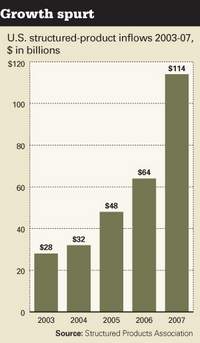
The Structured Products Association, an industry group in New York, says there is about $114 billion invested in the products now, up from just around $28 billion in 2003.

Commodity-related products account for about $55 billion of the market, says Barclays Capital, the biggest issuer of such products in the United States. The rest are linked to stocks, bonds and other securities.

For the full article by Barani Krishnan, click here.

ETNs' Steady Growth Pose Threat to ETFs, MFs (Investment News)

By David Hoffman, Investment News, April 14, 2008

As more companies begin to offer exchange traded notes, it's beginning to look like the small but growing ETN universe could one day be a competitor to mutual funds and exchange traded funds.

"ETNs are definitely a threat," said Jeff Ptak, director of exchange traded securities analysis at Morningstar Inc. of Chicago.

That's a problem for traditional asset managers because unless they partner with an investment bank, they may not be able to offer ETNs, which are actually debt instruments linked to an index.

Consequently, it's easier for an investment bank to bring an ETN to market than it is for a traditional asset manager.

A look at some of the companies offering ETNs illustrates the point.

UBS Investment Bank of New York, a unit of Zurich, Switzerland-based UBS AG, launched eight ETNs earlier this month. The UBS E-TRACS ETNs are the first of many the company hopes to launch before the end of the year, said Kurt Nelson, a managing director and head of ETNs at UBS.

Last month, Morgan Stanley of New York listed its first ETNs, the Market Vectors-Chinese Renminbi/ USD ETN and the Market Vectors-Renminbi/USD ETN.

Lehman Brothers Holdings Inc. of New York stirred things up in February when it launched Opta, an ETN platform, and three Opta exchange traded notes. The launch of Lehman's ETN platform followed the launch of the Elements ETN platform last August.

For David Hoffman's full article, click here.

SPA-2008: ETNs Elude Tax Strictures (Investment News)

By Jeff Benjamin April 10, 2008

Despite the best efforts of the Investment Company Institute to convince lawmakers to strip away the tax advantages of exchange traded notes, the structured products industry isn’t losing any sleep over the issue ... yet.

“You are not likely to see anything happen on this in 2008,” said Thomas Humphreys, a partner at Morrison & Foerster LLP in New York.

Speaking today at the Structured Products Association’s annual convention in New York, Mr. Humphreys explained that by zeroing in on ETNs, the mutual funds industry has effectively opened a broader debate over the tax treatment of all investment products.

The Washington-based ICI has been lobbying lawmakers to close a tax loophole that it claims gives ETNs an unfair advantage over mutual funds.

This effort was bolstered in December when Rep. Richard E. Neal, D-Mass., introduced federal legislation that would end the tax deferrals of ETNs.

The Internal Revenue Service has since opened the issue up to public comment until May 15, which Mr. Humphreys interpreted as meaning the IRS “doesn’t really know what to do.”

Part of the challenge of closing the loophole involves the link to a vast universe of other derivative products, according to Keith Styrcula, chairman of the New York-based Structured Products Association.

“The mutual fund industry was hoping for a rifle shot to take out ETNs, but it has instead introduced a wholesale look at all financial products,” he said.

“They’re now essentially faced with the challenge of going after a $500 trillion global derivatives market,” Mr. Styrcula added.

For the original source for this article, click here.

Goldman's Golden Duo to Form $1B Hedge Fund (Bloomberg)

April 17 (Bloomberg) -- Josh Birnbaum, one of the traders who led Goldman Sachs Group Inc.'s push into bets against subprime-mortgage bonds, has left the world's biggest securities firm and plans to form a $1 billion hedge fund.

Birnbaum, 35, confirmed his departure and declined to elaborate on his plans. He has told colleagues he expects his new fund will invest in mortgage assets, according to two people familiar with his thinking who declined to be identified.

At least 70 funds have been established during the past year by firms such as New York-based Goldman, Blackstone Group LP and Pacific Investment Management Co. to snap up cheap home-loan debt amid the steepest drop in U.S. home values since the Great Depression. Birnbaum helped Goldman offset losses on mortgage holdings and earn a record $11.6 billion last year.

``The question is really, `What's his encore?''' said Geoff Bobroff, a consultant in East Greenwich, Rhode Island, who advises asset managers.

Birnbaum and Michael Swenson, another structured-products trader, pushed for New York-based Goldman's bets on a subprime collapse with backing from Dan Sparks, its mortgage-department head, the Wall Street Journal reported in December. Michael Duvally, a company spokesman, declined to comment.

Reporting by Bloomberg's Jody Shenn. For the full article, click here.

Thursday, April 3, 2008

SPA-2008: The Final Agenda for April 9-10, 2008


For a .pdf version of the SPA-2008 Agenda, click here.

THE FOURTH ANNUAL STRUCTURED PRODUCTS ASSOCIATION CONFERENCE

Wednesday, April 9 & Thursday, April 10, 2008
Grand Hyatt Hotel, New York City

Day One (Wed, Apr 9): The Distribution Perspective

8:15 – 9:00 -- REGISTRATION and BREAKFAST

9:00 - 9:45 -- THE DEALERS - The Cause and Effect of the $114 Billion Year
Jennifer Zogg, E*Trade
Michael Leon, Northern Trust
Michael Prucher , Fidelity Investments

9:45 - 10:30 -- WHOLESALERS and the THIRD-PARTY CHANNELS
Scott Greenwood, JVB Capital
Kevin Mahon, Countrywide
Scott Colyer, FIS-AAM

10:30 – 11:15 -- NEW STRUCTURED PRODUCTS DISTRIBUTORS -- Opportunities and Challenges
Guy Gregoire, Pershing
Mike Forstl , Nuveen Investments
Som Seif, Claymore (Canada)
Jason Hubschman, DWS Scudder

11:15 - 11:45 -- Interactive Segment: SPA-NUMERIX STRUCTURED PRODUCTS IQ CHALLENGE
The audience competes with electonic devices to win an Apple iTouch and other prizes by matching wits and being fastest on the draw to answer brainteasers on the industry and the investment class from StructuredRetailProducts.com, InCapital and FIS-AAM Securities. Sponsored by NUMERIX.

11:45- 12:30 -- THE NEXT WAVE, Part 1 - Thinking Outside the Box
Kevin Ireland, ALPS
Ryan Johnson, Foreside Advisors
Steve O'Grady, Kellogg Group

12:30 - 1:45 -- LUNCH -- Click here for menu.

1:45 – 2:15 -- The First Annual SPA LeadingEdge Advisors Awards
co-sponsored by Societe Generale CIB

2:15 – 3:00 -- INVESTMENT ADVISORS - Looking Into The Future of Structured Products
Frederick Wright, Smith & Howard Wealth Mgmt
Steve Braverman, MyCFO Harris Bank
J. Scott Miller, Blue Bell Private Wealth
Tony Proctor, Proctor Financial
Tom Balcom, Financial Planning Association

3:00 - 3:20 -- UPDATE: SIFMA’S GLOBAL PRINCIPALS FOR STRUCTURED PRODUCTS
John Maurello, SIFMA

3:15 – 4:00 -- THE FIRST TRILLION: Structured Products’ Untapped Opportunities
Gerry Nowotny, Long Gray Line Consulting
Jaeson Dubrovay, NorthEast Pension Consultants
George Varinos, HSBC Halbis
Russell Kamp, INVESCO

4:00 – 4:45 -- Interactive Segment: SPA FIRST ANNUAL “ELEVATOR PITCH” COMPETITION
Hosted by John (JT) Tessar
Forget the Final Four, American Idol or the Democratic primaries – SPA-2008 is where the action is. SPA-2008 closes out Day One with your favorite Structured Products Marketers facing-off in an interactive competition to see who has the best 120-second pitch for a structured product. Your vote counts – with interactive touchpads.

5:00 - 6:30 -- SPA-2008 COCKTAIL RECEPTION: co-Sponsored by Barclays Capital

==============

Day Two (Thur, Apr 10):
The Issuer Perspective
8:15 – 9:00 -- REGISTRATION and BREAKFAST
8:45 – 9:00 -- DAY 2 OPENING REMARKS

9:00 – 10:00 -- DYNAMIC INDEXING & FUND LINKED STRUCTURES
Moderator: Ray Shirazi, Cadwalader
Bill Bamber, Bear Stearns
Adrienne Browning, Deutsche Bank
Laura Burns, Lehman Brothers
Joe O'Connor, Deutsche Bank
Muriel Asmar / Olivier Daguet, Societe Generale (TBD)

10:00 - 10:45 STRUCTURED PRODUCTS and the STATE OF INDEXING: “New and Novel”
David Blitzer, Standard & Poor’s

10:45 – 11:30 -- STRUCTURED PRODUCTS 2008 and Beyond: Experts Roundtable
Philippe el Asmar, Barclays Capital
Stephanie Bosio ,Calyon
Eric Miller, HSBC
Brian Jones, ABN Amro
Raina Mathur, Societe Generale CIB

11:30 – 11:40 -- Special Announcement – SPA and WSJ in Fall 2008
Steve Schwartzkopf, Wall Street Journal

11:40 – 12:30 -- TAXATION: Current Issues
Thomas Humphreys, Morrison & Foerster
John Rogers, U.S. Treasury
Mark Perwien, Goldman Sachs
Chris Pinho, UBS

12:30 - 1:45 -- LUNCH -- Click here for menu.

1:45 – 2:15 -- INNOVATIVE INDEXING – Going After the Mutual Fund Assets
Richard Ciuba, Dow Jones Indexes
Matthew O’Connor, Lehman Brothers
Serge Troyanovsky, BNP Paribas

2:15 – 3:15 -- CHALLENGES & SOLUTIONS: The Experts Speak
= EDUCATION: Allen Ferrell, Harvard Law School
= CREDIT: Martine Mills Hagen, Eksportfinans
= TECHNOLOGY: Mirko Filippi, Bloomberg
= RESEARCH: Tim Mortimer, Future Value Consultants

3:15 – 4:00 -- THE MARKET – Latest Reports on the Industry
Andy Awad, Greenwich Research
Joe Burris, Structured Retail Products, Arete Consulting

4:00 – 4:15 -- CLOSING THOUGHTS

Wednesday, March 26, 2008

WSJ on Reverse Convertibles: "Risky Strategy Offer Lucrative Payouts, But Could Cause Steep Losses"

Risky Strategy Lures Investors Seeking Yield
Popular 'Reverse Convertibles' Offer Lucrative Payouts But Could Cause Steep Losses


By ELEANOR LAISE
Wall Street Journal
March 26, 2008; Page D1

Wall Street is luring income-hungry investors with complex securities that come with big risks as well as extravagant yields.

The products -- called "reverse convertibles" -- are typically linked to the performance of a single stock like Apple Inc. or AT&T Inc. and often offer yields ranging from 7% to as high as 25% or more. Sales on these notes have been soaring as yields on many fixed-income investments have been sinking. Small U.S. investors snapped up $8.5 billion worth of reverse convertibles in 2007, up 81% from 2006, according to Arete Consulting LLC, which tracks the products.

At Incapital LLC, a distributor of reverse convertibles, sales doubled in 2007 from a year earlier, says Chief Executive Tom Ricketts. The notes are issued by firms such as Morgan Stanley, Barclays PLC and ABN Amro Holding NV. The companies whose share prices are linked to reverse convertibles have no involvement in the products.

For small investors, reverse convertibles offer a high level of income for a low minimum investment. But investors typically don't participate in any gains in the underlying stock, and if the stock falls sharply, they can lose much of their investment. Regulators have grown increasingly concerned about how complex "structured products" such as reverse convertibles are marketed to small investors, and they're pushing issuers to closely monitor their sales practices.

For full article, click here.