Excerpt: DWS Scudder has launched 155 structured notes since 2006, including 59 through June 30 of this year, with another 61 expected by the end of the year. It expects to sell $600 million in structured notes this year, compared with $300 million last year.
By Aaron Siegel
Investment News
In a bid to increase its market share among retail investors in the United States, DWS Investments has pursued a branding strategy and broadened its product line.
Its parent company, Deutsche Asset Management Inc. of New York, changed the name of its U.S. retail unit to DWS Investments, from DWS Scudder. The name switch means that the company will operate under a single brand.
"It makes sense for DWS to have a global brand ... so the brand positioning is consistent with the rest of the world," said Howard Schneider, a former Scudder employee and president of Boxford, Mass.-based Practical Perspectives LLC. "Having multiple brands just causes confusion as to who you are, unless you are creating a certain brand for a certain way of managing money."
The company has been pushing to penetrate the U.S. adviser market long before the re-branding. It has expanded its sales organization to 200 wholesalers, from 172 in 2005, and plans to expand its head count next year.
Additionally, the firm plans "to play a bigger role in the U.S. market" and has expanded the company's product mix beyond mutual funds, said Axel Schwarzer, chief executive of DWS Investments.
The asset management firm wants to become a multiwrapper absolute-return manager that integrates retail, alternative investments, insurance and institutional businesses, the company said.
To attract advisers, New York-based DWS Investments has unveiled a slogan and a website to highlight its commitment to advisers.
Using the "Reshaping Investing" slogan, the company is emphasizing how it will help investors cope with lower-return expectations and higher volatility through investments in alternative investments, structured notes, absolute returns and structured products, according DWS Investments.
DWS has launched 155 structured notes since 2006, including 59 through June 30 of this year, with another 61 expected by the end of the year. It expects to sell $600 million in structured notes this year, compared with $300 million last year.
Additionally, DWS Investments launched the DWS RREEF Global Infrastructure Fund this year, after bringing to market in 2007 the DWS Disciplined Market Neutral Fund, DWS Alternative Asset Allocation Fund, DWS LifeCompass Protect Fund and DWS Life Compass Income Fund.
DWS Investments manages $817 billion in assets worldwide, including $345.9 billion of retail assets under management as of March 31.
Fully 71% of those assets are from European investors, while 24% are from the Americas, and 5% are from the Asia-Pacific region.
The figure also includes $80 billion in retail and retirement assets in the United States.
The company also wants to move up its asset rank to the top 10, from 24th, in the United States, and to the top five globally, from ninth.
However, Mr. Schneider questions whether DWS' strategy to focus on just niches will help propel it into the top 10 among asset managers. DWS Investments is "doing lots of innovative things, and the challenge is to get critical mass" in products such as alternatives and structured notes, he said.
A danger in creating these kinds of products "is that you can be successful but not raise enough assets to raise the core of your business," Mr. Schneider said. "If their goal is to become a top 10 asset manager, they have to hit the right niche, then they have to have the right product to bring to market."
Meanwhile, one analyst is taking a wait-and-see approach.
"DWS has made some positive changes to focus on their strengths, and we need to see them stabilize and deliver good results for shareholders," said Miriam Sjoblom, a mutual fund analyst for Morningstar Inc. of Chicago. "Just putting the changes in place is not good enough, and we need to see them actually work."
E-mail Aaron Siegel at asiegel@investmentnews.com.
SPA-2008


Tuesday, July 29, 2008


Friday, July 25, 2008
SPA Comments to SEC on Proposed ABS' Credit Rating Rules
July 25, 2008
Securities and Exchange Commission
100 F Street, N.E.
Washington, D.C. 20549-1090
Attn: Nancy M. Morris, Secretary
Re: Proposed Rules for Nationally Recognized Statistical Rating Organizations Release No. 34 57967 (File No. S7 13 08)
Ladies and Gentlemen:
This letter is submitted on behalf of the Structured Products Association in response to the request of the Securities and Exchange Commission (the “Commission” or the “SEC”) for comments on Release No. 34-57967 (the “Release”). The Release sets forth proposed rules that aim to increase transparency and avoid conflicts of interest in the credit rating process. We note that at or about the same time that the Commission published the Release, the Commission also published several other proposed revisions to the Commission’s rules and regulations that refer to and rely upon credit ratings. We are not commenting on those additional rule proposals.
The comments presented in this letter represent the views of the Structured Products Association (the "SPA" or the "Association"). The Structured Products Association is a New York-based trade group. The Association’s mission includes positioning structured products as a distinct asset class; promoting financial innovation among member firms; developing model “best practices” for members and their firms; and identifying legal, tax, compliance and regulatory challenges to the structured products industry. The Association was the first trade organization for structured products in the United States and now has more than 2,000 members, including members from securities exchanges, self-regulatory organizations, law firms, compliance professionals, investor networks, family offices, and buy-side and sell-side structured products firms. The Association counts among its members some of the largest and most active investment banks and distributors in the U.S. structured products market.
The Association is committed to promoting the development and growth of the structured products market in the United States, and to ensuring that investors in structured products understand the terms and risks of their investments. To our dismay, there has been a great deal of confusion in the popular business press regarding the nature of “structured products.” For example, in articles and commentaries on the current credit crisis, “structured products” have been frequently confused with products issued by securitization vehicles, including mortgage-backed and asset-backed securities, such as CDOs and CLOs.
Please note that, unlike the securities at the heart of the current credit crisis, the holders of these structured securities are subject only to the creditworthiness of the issuer of these securities. The issuer of structured products does not typically pass along (and therefore depend upon) the payments from the underlying assets, as would occur in the case of a securitization transaction.
The entire comment letter can be accessed from the SPA website by clicking here.
Securities and Exchange Commission
100 F Street, N.E.
Washington, D.C. 20549-1090
Attn: Nancy M. Morris, Secretary
Re: Proposed Rules for Nationally Recognized Statistical Rating Organizations Release No. 34 57967 (File No. S7 13 08)
Ladies and Gentlemen:
This letter is submitted on behalf of the Structured Products Association in response to the request of the Securities and Exchange Commission (the “Commission” or the “SEC”) for comments on Release No. 34-57967 (the “Release”). The Release sets forth proposed rules that aim to increase transparency and avoid conflicts of interest in the credit rating process. We note that at or about the same time that the Commission published the Release, the Commission also published several other proposed revisions to the Commission’s rules and regulations that refer to and rely upon credit ratings. We are not commenting on those additional rule proposals.
The comments presented in this letter represent the views of the Structured Products Association (the "SPA" or the "Association"). The Structured Products Association is a New York-based trade group. The Association’s mission includes positioning structured products as a distinct asset class; promoting financial innovation among member firms; developing model “best practices” for members and their firms; and identifying legal, tax, compliance and regulatory challenges to the structured products industry. The Association was the first trade organization for structured products in the United States and now has more than 2,000 members, including members from securities exchanges, self-regulatory organizations, law firms, compliance professionals, investor networks, family offices, and buy-side and sell-side structured products firms. The Association counts among its members some of the largest and most active investment banks and distributors in the U.S. structured products market.
The Association is committed to promoting the development and growth of the structured products market in the United States, and to ensuring that investors in structured products understand the terms and risks of their investments. To our dismay, there has been a great deal of confusion in the popular business press regarding the nature of “structured products.” For example, in articles and commentaries on the current credit crisis, “structured products” have been frequently confused with products issued by securitization vehicles, including mortgage-backed and asset-backed securities, such as CDOs and CLOs.
Please note that, unlike the securities at the heart of the current credit crisis, the holders of these structured securities are subject only to the creditworthiness of the issuer of these securities. The issuer of structured products does not typically pass along (and therefore depend upon) the payments from the underlying assets, as would occur in the case of a securitization transaction.
The entire comment letter can be accessed from the SPA website by clicking here.
Wednesday, July 23, 2008
India: Equity SPs - Best of both worlds (Business Times)
By: Akhilesh Singh
Over the years, investment managers have worked hard to develop products that suit various investor profiles. Asset managers in western countries have been offering products across asset classes such as equities, debt, foreign exchange, commodities , and so on, for a long time now. However, in India, the pace has been comparatively slow in innovating and offering such products, partly due to regulatory issues and partly due to the lack of investor awareness and acceptance.
In the last three years, there has been a significant effort by the investment managers to offer equity-linked derivatives structures in India, and many of the most sophisticated equity derivatives structured products have been introduced recently. They have developed significantly, largely due to constantly changing market dynamics, and therefore the changing investor appetite, which has encouraged the investment managers to innovate and modify constantly.
What they are
They are an effective and efficient way to invest in hybrid structures that allow one to invest in debt while also participating in equity markets, without risking one’s capital, and, in certain cases, even guaranteeing at least a minimum return.
Most structures in India offer 100% capital protection. However, if you’d like a more aggressive structure, capital protection may be a little less than 100%, depending on product design. As such, they are mainly used within the secure part of a portfolio to increase returns with limited risk on capital. Equity derivative structured products can also be customised to meet an investor’s risk or return profile.
Advantages
For one thing, they provide an opportunity to participate in equity markets coupled with capital protection or even return protection. This kind of product is best suited for investors who are very conservative , but who also want to enhance returns without taking any additional risk.
Secondly, equity derivative structured products enable risk-controlled access to volatile asset classes and alternative investments. In the current market scenario, these kinds of products offer a fantastic risk-minimised investment option in alternate asset classes.
Thirdly, they are an efficient diversification tool. They help diversify the portfolio management style, and hence provide a hedge in the portfolio in case of a difficult market situation.
Fourthly, they offer an efficient way for an investor to take advantage of a given market scenario. Fund managers have been constantly churning various structures that suit the prevailing market and economic situations, which helps the investor to adjust to the changed scenario and accordingly make her or his investment decisions.
And fifthly, equity derivative structured products let us minimise the frequency of interventions , which are too often guided by sentiment. These products are closed-ended and mostly follow a predefined investment strategy that is executed in the beginning. One cannot make any changes later in the structure. However, this can, in some situations, be detrimental to performance.
Types of products
There are several types of equity derivative structured products. Investors can choose from the palette depending on their risk profile.
High fixed return products:
These compare with debt products, and offer a high yield on the portfolio and keep a measured equity participation, to ensure low-to-moderate risk. Investing in such products also helps the investor get a higher post-tax yield, as these debentures attract long-term capital gains tax for such structures that mature over a 365-day period , where the tax rate is lower than on fixed deposits.
Market neutral products:
These are designed for investors who don’t have directional market views, and especially suited for highly volatile and uncertain market environments. These products are designed to yield betterthan-market returns if the markets rise, but—pleasantly enough—give similar returns even when the markets move downwards. Investors who have been historically investing in bank fixed deposits because of a strong aversion to risk should consider such product structures.
High equity participation:
These products offer a high level of equity participation. However, they still hedge or limit the downside risk on the capital. These structures are ideal for investors who are aggressive and want significant participation in a rising market , and are willing to sacrifice their fixed-income returns for that opportunity. However, these structures mostly do not allow positive participation if the markets are bearish. In my assessment, these products offer investors the best of both worlds, with riskadjusted returns. When the markets are volatile and directionless , they hedge or at least limit the downside risk, and eliminate the need to monitor one’s portfolio daily. They also eliminate the risk of impulsive decisions.
Akhilesh Singh is Business Head, Emkay Midas Wealth Management
Over the years, investment managers have worked hard to develop products that suit various investor profiles. Asset managers in western countries have been offering products across asset classes such as equities, debt, foreign exchange, commodities , and so on, for a long time now. However, in India, the pace has been comparatively slow in innovating and offering such products, partly due to regulatory issues and partly due to the lack of investor awareness and acceptance.
In the last three years, there has been a significant effort by the investment managers to offer equity-linked derivatives structures in India, and many of the most sophisticated equity derivatives structured products have been introduced recently. They have developed significantly, largely due to constantly changing market dynamics, and therefore the changing investor appetite, which has encouraged the investment managers to innovate and modify constantly.
What they are
They are an effective and efficient way to invest in hybrid structures that allow one to invest in debt while also participating in equity markets, without risking one’s capital, and, in certain cases, even guaranteeing at least a minimum return.
Most structures in India offer 100% capital protection. However, if you’d like a more aggressive structure, capital protection may be a little less than 100%, depending on product design. As such, they are mainly used within the secure part of a portfolio to increase returns with limited risk on capital. Equity derivative structured products can also be customised to meet an investor’s risk or return profile.
Advantages
For one thing, they provide an opportunity to participate in equity markets coupled with capital protection or even return protection. This kind of product is best suited for investors who are very conservative , but who also want to enhance returns without taking any additional risk.
Secondly, equity derivative structured products enable risk-controlled access to volatile asset classes and alternative investments. In the current market scenario, these kinds of products offer a fantastic risk-minimised investment option in alternate asset classes.
Thirdly, they are an efficient diversification tool. They help diversify the portfolio management style, and hence provide a hedge in the portfolio in case of a difficult market situation.
Fourthly, they offer an efficient way for an investor to take advantage of a given market scenario. Fund managers have been constantly churning various structures that suit the prevailing market and economic situations, which helps the investor to adjust to the changed scenario and accordingly make her or his investment decisions.
And fifthly, equity derivative structured products let us minimise the frequency of interventions , which are too often guided by sentiment. These products are closed-ended and mostly follow a predefined investment strategy that is executed in the beginning. One cannot make any changes later in the structure. However, this can, in some situations, be detrimental to performance.
Types of products
There are several types of equity derivative structured products. Investors can choose from the palette depending on their risk profile.
High fixed return products:
These compare with debt products, and offer a high yield on the portfolio and keep a measured equity participation, to ensure low-to-moderate risk. Investing in such products also helps the investor get a higher post-tax yield, as these debentures attract long-term capital gains tax for such structures that mature over a 365-day period , where the tax rate is lower than on fixed deposits.
Market neutral products:
These are designed for investors who don’t have directional market views, and especially suited for highly volatile and uncertain market environments. These products are designed to yield betterthan-market returns if the markets rise, but—pleasantly enough—give similar returns even when the markets move downwards. Investors who have been historically investing in bank fixed deposits because of a strong aversion to risk should consider such product structures.
High equity participation:
These products offer a high level of equity participation. However, they still hedge or limit the downside risk on the capital. These structures are ideal for investors who are aggressive and want significant participation in a rising market , and are willing to sacrifice their fixed-income returns for that opportunity. However, these structures mostly do not allow positive participation if the markets are bearish. In my assessment, these products offer investors the best of both worlds, with riskadjusted returns. When the markets are volatile and directionless , they hedge or at least limit the downside risk, and eliminate the need to monitor one’s portfolio daily. They also eliminate the risk of impulsive decisions.
Akhilesh Singh is Business Head, Emkay Midas Wealth Management
Tuesday, July 22, 2008
Lawyer: The Hapless Members of Citi’s ELKS Club (Seeking Alpha)
by Jake Zamansky, Esq.
It’s only a hunch, but experience tells me you can soon expect to be reading a lot about “ELKS” and other structured investments in the business press.
The name evokes images of a hardy, austere and stable animal able to withstand the harsh elements of the forest. But not in this story. For some Citigroup customers, ELKS might conjure images of a broker who duped you into buying risky securities that were inappropriate with your investment goals.
Citi’s ELKS (equity linked security) product is a risky derivative instrument where an investor is offered a specified return on a structured security tied to an individual stock. Providing the stock maintains a minimum value, the guaranteed return is paid. If the stock ever falls below the minimum value (sometimes around 80 percent), the ELKS immediately convert into shares of that stock. Then if the price of the underlying stock declines, the investor could receive a stock worth much less than the initial investment.
Here’s the catch: ELKS offer potentially higher returns, but the downside risk is unlimited if the stock goes south. If the underlying stock happens to dramatically increase in value, the investor only gets the guaranteed return.
For Citigroup, it’s a classic case of “heads I win, tales you lose.” The bank charges investors an upfront commission to buy ELKS and likely earns additional profits through hedging. Not surprisingly, brokerage firms were aggressively peddling structured derivative products like ELKS to unsophisticated retail investors a few years back, prompting FINRA to warn member firms of concerns that customers didn’t understand the inherent risks.
There’s evidence that FINRA’s warnings weren’t heeded. I represent a retired couple over 80 whose Citi broker last year bought $300,000 worth of ELKS on their behalf. The ELKS were highly unsuitable for retirees simply looking to preserve capital. The highly volatile stocks my client’s ELKS were derived from included Yahoo!, Cemex and Sandisk. The couple has lost nearly a third of their principal as the underlying stock’s value plummeted.
Admittedly, I have only encountered one ELKS case so far, but many brokerages firms peddled similar products using monikers such as PACERS, STRIDES, SPARQS, and ELEMENTS. Some commentators were critical of me when I sounded the early alarm about auction rate securities, but that warning proved quite prescient. Recall, that the SEC uncovered wrongdoing in the ARS market in 2006, but the activity persisted. Sadly, I can’t help but suspect that the experience of my elderly clients with ELKS is not an isolated incident.
Stay tuned.
This article is found on the SeekingAlpha.com website. For the original post, click here.
It’s only a hunch, but experience tells me you can soon expect to be reading a lot about “ELKS” and other structured investments in the business press.
The name evokes images of a hardy, austere and stable animal able to withstand the harsh elements of the forest. But not in this story. For some Citigroup customers, ELKS might conjure images of a broker who duped you into buying risky securities that were inappropriate with your investment goals.
Citi’s ELKS (equity linked security) product is a risky derivative instrument where an investor is offered a specified return on a structured security tied to an individual stock. Providing the stock maintains a minimum value, the guaranteed return is paid. If the stock ever falls below the minimum value (sometimes around 80 percent), the ELKS immediately convert into shares of that stock. Then if the price of the underlying stock declines, the investor could receive a stock worth much less than the initial investment.
Here’s the catch: ELKS offer potentially higher returns, but the downside risk is unlimited if the stock goes south. If the underlying stock happens to dramatically increase in value, the investor only gets the guaranteed return.
For Citigroup, it’s a classic case of “heads I win, tales you lose.” The bank charges investors an upfront commission to buy ELKS and likely earns additional profits through hedging. Not surprisingly, brokerage firms were aggressively peddling structured derivative products like ELKS to unsophisticated retail investors a few years back, prompting FINRA to warn member firms of concerns that customers didn’t understand the inherent risks.
There’s evidence that FINRA’s warnings weren’t heeded. I represent a retired couple over 80 whose Citi broker last year bought $300,000 worth of ELKS on their behalf. The ELKS were highly unsuitable for retirees simply looking to preserve capital. The highly volatile stocks my client’s ELKS were derived from included Yahoo!, Cemex and Sandisk. The couple has lost nearly a third of their principal as the underlying stock’s value plummeted.
Admittedly, I have only encountered one ELKS case so far, but many brokerages firms peddled similar products using monikers such as PACERS, STRIDES, SPARQS, and ELEMENTS. Some commentators were critical of me when I sounded the early alarm about auction rate securities, but that warning proved quite prescient. Recall, that the SEC uncovered wrongdoing in the ARS market in 2006, but the activity persisted. Sadly, I can’t help but suspect that the experience of my elderly clients with ELKS is not an isolated incident.
Stay tuned.
This article is found on the SeekingAlpha.com website. For the original post, click here.
Monday, July 21, 2008
Reg. Rep: Structured Products - Bright Future for Securitization?
By Christina Mucciolo
July 16, 2008
Securitization has gotten a bad reputation lately. But the securitization process—taking debt and pooling it into a derivative whose value is based on the underlying assets—was meant to reduce risk. Take collateralized-debt obligations (CDOs); they are a kind of derivative, a structured product, if you will, that put the lie to that concept. Indeed, given the current dismal state of the CDO market, you’d think that they might taint the entire derivative, structured product marketplace.
Of course, derivatives and structured products refer to a broad category of investments.
Basically, the definition of structured product includes any hybrid financial instrument—typically a registered note, bank deposit or private placement—linked to the performance of a derivative, i.e. an underlying asset, such as a stock, an index, a commodity, currency or other investment. If you don’t know about the vehicles, you may want to learn.
Advisors who use them say they allow an investor to enjoy upside potential on an asset while protecting the on the downside should the underlying asset value drop. Already popular in Europe, structured products have gained popularity at wirehouses and investment banks.
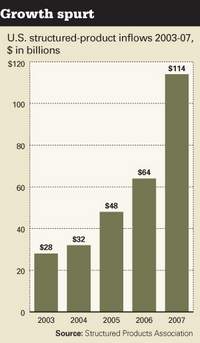
In fact, the retail market bought almost half (worth about $58 billion) of the structured products issued in the U.S. in 2007, according to the Structured Products Association (SPA). About $114 billion in structured products were issued in the U.S. in 2007, a jump of 78 percent over 2006. As of year-end 2007, the American Stock Exchange was trading 400 structured products, with 128 new listings.
While many advisors find them too complex and expensive (loads can reach 6 percent), structured products are being mastered and used by some advisors, such as Scott Miller Jr., managing partner at Blue Bell Private Wealth Management, a fee-only RIA in Blue Bell, Pa. Of the $300 million in assets managed by the firm, Miller estimates 30 percent of it is invested in structured products. Miller says structured products are good for clients who want exposure to equities, but who are willing to give up some upside return potential for some downside protection—they’re buy-and-hold investments. “It is just the nature of anything derivative-based; they may get too complicated for some people,” Miller says.
That’s why advisors specialize in the ones they understand best. Bradley Pace, president of Pace Capital Management, says they are suitable for HNW clients, and he only invests about 10 percent to 15 of any one clients’ portfolio in such products. Pace says he stays away from the risky structured investment vehicles (SIVs), such as reverse convertibles; he sticks to the equity-linked CDs that are more basic. “These are great for clients who are very nervous about the market, but don’t want to lock up all their money in a Treasury note, make 2 percent and lose against inflation for the next two or three years,” says Pace.
Too Good To Be True? The complicated nature of structured products has raised some concern that some advisors and banks understand these products as little as they understood CDOs and other credit swaps that caused the current financial meltdown. “Everyone is wondering about the future of securitization, and I think there is a great deal of concern about credit derivatives generally,” says Anna Pinedo, a securities and derivatives lawyer with Morrison & Foerster and co-chair of the SPA’s Best Practices Committee. “Even though I think structured products are relatively straightforward, there is the possibility that there could be a little bit of a market overreaction against anything that is perceived as being at all structured or complicated, and so that is something that everybody needs to watch out for.”
Still, industry professionals haven’t seen advisors or investors backing away from structured products. In fact, the credit crisis has highlighted the importance of credit quality, says Chris Warren, managing director and head of structured products Americas at DWS Investments, the U.S. retail division of Deutsche Asset Management.
For the full article from Registered Rep., click here.
July 16, 2008
Securitization has gotten a bad reputation lately. But the securitization process—taking debt and pooling it into a derivative whose value is based on the underlying assets—was meant to reduce risk. Take collateralized-debt obligations (CDOs); they are a kind of derivative, a structured product, if you will, that put the lie to that concept. Indeed, given the current dismal state of the CDO market, you’d think that they might taint the entire derivative, structured product marketplace.
Of course, derivatives and structured products refer to a broad category of investments.
Basically, the definition of structured product includes any hybrid financial instrument—typically a registered note, bank deposit or private placement—linked to the performance of a derivative, i.e. an underlying asset, such as a stock, an index, a commodity, currency or other investment. If you don’t know about the vehicles, you may want to learn.
Advisors who use them say they allow an investor to enjoy upside potential on an asset while protecting the on the downside should the underlying asset value drop. Already popular in Europe, structured products have gained popularity at wirehouses and investment banks.
In fact, the retail market bought almost half (worth about $58 billion) of the structured products issued in the U.S. in 2007, according to the Structured Products Association (SPA). About $114 billion in structured products were issued in the U.S. in 2007, a jump of 78 percent over 2006. As of year-end 2007, the American Stock Exchange was trading 400 structured products, with 128 new listings.
While many advisors find them too complex and expensive (loads can reach 6 percent), structured products are being mastered and used by some advisors, such as Scott Miller Jr., managing partner at Blue Bell Private Wealth Management, a fee-only RIA in Blue Bell, Pa. Of the $300 million in assets managed by the firm, Miller estimates 30 percent of it is invested in structured products. Miller says structured products are good for clients who want exposure to equities, but who are willing to give up some upside return potential for some downside protection—they’re buy-and-hold investments. “It is just the nature of anything derivative-based; they may get too complicated for some people,” Miller says.
That’s why advisors specialize in the ones they understand best. Bradley Pace, president of Pace Capital Management, says they are suitable for HNW clients, and he only invests about 10 percent to 15 of any one clients’ portfolio in such products. Pace says he stays away from the risky structured investment vehicles (SIVs), such as reverse convertibles; he sticks to the equity-linked CDs that are more basic. “These are great for clients who are very nervous about the market, but don’t want to lock up all their money in a Treasury note, make 2 percent and lose against inflation for the next two or three years,” says Pace.
Too Good To Be True? The complicated nature of structured products has raised some concern that some advisors and banks understand these products as little as they understood CDOs and other credit swaps that caused the current financial meltdown. “Everyone is wondering about the future of securitization, and I think there is a great deal of concern about credit derivatives generally,” says Anna Pinedo, a securities and derivatives lawyer with Morrison & Foerster and co-chair of the SPA’s Best Practices Committee. “Even though I think structured products are relatively straightforward, there is the possibility that there could be a little bit of a market overreaction against anything that is perceived as being at all structured or complicated, and so that is something that everybody needs to watch out for.”
Still, industry professionals haven’t seen advisors or investors backing away from structured products. In fact, the credit crisis has highlighted the importance of credit quality, says Chris Warren, managing director and head of structured products Americas at DWS Investments, the U.S. retail division of Deutsche Asset Management.
For the full article from Registered Rep., click here.
WSJ: New ETNs Fail To Grab Investor Interest
By IAN SALISBURY
July 17, 2008
This might have been the year of the exchange-traded note, with fund firms and investment banks launching more than 60 new ETNs.
As it turns out, investors have so far turned up their noses at most of these complicated ETF-like securities. While the bulk of new products focus on red-hot assets like oil and other commodities, drawbacks such as credit risk, complicated strategies and uncertainty about the securities' tax status have kept many investors on the sidelines.
"I've talked with a lot of [financial advisors] and they've been staying away," says Ronald DeLegge, a former financial advisor who now offers ETF investing advice to online subscribers. "You've got a lot of risks with these things."
Exchange-traded notes have collected about $7.2 billion in assets since the first ones were launched in 2006, according to fund researcher Morningstar Inc. But the bulk of that, about $6 billion, is in 30 ETNs by Barclays PLC, which invented the product.
Another 59 ETNs created by eight other providers, mostly this year, hold just $1.29 billion, collectively, or about $22 million on average.
In all, 78 of the 89 ETNs on the market have less than $100 million. Barclays couldn't be reached for comment.
Investors, of course, could warm to new ETNs over time. It sometimes takes new funds several years to build a following. Still, ETNs' struggles seem to mirror those of their close cousins exchange-traded funds, where fund companies launched hundreds of products hoping to replicate success of a few early blockbusters and garnered only mixed results.
For the full article from the Wall Street Journal, click here.
July 17, 2008
This might have been the year of the exchange-traded note, with fund firms and investment banks launching more than 60 new ETNs.
As it turns out, investors have so far turned up their noses at most of these complicated ETF-like securities. While the bulk of new products focus on red-hot assets like oil and other commodities, drawbacks such as credit risk, complicated strategies and uncertainty about the securities' tax status have kept many investors on the sidelines.
"I've talked with a lot of [financial advisors] and they've been staying away," says Ronald DeLegge, a former financial advisor who now offers ETF investing advice to online subscribers. "You've got a lot of risks with these things."
Exchange-traded notes have collected about $7.2 billion in assets since the first ones were launched in 2006, according to fund researcher Morningstar Inc. But the bulk of that, about $6 billion, is in 30 ETNs by Barclays PLC, which invented the product.
Another 59 ETNs created by eight other providers, mostly this year, hold just $1.29 billion, collectively, or about $22 million on average.
In all, 78 of the 89 ETNs on the market have less than $100 million. Barclays couldn't be reached for comment.
Investors, of course, could warm to new ETNs over time. It sometimes takes new funds several years to build a following. Still, ETNs' struggles seem to mirror those of their close cousins exchange-traded funds, where fund companies launched hundreds of products hoping to replicate success of a few early blockbusters and garnered only mixed results.
For the full article from the Wall Street Journal, click here.
Thursday, July 10, 2008
Final: SP Principles Released For Individual Investors
Five leading trade associations, co-sponsors of the Joint Associations Committee (JAC), today released “Structured Products: Principles for Managing the Distributor-Individual Investor Relationship.” The global, non-binding Principles address a wide range of issues affecting distribution of retail structured products to individual investors.
The Principles complement the JAC’s “Principles for Managing the Provider-Distributor Relationship,” which were released in July 2007. The Associations issued the Principles for public comment on May 12 and are today publishing them in final form.
"The second set of JAC Principles represents many months of thorough memberdiscussion and wider syndication, and articulates the values that market participants share as they promote the continued development of a healthy market in retail structured products,” said JAC’s Chairman, Timothy Hailes, Managing Director and Associate General Counsel at JP Morgan Chase in London.
“As with the July 2007 Provider-Distributor Principles, the key will be intelligent and proportionate application to local regimes."
The JAC comprises the following trade associations: European Securitisation Forum (ESF), International Capital Market Association (ICMA), London Investment Banking Association (LIBA), the International Swaps and Derivatives Association (ISDA®) and Securities Industry and Financial Markets Association (SIFMA).
The principles were based on extensive work and collaboration with the associations’ member firms, and on consultation with distributor associations.
The Principles can be accessed by clicking here.
The Principles complement the JAC’s “Principles for Managing the Provider-Distributor Relationship,” which were released in July 2007. The Associations issued the Principles for public comment on May 12 and are today publishing them in final form.
"The second set of JAC Principles represents many months of thorough memberdiscussion and wider syndication, and articulates the values that market participants share as they promote the continued development of a healthy market in retail structured products,” said JAC’s Chairman, Timothy Hailes, Managing Director and Associate General Counsel at JP Morgan Chase in London.
“As with the July 2007 Provider-Distributor Principles, the key will be intelligent and proportionate application to local regimes."
The JAC comprises the following trade associations: European Securitisation Forum (ESF), International Capital Market Association (ICMA), London Investment Banking Association (LIBA), the International Swaps and Derivatives Association (ISDA®) and Securities Industry and Financial Markets Association (SIFMA).
The principles were based on extensive work and collaboration with the associations’ member firms, and on consultation with distributor associations.
The Principles can be accessed by clicking here.
Bloomberg: Bridgewater predicts $1.6 trillion in subprime losses
Bridgewater Associates has warned of a massive $1,600bn (€1,020bn) of banking losses from the global credit crunch, four times official projections, according to a report in Swiss newspaper SonntagsZeitung.
The US hedge fund said true losses would swell if banks were forced to adopt "mark-to-market" methods of valuing structured credit instead of the "mark-to-model" currently being used.
“We are facing an avalanche of bad assets. We have big doubts as to whether financial institutions will be able to obtain enough new capital to cover their losses. The credit crisis is going to get worse," Bridgewater was quoted as saying the report.
UK: Wealth advisers and private banks turn to structured products
Wealth advisers are increasingly turning to structured products in an effort to protect clients from stormy markets while offering the potential for capital growth, according to the chief executive of Blue Sky Asset Management, a UK-based structured products specialist set up last year.
Blue Sky is launching a third issue of its Asset Allocation Accelerated Growth Plan, which enables investors to construct their own portfolio split between UK, US, European and Japanese equity markets, while receiving capital protection and leveraged returns.
Chris Taylor, chief executive, said: "We are laying down the gauntlet to the traditional mutual fund and index tracker world. We think the features of the plan question the rationale for investing in those products."
He pointed out that traditional mutual funds had haemorraged assets in the first quarter in the both the UK and US, while demand for cautiously managed and structured products had been robust. "Investors are voting with their feet, and walking out of traditional mutual funds into structured investments that can alter the risk and return profile of their portfolio."
While the firm is focussing its efforts on high-end intermediaries, which are increasingly targeting high net worth investors, it is also seeing interest from private banks.
Taylor said it recently structured a sophisticated product based on a distressed debt hedge fund which was being sold by a Swiss private bank. "We are seeing interest from the more open-minded private banks which are prepared to talk to an independent provider," he added.
Blue Sky is increasingly building inflation protection into its structures. "While a lot of people are talking about how to structure portfolios to hedge against rising inflation, we think there is no better protection that a direct link to the retail price index. It doesn't get much cleaner than that," said Taylor.
For the original article in Wealth Bulletin, click here.
Blue Sky is launching a third issue of its Asset Allocation Accelerated Growth Plan, which enables investors to construct their own portfolio split between UK, US, European and Japanese equity markets, while receiving capital protection and leveraged returns.
Chris Taylor, chief executive, said: "We are laying down the gauntlet to the traditional mutual fund and index tracker world. We think the features of the plan question the rationale for investing in those products."
He pointed out that traditional mutual funds had haemorraged assets in the first quarter in the both the UK and US, while demand for cautiously managed and structured products had been robust. "Investors are voting with their feet, and walking out of traditional mutual funds into structured investments that can alter the risk and return profile of their portfolio."
While the firm is focussing its efforts on high-end intermediaries, which are increasingly targeting high net worth investors, it is also seeing interest from private banks.
Taylor said it recently structured a sophisticated product based on a distressed debt hedge fund which was being sold by a Swiss private bank. "We are seeing interest from the more open-minded private banks which are prepared to talk to an independent provider," he added.
Blue Sky is increasingly building inflation protection into its structures. "While a lot of people are talking about how to structure portfolios to hedge against rising inflation, we think there is no better protection that a direct link to the retail price index. It doesn't get much cleaner than that," said Taylor.
For the original article in Wealth Bulletin, click here.
Monday, July 7, 2008
Financial Times: Downside protection gains popularity
By Steve Johnson
Published: July 7 2008 03:00
One of the key selling points of structured products is that, in many cases, they offer risk-averse investors the chance to shield themselves from falling markets.
The capital guarantees embedded in structured products can be absolute, promising the investor all their money back irrespective of the losses suffered by the underlying assets. However, to stand a stronger chance of delivering meaningful returns, more often than not the downside protection is limited - if asset markets suffer particularly sharp falls, the end investor will suffer as well.
For example, equity-linked products may offer capital protection providing an underlying equity market does not fall by more than 50 per cent during the fixed term life of the product.
If this "soft floor" protection barrier is breached, and the market fails to recover during the product term, the investor may end up shouldering losses on a one-for-one basis, just as they would had they entered the market in a traditional, naked, manner.
Some products, such as many of the precipice bonds sold en masse to UK retail investors in the early years of the millennium, had an even nastier trick in the smallprint.
When these soft barriers were breached, as they were in many cases, investors often lost money on a leveraged two-for-one basis - losing up to 80 per cent of their investment in some cases.
The industry has cleaned up its act since then, and few reputable issuers would market such leveraged downside products to retail investors, certainly not without adequate risk warnings.
But despite this episode, the provision of downside protection is a crucial selling point for the structured products industry, particularly when investors are cautious, as they are at present.
For the full article from Financial Times, click here.
Published: July 7 2008 03:00
One of the key selling points of structured products is that, in many cases, they offer risk-averse investors the chance to shield themselves from falling markets.
The capital guarantees embedded in structured products can be absolute, promising the investor all their money back irrespective of the losses suffered by the underlying assets. However, to stand a stronger chance of delivering meaningful returns, more often than not the downside protection is limited - if asset markets suffer particularly sharp falls, the end investor will suffer as well.
For example, equity-linked products may offer capital protection providing an underlying equity market does not fall by more than 50 per cent during the fixed term life of the product.
If this "soft floor" protection barrier is breached, and the market fails to recover during the product term, the investor may end up shouldering losses on a one-for-one basis, just as they would had they entered the market in a traditional, naked, manner.
Some products, such as many of the precipice bonds sold en masse to UK retail investors in the early years of the millennium, had an even nastier trick in the smallprint.
When these soft barriers were breached, as they were in many cases, investors often lost money on a leveraged two-for-one basis - losing up to 80 per cent of their investment in some cases.
The industry has cleaned up its act since then, and few reputable issuers would market such leveraged downside products to retail investors, certainly not without adequate risk warnings.
But despite this episode, the provision of downside protection is a crucial selling point for the structured products industry, particularly when investors are cautious, as they are at present.
For the full article from Financial Times, click here.
Subscribe to:
Posts (Atom)